

More news on this day
Qatar is emerging as a central player in a fast-forming coalition of countries seeking to overhaul global aviation coordination, as publicly available flight-tracking data for early April shows at least 114 cancellations and more than 3,400 delays across key hubs from Europe to Asia.
Get the latest news straight to your inbox!
Coordinated Push to Rethink Airspace and Crisis Management
Recent disruptions in and around the Gulf region, coupled with severe weather and congestion at major hubs, have accelerated efforts by Qatar and a growing group of partner states to press for stronger international standards on airspace management, contingency routing and passenger protection. Publicly available policy documents and industry statements indicate that Qatar is now working in parallel with the United Kingdom, Spain, the Philippines, Bahrain, Brazil, Canada, Colombia and Malaysia, among others, to examine how cross-border aviation rules can better keep pace with geopolitical and climate-driven shocks.
While many of these countries were already active within long-standing aviation forums, the scope and intensity of recent disruptions have added urgency to their cooperation. Discussions have increasingly focused on how to streamline communications between civil aviation authorities, clarify responsibilities when airspace is abruptly restricted, and expand the use of standardized contingency corridors to prevent entire networks from grinding to a halt.
Specialists following these developments note that Qatar’s position as a global connecting hub gives it a particular interest in reducing systemic fragility. When Hamad International Airport in Doha experiences sudden constraints, ripple effects are felt not only across the Middle East but also on routes linking Europe, Asia, Africa and the Americas. This interdependence is pushing policymakers in partner countries to view aviation resilience as a shared, rather than purely national, concern.
Publicly available information from regional aviation bodies suggests that the emerging coalition is also exploring ways to align national crisis protocols so that airlines and airports receive more consistent guidance during fast-moving events. That could include agreed thresholds for rerouting traffic, coordinated use of alternative airports and clearer frameworks for when carriers can safely resume normal operations.
114 Cancellations and 3,400-Plus Delays Highlight System Strain
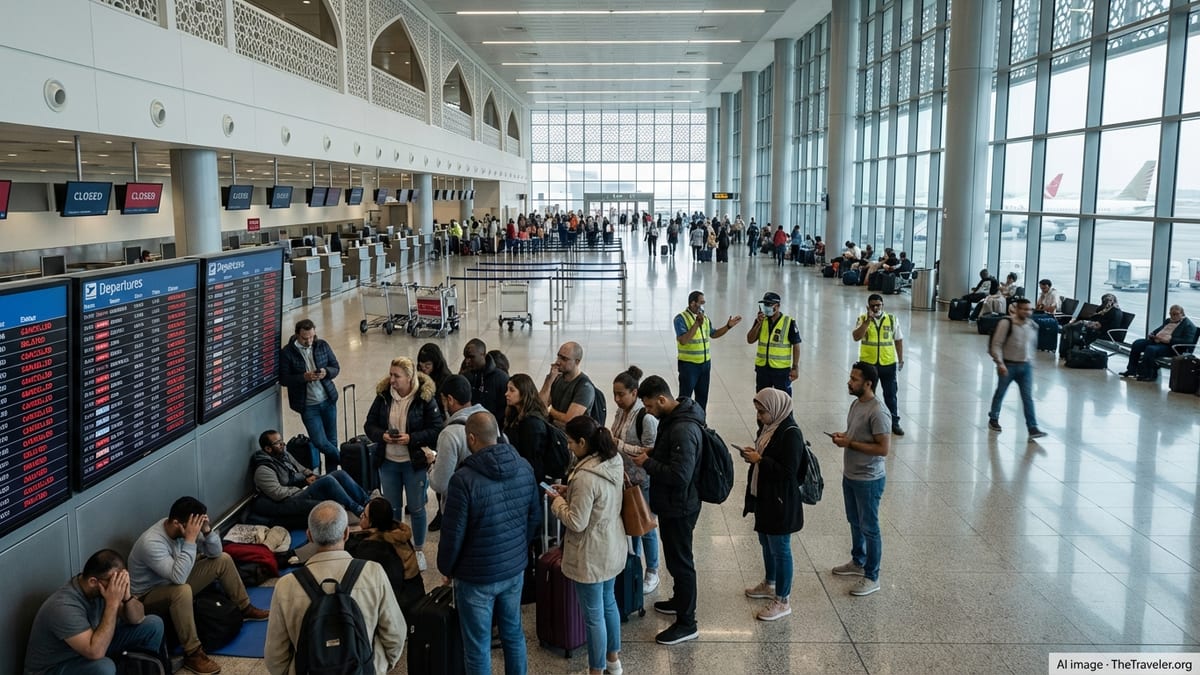
Against this backdrop of high-level policy work, passengers are confronting very immediate disruption. Aggregated flight data for the most recent 24-hour operational window examined by TheTraveler.org indicates that at least 114 scheduled services were cancelled outright worldwide, while more than 3,400 flights experienced significant delays, many of them exceeding one or two hours.
The disruptions have been most visible on long-haul and connecting routes that pass through or near constrained airspace, as well as on dense intra-Asian and transatlantic networks where aircraft and crew rotations are tightly choreographed. Knock-on effects have been particularly acute at hub airports that rely heavily on banks of coordinated arrivals and departures, where a small number of early delays can cascade through the remainder of the day.
Operational logs show that carriers have responded with a mix of cancellations, schedule thinning and tactical rerouting to avoid bottlenecks. In some cases, flights that might previously have been held on the ground in the hope of late departures are now being cancelled earlier in the day, a strategy that industry observers say is designed to prevent further strain on airport and air traffic control resources.
For travellers, the distinction is academic. Many passengers have faced missed connections, enforced overnights at transit points and complex rebooking processes that may involve multiple carriers. Consumer advocates point out that even when airlines ultimately provide refunds or alternative journeys, the lack of predictability has become a defining feature of the current disruption cycle.
Qatar’s Hub Role and the Middle East Shockwaves
Qatar’s prominence in the latest phase of aviation disruption reflects both geography and business model. Doha’s Hamad International Airport has developed as a transfer-heavy hub linking Europe and the Americas with Asia and Africa, meaning that any constraint on its operations immediately affects passengers who may never have intended to stop in Qatar for more than a few hours.
Publicly available coverage over recent weeks has documented how partial airspace closures, precautionary routing changes and intermittent schedule suspensions in the wider Gulf region have prompted Qatar Airways and other carriers to curtail or modify services. These measures, while framed as necessary for safety, have reduced capacity on some of the world’s busiest long-haul corridors and contributed to the pool of cancelled and delayed flights recorded globally.
Industry data shows that when primary Gulf hubs scale back operations, secondary gateways from Istanbul and Cairo to key European and Asian airports often experience a surge in connecting traffic and diversionary landings. This can lead to stand shortages, congestion at immigration and customs, and pressure on local hotel stock as stranded passengers seek last-minute accommodation.
Analysts tracking flight movements note that some airlines have temporarily shifted widebody aircraft to alternative routes or parked them while conditions stabilize. Such moves are costly for carriers but are viewed as preferable to operating heavily disrupted schedules that erode customer confidence and generate mounting compensation and care obligations.
Global Partners Seek Stronger Passenger Protections
Alongside the operational response, a parallel debate is unfolding over how best to protect passengers caught up in large-scale disruptions. The participation of countries such as the United Kingdom, Spain and Canada in discussions with Qatar reflects their existing experience with comprehensive passenger rights frameworks, which influence how airlines handle cancellations and long delays.
Publicly available regulatory documents in these markets outline obligations ranging from refunds and rebooking to accommodation and meal vouchers in specific circumstances. Observers say that as disruptions become more frequent and complex, there is growing interest in exploring whether elements of these models can be adapted or harmonized more widely, particularly on routes that involve multiple jurisdictions.
Stakeholders in Latin America and Asia, including Brazil, Colombia, Malaysia and the Philippines, are also weighing how to balance consumer protection with the financial realities facing airlines. Aviation law specialists point out that excessively punitive regimes could discourage carriers from serving marginal routes, while overly permissive rules risk leaving passengers without meaningful recourse when things go wrong.
Within this emerging coalition, Qatar is seen as a potential bridge between regulatory traditions. Its extensive bilateral air service agreements and role as a transit hub give it leverage in shaping how carriers and partner states approach disruption management, compensation policies and the sharing of real-time information with passengers.
Data, Technology and the Future of Resilient Travel
Beneath the headline figures on cancellations and delays, the current crisis is prompting a deeper conversation about how data and technology can make aviation more resilient. Publicly available technical papers and industry briefings indicate that Qatar and its partners are exploring expanded use of predictive analytics to anticipate bottlenecks, as well as automated decision-support tools to help air traffic controllers and airline operations centers choose the least disruptive course of action during fast-moving events.
One area of particular focus is the integration of real-time weather, airspace and airport capacity feeds into unified platforms that can be accessed by multiple stakeholders. Advocates say this could reduce the number of situations in which airlines and aviation authorities are working from incomplete or conflicting information, a factor frequently cited in post-incident reviews of major disruption days.
Another key strand of the discussion concerns passenger-facing technology. Many travellers caught up in the latest wave of cancellations and delays have reported learning of schedule changes only after arriving at the airport, underscoring gaps in notification systems. Proposals under consideration in several partner countries include stricter standards for proactive alerts, clearer digital dashboards for rebooking options and greater transparency around expected waiting times and disruption scenarios.
For now, the alliance-driven reforms championed by Qatar and its partners remain largely in the policy and planning phase. Yet the sheer scale of recent disruptions, encapsulated by at least 114 flight cancellations and more than 3,400 delays in a single reporting window, is sharpening pressure on governments, regulators and airlines to move from diagnosis to delivery. Travellers worldwide will be watching closely to see whether these efforts translate into a more predictable and resilient journey in the months ahead.