

More news on this day
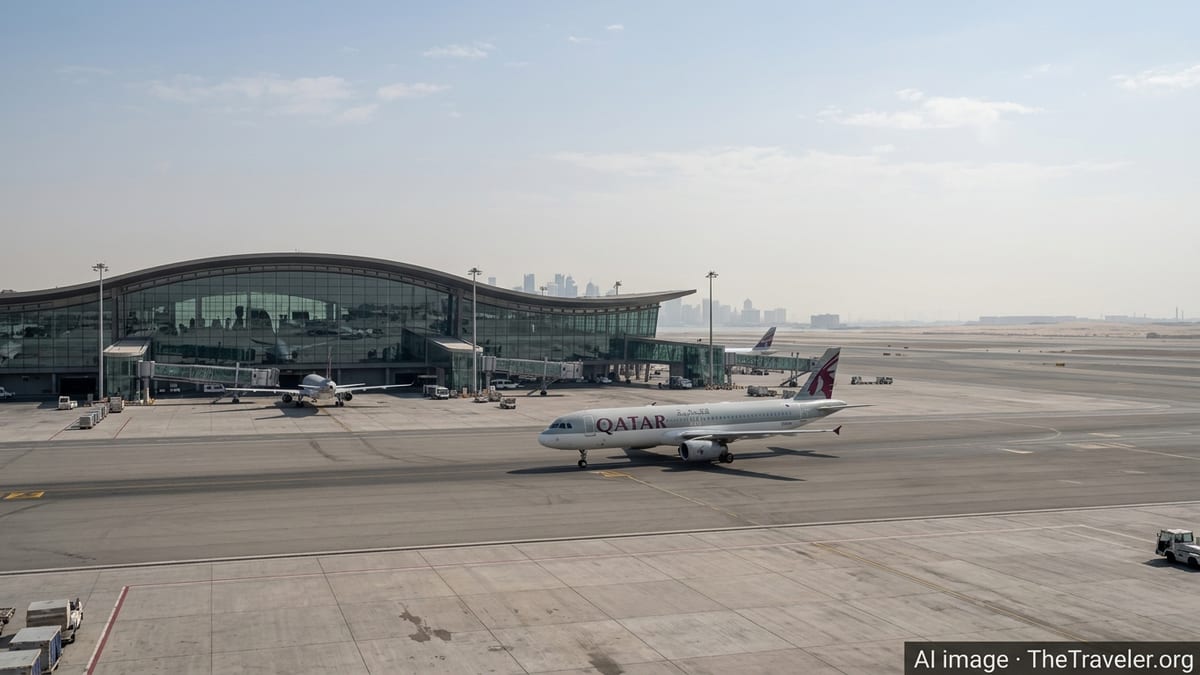
Qatar has begun restoring limited flight services under strict safety controls, marking a cautious shift from total airspace closure to tightly managed operations as the wider Middle East crisis continues to disrupt regional travel and airline networks.
Get the latest news straight to your inbox!
From Total Shutdown to Tightly Managed Reopening
Qatar’s airspace, which was fully closed on 28 February 2026 following a sharp escalation in regional hostilities, has now moved into a phase of partial reopening under heavily restricted conditions. Publicly available notices and industry advisories describe a layered system of emergency routes and safe corridors designed to allow only a narrow band of traffic to operate while military activity and missile risks remain elevated across the Gulf.
Information from aviation briefings indicates that the Qatar Civil Aviation Authority initially halted all civilian movements in and out of Doha as missile attacks and air defense activity intensified around key infrastructure, including Hamad International Airport and Al Udeid Air Base. The blanket closure triggered widespread diversions, with flights rerouted over alternative hubs and long-haul services reconfigured to avoid the Gulf region entirely.
By early March, updates shared by travel management companies and airline operational bulletins began to reference a shift to what they describe as “restricted” or “limited access” operations for Qatar, distinguishing the country from neighboring states that either kept airspace fully closed or moved more quickly to reopen to commercial traffic. These characterizations underline that the new phase is not a return to normal scheduling but a controlled experiment in restoring essential connectivity while maintaining heightened risk thresholds.
Regional situation reports continue to point to an unsettled operating environment, with airspace restrictions in multiple Gulf states, elevated insurance requirements for overflights, and ongoing concerns around potential missile launches affecting flight planning. Qatar’s move to allow a narrow slice of traffic back into its skies sits within this broader patchwork of closures, diversions, and ad hoc contingencies that has reshaped air routes across the Middle East.
Emergency Corridors and New Layers of Air Traffic Safety
Central to Qatar’s limited reopening is the creation of designated “safe corridors” and contingency routes that allow specific flights to cross its airspace under tightly controlled conditions. Documents discussing current restrictions describe these as narrow, pre-approved tracks that are kept clear of non-essential traffic and adjusted in real time based on military and security assessments.
Publicly available information indicates that these corridors are being reserved primarily for relief, evacuation, and critical cargo operations, with most routine commercial passenger services still suspended. Industry updates state that the operational capacity along these routes is intentionally kept low, reducing the number of aircraft exposed at any one time and allowing controllers to react quickly to sudden changes in the threat environment.
Aviation risk assessments published in recent weeks highlight how Qatar’s measures fit into a wider regional recalibration of air traffic safety. Analysts note the expanded use of higher cruising altitudes, rerouted flight paths that avoid known conflict zones, and stricter separation minima in sectors near potential missile trajectories. These practices, already familiar from earlier phases of the Middle East crisis and from Red Sea diversions, have now been extended and refined for the current emergency.
Operational briefings also draw attention to reinforced coordination between civil aviation authorities, air defense systems, and neighboring flight information regions. While those documents do not detail classified procedures, they emphasize that any resumption of flights is being tied to rapid information-sharing on aerial threats, real-time trajectory monitoring, and contingency plans for immediate rerouting or holding patterns if risk levels spike.
Limited Relief Flights for Stranded Travelers
Against this backdrop of restricted corridors and strict safety protocols, Qatar’s national carrier has begun operating a small number of flights aimed at moving stranded travelers out of Doha and key international hubs. Updates shared with passengers and discussed on public forums describe repatriation-style services on selected days in early and mid-March, connecting Doha with major European gateways such as London, Paris, Madrid, Rome, and Frankfurt.
These flights are framed as relief or evacuation movements rather than a resumption of normal commercial operations. Industry commentary indicates that seat availability has been highly constrained and often prioritized for passengers already stuck in transit when the initial airspace closure took effect. Travel advisories emphasize that these departures remain dependent on continued authorization from Qatar’s aviation authorities and on the stability of safe operating windows along the approved routes.
Further communications seen in recent days suggest that airlines are drawing up rolling short-term schedules, with some references to limited flight programs stretching from mid- to late March. However, these plans are frequently described as provisional and subject to abrupt change, reflecting both the security situation and the knock-on effects of displaced aircraft and crews across global networks.
Passengers are being urged, in public guidance from travel agencies and airline customer channels, to verify the status of any itinerary touching Doha or overflying Qatar shortly before departure. Even where limited services have been restored, observers note that last-minute cancellations or reroutings remain common as carriers react to updated risk assessments or sudden congestion along approved corridors.
Ongoing Disruptions for Airlines and Global Routes
For airlines, Qatar’s restricted reopening presents both a partial relief and a persistent operational challenge. The complete closure of Qatari airspace in late February removed a key junction on popular Europe to Asia and Africa to Asia routes, forcing carriers to add flight time, increase fuel burns, and reconfigure crew rosters to comply with duty limits. The gradual introduction of narrow transit corridors eases some pressure but does not yet allow a wholesale return to pre-crisis routings.
Industry analyses published this month describe how carriers have layered the Qatar disruption onto existing detours around the Red Sea and parts of the eastern Mediterranean, producing what some analysts term a “stacked disruption” pattern. Longer great-circle deviations, fuel stops at secondary hubs, and alternate-night operations are being used to keep core markets connected while minimizing exposure to high-risk airspace.
Logistics and cargo operators report similar strains. Supply chain briefings note that Qatar’s position as a regional air freight hub has been constrained by the combination of airspace limits and tighter handling windows at Hamad International Airport. With only select cargo flights authorized to use the emergency corridors, shippers have been rerouting high-value or time-sensitive consignments through other Gulf and South Asian gateways, accepting longer transit times and higher costs in exchange for more predictable operations.
Analysts looking at the medium-term outlook caution that even a broader reopening of Qatar’s airspace would not immediately unwind these global adjustments. Network planners may retain some of the new routings as contingency options while the security environment in the Gulf remains volatile, and insurers are likely to keep elevated war risk premiums in place until there is sustained evidence of de-escalation.
Traveler Guidance Amid a Volatile Safety Landscape
For individual travelers, Qatar’s restoration of limited flight services provides a narrow path home for those already affected while offering little certainty to those considering new itineraries through the region. Publicly available travel advisories and airline statements continue to recommend avoiding non-essential journeys that rely on transiting the Gulf, especially where alternative routings through other regions are available.
Consumer-facing guidance highlights several practical implications of the current regime. With flight status often changing within hours, travelers are advised to rely on direct communication from their airline, rather than assuming that listed schedules will operate as planned. Flexible tickets, generous change policies, and clear documentation of disruption-related messages are being emphasized as key tools for navigating shifting conditions.
Industry experts also point to the importance of understanding that “limited service” does not equate to predictable service. Even as Qatar opens carefully controlled corridors and authorizes selected departures, operational capacity remains far below normal. Overbooked relief flights, constraints in rebooking options, and the possibility of extended layovers at third-country hubs all remain part of the travel landscape linked to Qatar and its neighbors.
While Qatar’s measured steps toward restoring air connectivity suggest a desire to maintain its role as a regional aviation center, observers note that safety considerations are still clearly outweighing commercial imperatives. With the broader Middle East crisis unresolved, the country’s cautious use of limited flight services and reinforced air traffic safety measures is likely to remain the defining feature of travel through its airspace for the foreseeable future.