

More news on this day
As Lebanon races to relaunch the long-dormant Qlayaat airport before the 2026 summer season, the once-overlooked north is suddenly at the center of an ambitious plan to rebalance growth, attract investment and turn a marginalised border region into a new economic gateway.
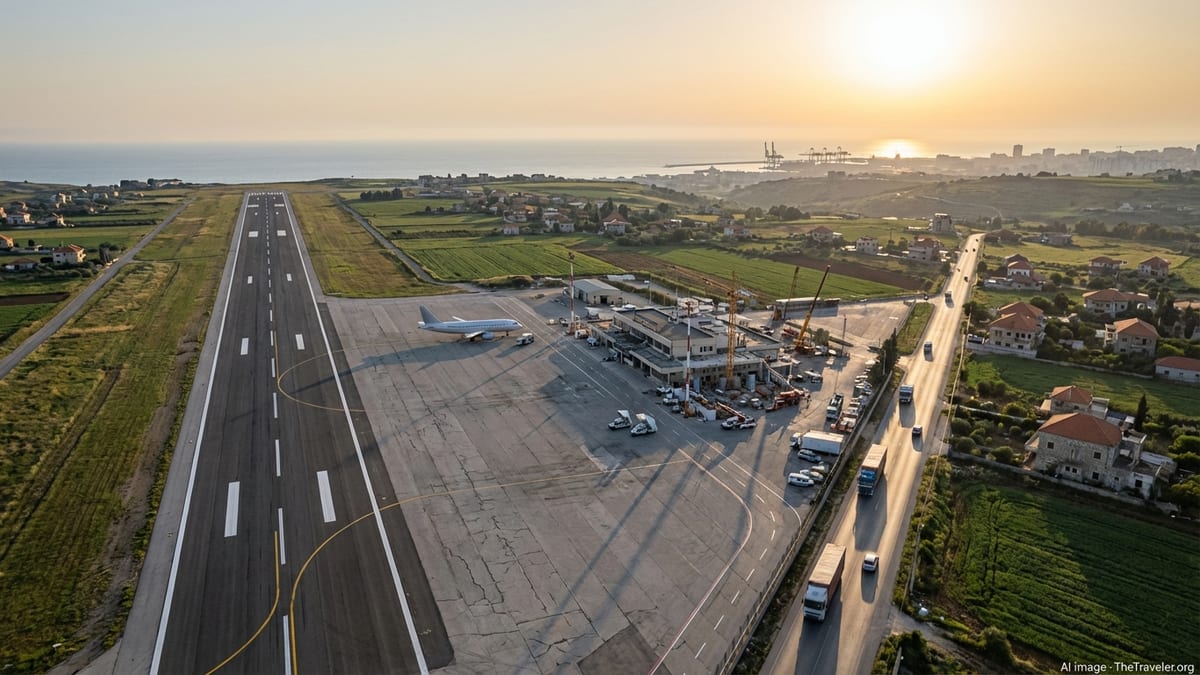
A Long-Forgotten Airfield Returns to the National Agenda
For decades, the René Mouawad Air Base at Qlayaat, a windswept strip of tarmac in the Akkar governorate just south of the Syrian border, stood as a symbol of missed opportunities. Built by the French military in 1938 and heavily damaged during the 2006 war, it remained confined to limited military use while Lebanon funneled nearly all commercial traffic through Beirut’s Rafic Hariri International Airport.
That long period of inertia began to shift in 2025, when Prime Minister Nawaf Salam pledged during a high-profile visit to northern Lebanon that Qlayaat would be brought into civilian service within a year. Since then, the project has picked up pace, underpinned by cabinet decisions, feasibility studies and growing investor interest. Officials now say the airport could start operating within three to four months, potentially before the 2026 summer tourism season.
The push comes as Beirut’s airport struggles with congestion, regional security risks and the practical limits of operating as the country’s sole commercial gateway. By contrast, Qlayaat’s northern location is increasingly being seen not only as a backup in times of crisis, but as a strategic asset that can plug Lebanon into new trade and tourism flows across the eastern Mediterranean.
Public Works and Transport Minister Fayez Rasamny has repeatedly framed the relaunch of Qlayaat as both a transport necessity and a development project. In recent months he has underlined that the economic feasibility study is complete and that the project is moving from talk to implementation, with a public-private partnership model expected to draw in regional and international operators.
Decentralising Air Travel and Reducing Risk
The plan to revive Qlayaat is unfolding against a backdrop of hard lessons learned from recent crises. With Beirut’s airport located close to densely populated southern suburbs and well within range of regional conflicts, policymakers and aviation officials have warned for years that Lebanon needs redundancy in its air infrastructure.
Those warnings took on new urgency as security tensions repeatedly raised questions about the capital’s airport remaining fully operational in an emergency. In this context, a second international gateway in Akkar is being sold as an insurance policy: an alternative route for evacuations, humanitarian flights and essential cargo should Beirut be compromised.
The emerging blueprint envisions Qlayaat handling low-cost carriers and cargo operations in its early phases, complementing Beirut rather than competing with it. By channeling freight and budget airlines northward, officials argue, the country can relieve pressure on Rafic Hariri Airport, extend runway life, and rationalise ground operations and security demands in the capital.
Infrastructure experts also point out that spreading traffic between two airports could improve resilience against seasonal peaks. During the summer months and major holidays, Beirut’s terminal frequently strains under the weight of returning expatriates and tourists. A functioning Qlayaat could absorb part of that surge, while simultaneously opening direct links for passengers whose final destinations lie closer to Tripoli, Akkar or the Beqaa valley.
Promise of Jobs and Investment for an Underserved North
Beyond the aviation calculus, the stakes for northern Lebanon are profound. Akkar has long ranked among the country’s poorest regions, with chronic underinvestment in infrastructure, high unemployment, and limited industrial activity. Many residents commute to other parts of Lebanon or emigrate entirely in search of work.
Local business leaders and officials describe Qlayaat’s revival as a once-in-a-generation opportunity to reverse that pattern. Construction, ground handling, security, logistics, retail and hospitality jobs are all expected to surge during and after the rehabilitation phase. Estimates from various stakeholders suggest that thousands of direct and indirect jobs could be created in the first years of operation.
Critically, the impact may not stop at the airport fence. Improved air connectivity is likely to attract warehouses, cold-storage facilities, freight forwarders and light manufacturing firms to nearby zones, particularly around Tripoli’s industrial areas and port. The presence of an international airport a short drive away could also push up demand for housing, services and commercial real estate across Akkar and the northern coastline.
Officials in Tripoli’s Chamber of Commerce and local municipalities have openly linked the airport to a broader vision of northern revival. They anticipate that Qlayaat will catalyse private investment in roads, utilities, and business parks, provided that stable regulation and security conditions hold. For many, the project represents the clearest sign in years that the state is prepared to treat Akkar and Tripoli as engines of growth rather than peripheral afterthoughts.
Tripoli’s Port and Special Economic Zone as Natural Partners
Qlayaat’s potential is intimately tied to what happens in Tripoli, Lebanon’s second city and principal northern seaport. Long touted as a prospective logistics and industrial hub, Tripoli has struggled to realise its ambitions despite significant assets, including a deepwater port, available land, and proximity to regional markets.
The reopening of the airport could change that equation. Business planners envision a multimodal corridor linking Qlayaat, Tripoli Port and the city’s Special Economic Zone into a coherent platform for trade and light industry. In theory, such a cluster could handle everything from perishables and pharmaceuticals to construction materials and consumer goods, with goods flown in or out via Qlayaat and shipped onward by sea or road.
Political leaders have increasingly embraced this integrated vision. The presidency and key ministries have spoken of Tripoli as central to Lebanon’s next phase of economic recovery, highlighting the need to activate its port, finalise governance for the Special Economic Zone and streamline customs and logistics procedures. Within that framework, Qlayaat is seen as the missing aviation piece that could attract anchor investors and global operators.
Logistics consultants note that the combination of a functioning northern airport and a modernised port would position Tripoli as a competitive alternative to more congested gateways in the region. If matched by reliable power supply, digital infrastructure and transparent administration, this could make the city an attractive base for companies serving Levantine, Turkish and European markets.
Tourism, Diaspora Travel and New Routes to the North
While cargo and low-cost carriers are likely to drive the initial business case, the tourism and diaspora segments could prove equally transformative for northern Lebanon. The region offers a mix of Mediterranean coastline, historic towns, mountainous landscapes and rural villages that have long been overshadowed by destinations around Beirut, Mount Lebanon and the south.
Direct flights into Qlayaat would make it far easier for Lebanese expatriates with roots in Akkar, Tripoli and the surrounding areas to visit family, particularly during short trips when a three-hour round drive from Beirut is a deterrent. Travel agents expect that charter flights and seasonal services from Gulf states and major European hubs could emerge quickly if the airport’s facilities and regulatory framework meet international standards.
Smaller tour operators and guesthouse owners in the north are already imagining curated itineraries built around a Qlayaat arrival: coastal stays in Tripoli, eco-tourism in Akkar’s highlands, religious and cultural circuits that link Crusader-era sites, Ottoman streets and rural monasteries. Improved access could, in time, encourage boutique hotels, agro-tourism ventures and adventure tourism companies to invest beyond the capital region.
For Lebanon’s national tourism strategy, a functioning northern gateway could help diversify visitor flows and reduce pressure on already saturated areas. Industry analysts argue that if authorities pair the airport’s opening with marketing campaigns, heritage restoration and environmental safeguards, the north could begin to carve out a distinct identity that complements, rather than competes with, Beirut and the south.
Regional Connectivity and Cross-Border Economic Potential
Qlayaat’s geography gives it a reach that extends beyond Lebanon’s own borders. Located only a few kilometres from Syria, the airport sits at a potential crossroads for trade and reconstruction flows to and from the wider region. Some economists argue that its true value will emerge only if it is planned with regional connectivity in mind.
In this vision, Qlayaat could serve as a logistics and passenger hub for northern Syria once conditions allow, handling aid, reconstruction materials and business travel linked to cross-border projects. That would significantly widen its catchment area and make it easier to justify the scale of investments needed to modernise runways, terminals and air navigation systems.
Regional investors, particularly from Gulf states, have shown interest in using Lebanon as a springboard into neighbouring markets, from Iraq to the eastern Mediterranean. Advocates of the airport project argue that a competitive, efficiently run facility in the north would strengthen Lebanon’s pitch as a practical base for such ventures, especially when paired with Tripoli’s port and free-zone incentives.
At the same time, analysts caution that any cross-border role would depend on delicate diplomatic and security dynamics. Airspace agreements, customs protocols and international sanctions regimes could all affect how freely airlines and freight operators are able to route traffic through Qlayaat. Policymakers are therefore urged to design the airport with flexibility, allowing it to pivot between domestic, diaspora-focused and regional roles as conditions evolve.
Financing, Governance and the Public-Private Balancing Act
Behind the ambitious rhetoric lies a complex financial and institutional puzzle. Lebanon’s protracted economic crisis has left the state with limited fiscal space, making private capital essential for a project of this scale. The plan currently under discussion relies on a public-private partnership, likely under a build-operate-transfer model that would see a consortium finance, upgrade and operate the airport for a defined concession period.
Public Works officials say the technical studies and tender documents are being finalised, and that international interest has been strong from operators and investors across the region. However, parliamentary approval of updated public-private partnership legislation and the appointment of key oversight bodies will be critical tests of political will. Any perception of opacity or favouritism in the bidding process could undermine public confidence and deter serious bidders.
Aviation and governance experts stress that robust regulation will matter as much as capital. Clear safety, security and environmental standards, an independent regulator for the aviation sector, and transparent reporting requirements for the concessionaire are seen as prerequisites to ensure that Qlayaat operates in the public interest. Without them, the risk is that the project becomes another politicised asset rather than a professionally run gateway.
Local communities are also demanding a voice in how the project unfolds. Civil society groups in Akkar and Tripoli have called for social and environmental impact assessments, guarantees on fair hiring practices, and measures to ensure that revenues are reinvested in local infrastructure. Their engagement will likely shape how inclusive the benefits of the airport prove to be over the long term.
From Symbolic Project to Test Case for Northern Revival
As bulldozers prepare to move in and timelines tighten ahead of the summer 2026 target, Qlayaat airport is rapidly becoming a test case for Lebanon’s broader promises of economic recovery and decentralisation. Its success or failure will send a powerful signal about the state’s ability to deliver complex infrastructure in a still-fragile political and financial environment.
If the project stays on schedule, attracts reputable operators and tangibly improves life for residents of Akkar and Tripoli, it could mark the beginning of a new chapter in which the north is finally integrated into the national growth story. A steady flow of flights, cargo and visitors would not only generate revenue, but also reshape perceptions of a region long associated more with hardship than opportunity.
Conversely, delays, mismanagement or security lapses could entrench cynicism and squander a rare moment of consensus around a strategic investment. For now, however, the mood among many local stakeholders is cautiously optimistic. After years of being left on the tarmac, northern Lebanon’s economic hopes are once again looking to the runway at Qlayaat, waiting to see if this time the takeoff will be real.