

More news on this day
A popular Queensland beach has been temporarily closed after aerial footage showed hundreds of sharks massing in shallow waters and aggressively feeding on a bait school just offshore, prompting renewed discussion about seasonal marine activity and swimmer safety along the state’s coastline.
Get the latest news straight to your inbox!
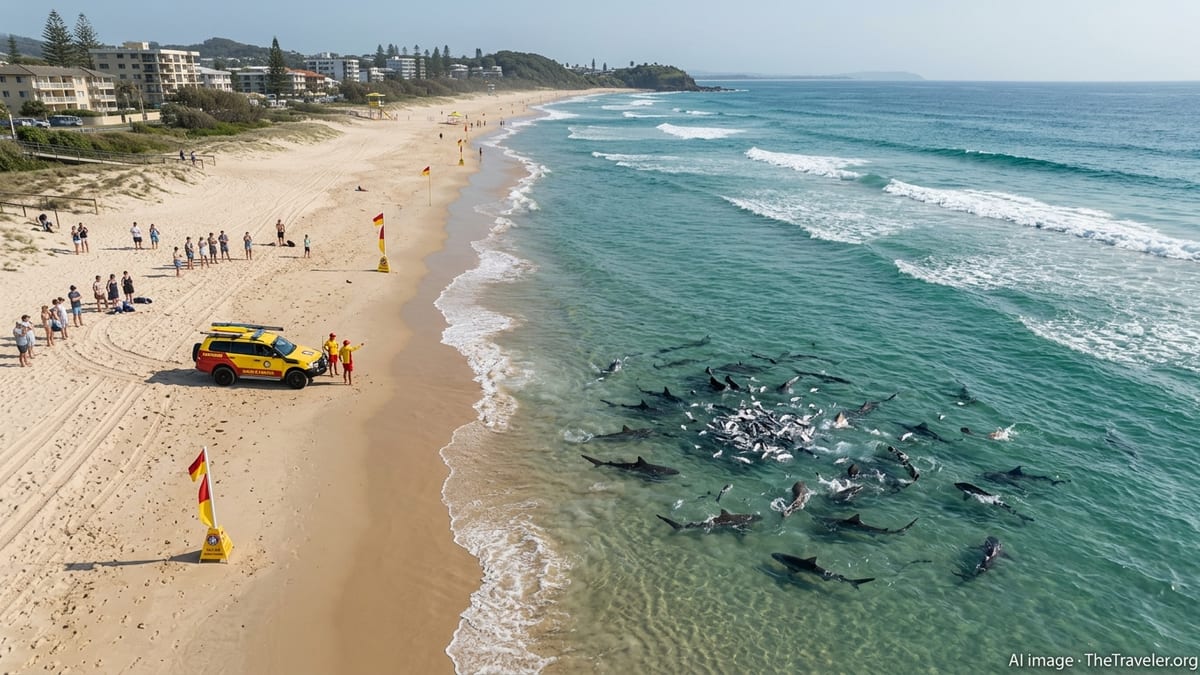
Beach closure follows dramatic aerial shark footage
Reports indicate that the closure was ordered after aircraft monitoring the coastline recorded dense clusters of sharks converging on a large school of bait fish close to the breakers. Vision shared in Australian media shows dark shapes crowding together and circling rapidly in water that appears only a few metres deep, with splashes on the surface consistent with active feeding.
Local lifeguards are reported to have cleared swimmers from the water and raised red flags along the beachfront once the scale of the aggregation became clear. Beachgoers described seeing patrol vehicles moving along the sand and advising people to stay out of the surf while the sharks remained in the area.
Publicly available information suggests that the incident coincided with a period of clear weather and relatively calm seas, conditions that can make large marine animals easier to spot from the air. The visibility of the sharks, combined with the tightly packed bait school, created striking images that quickly circulated across national news and social media platforms.
The beach has since been reopened on a cautiously monitored basis, with reports indicating that patrols have increased aerial and shoreline surveillance. Swimmers are being advised to remain inside flagged areas and to follow directions from lifeguards if further activity is detected.
Seasonal factors behind mass shark gatherings
Marine specialists cited in Australian coverage note that such dense aggregations are often linked to seasonal movements of bait fish and other prey species along the Queensland coast. During these periods, large schools of mullet and other small fish travel close to shore, attracting predators such as whaler, tiger and bull sharks.
According to publicly available scientific summaries on shark behaviour in Australian waters, coastal zones can function as feeding corridors when currents, water temperature and food availability align. Sharks may appear in large numbers over a relatively small area for hours or days while a food source remains concentrated, then disperse once the prey moves on or is depleted.
Reports also highlight that many shark species show predictable seasonal patterns in Queensland, with particular stretches of coastline seeing more activity in the warmer months. At the same time, beaches can be busiest with swimmers and surfers, increasing the likelihood that shark movements are observed, filmed and reported.
While the sight of so many sharks within view of the sand can be confronting, marine conservation groups quoted in recent Australian media stress that feeding aggregations are a normal part of ocean ecology. They argue that the visibility of events like this can serve as a reminder that popular beaches sit within dynamic marine habitats rather than separate from them.
Queensland’s established shark control and monitoring efforts
Queensland operates one of Australia’s most extensive shark control programs, combining drum lines with shark nets off popular swimming beaches. Publicly available government data shows that the program has been in place for decades and is designed to reduce, rather than eliminate, the risk of dangerous encounters by limiting the number of large sharks close to shore.
According to program summaries cited in national outlets, the state’s network of nets and drum lines captures hundreds of sharks each year, including larger species considered higher risk to humans. The same material notes that the system does not create a complete barrier and that occasional shark movements still occur inside the controlled zones.
In recent years, coverage in Australian media has documented growing debate about the long-term environmental impact of traditional shark control methods, particularly the mortality of non-target species such as dolphins, turtles and rays. Conservation advocates have called for greater investment in non-lethal tools, including drone surveillance, acoustic tagging and real-time alert systems.
The latest Queensland beach closure is likely to intensify that discussion, as communities weigh the reassurance provided by long-running control programs against the ecological cost and the reality that natural feeding events can still occur close to shore.
Risk to swimmers remains low but vigilance urged
Despite the dramatic scenes captured from the air, publicly accessible shark incident databases indicate that the overall likelihood of an individual swimmer being bitten remains very low compared with the number of people who enter the water each year in Australia. Historical records show that fatal shark encounters are rare, even on coasts where sharks are frequently present.
Australian surf life saving organisations and state agencies consistently promote a set of basic precautions for beach users. These commonly include swimming between the red and yellow flags, avoiding dawn and dusk when many predatory fish are more active, staying out of the water near schools of bait fish or diving seabirds, and leaving the surf promptly if large marine animals are seen.
Public information campaigns also encourage people to avoid swimming alone, to stay clear of river mouths and murky water after heavy rain, and to refrain from discarding fish scraps near popular swimming areas. These guidelines are framed as simple steps that can further reduce an already small level of risk.
Reports from Queensland following the latest closure suggest that many beachgoers accepted the disruption as a reasonable precaution. Some expressed curiosity rather than alarm, using vantage points on dunes and headlands to watch the offshore activity from a safe distance while lifeguards monitored conditions.
Balancing tourism, safety and marine conservation
Queensland’s beaches attract millions of domestic and international visitors each year, and tourism bodies routinely promote the state’s surf, sunshine and coastal lifestyle. Incidents involving visible shark activity can therefore have economic implications if they alter public perceptions of safety or lead to repeated closures during peak holiday periods.
Travel industry commentary following the shark feeding event has largely framed it as an episodic disruption rather than a sign of wider danger, noting that temporary closures are a standard precaution along many busy coastlines. Operators emphasise that most visits proceed without incident and that patrol systems are designed to respond quickly when risk increases.
At the same time, environmental organisations active in Queensland continue to highlight the importance of large sharks as apex predators in maintaining healthy marine ecosystems. Public statements from these groups, reported in national outlets, argue that fear-driven responses such as indiscriminate culling can undermine long-term ocean health and may not significantly change overall risk to humans.
The convergence of tourism interests, community expectations and conservation goals means that each high-profile shark incident along the Queensland coast tends to reignite questions about how best to manage shared coastal spaces. The latest closure, triggered by hundreds of sharks feeding in full public view, is likely to remain part of that ongoing conversation as the state heads into its next busy beach season.