

More news on this day
Queensland Dinosaur Week 2026 is emerging as a major drawcard for family travel, with the Capricorn Coast positioning itself as a gateway to the state’s prehistoric attractions, from coastal dinosaur parks to outback fossil fields and new geo-tourism initiatives.
Get the latest news straight to your inbox!
A Statewide Dinosaur Celebration With a Coastal Focus
Publicly available tourism material for Outback Queensland indicates that Queensland Dinosaur Week 2026 will run as a new statewide celebration of the state’s fossil heritage, combining exhibitions, guided tours, field workshops and family events across multiple regions. The program is designed to encourage visitors to follow dedicated dinosaur routes linking the coast with Central Queensland and the outback, timed to align with cooler travel months and school holiday periods.
Tourism and events guides released for 2026 describe the initiative as a platform to showcase Queensland’s globally significant dinosaur discoveries, including sauropod skeletons, trackways and marine reptiles preserved in inland rock formations. The week is expected to highlight the newly branded Great Queensland Dinosaur Trail, which connects established outback hubs such as Winton, Hughenden and Richmond with emerging coastal experiences.
Within this broader framework, the Capricorn Coast is being promoted as a starting point for self-drive journeys that trace the Tropic of Capricorn inland. Campaigns produced by regional tourism bodies describe the coast as a “prehistoric playground” for young explorers, combining reef and rainforest holidays with dinosaur-themed experiences, adventure activities and interpretive stops along a dedicated geo-trail.
Capricorn Coast Dinosaur Parks and Immersive Family Attractions
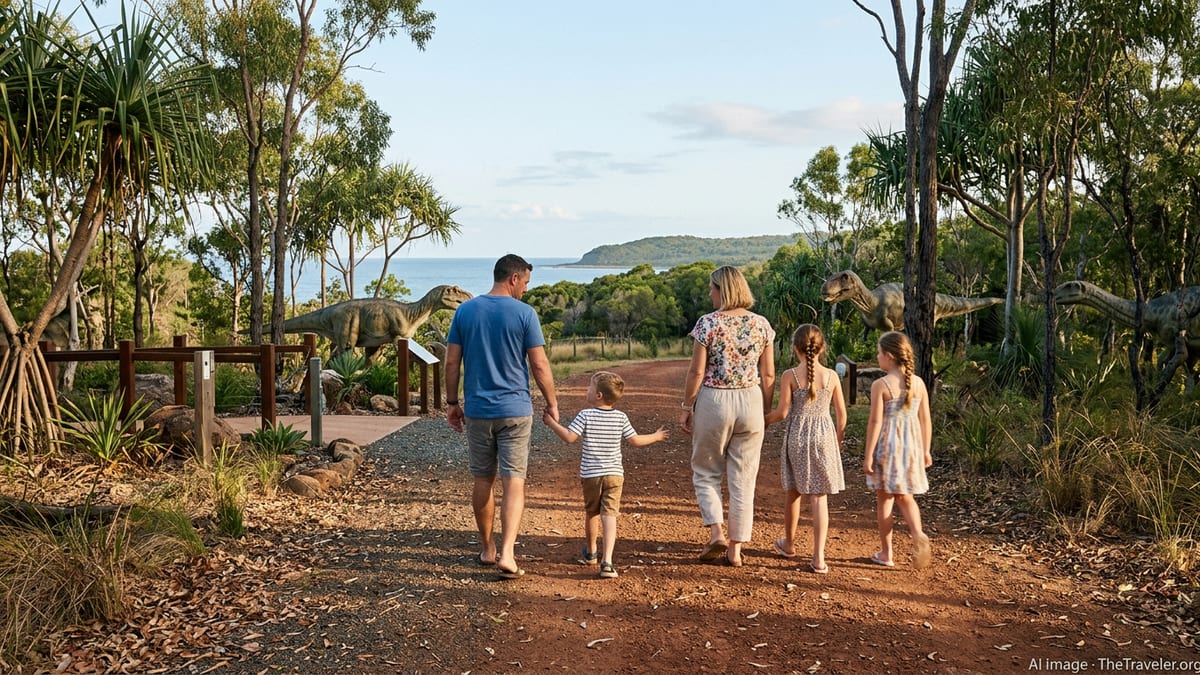
The Capricorn Coast’s newest anchor attraction is Capricorn Dinosaur Park, located in the hinterland near Yeppoon and developed with support from Queensland’s Growing Tourism Infrastructure Fund. Design information and recent destination features describe the park as an outdoor experience with life-sized dinosaur models set in landscaped bushland, animatronic displays and an accessible walking trail that aims to evoke the scale and movement of the animals that once roamed the region.
Coverage in regional travel publications notes that the park incorporates interactive elements aimed at school-age visitors, including fossil dig pits, educational signage and opportunities to engage with modern reptiles through its connection with neighbouring Cooberrie Park Wildlife Sanctuary. The site is being marketed as an all-ages experience that combines play with informal learning, with shaded rest areas and stroller-friendly paths to appeal to families traveling with younger children.
Event guides for the Capricorn Coast indicate that during Queensland Dinosaur Week 2026, operators are planning extended opening hours, themed mini-golf sessions and special activity days at Capricorn Dinosaur Park. These are expected to include ranger-style talks, scavenger hunts and educational sessions tied to the state’s fossil record, providing additional reasons for visitors to base themselves on the coast before or after longer outback journeys.
Along the shoreline and nearby hinterland, the dinosaur theme is being woven into broader visitor experiences. Destination marketing content points to family-oriented beach stays, stand-up paddleboarding and snorkeling on the Southern Great Barrier Reef being packaged alongside park entry, encouraging itineraries that alternate between prehistoric exploration and contemporary coastal leisure.
Dig the Tropic and the Rise of Geo-Tourism Trails
A key piece of the Capricorn Coast’s dinosaur positioning is the Dig the Tropic trail, a 1,200 kilometre self-drive geo-tourism route that runs along the Capricorn Highway from the coast through the Central Queensland Highlands towards the outback. Official trail descriptions highlight a sequence of geological and paleontological sites that together tell a story from the Jurassic era to the present, supported by interpretive panels at major stopping points.
The route links experiences such as the limestone formations of Capricorn Caves, volcanic features near Mount Hay, and sapphire fossicking sites in the Central Highlands. While not all waypoints are strictly dinosaur-focused, their combined narrative is being used to place dinosaur attractions in a wider context of shifting seas, erupting volcanoes and changing climates that shaped Queensland’s ancient landscapes.
Travel content produced for the 2026 season suggests that Queensland Dinosaur Week will promote Dig the Tropic as a bridge between the Capricorn Coast and the inland dinosaur triangle. Suggested itineraries encourage visitors to start with time at Capricorn Dinosaur Park and coastal beaches, then follow the trail westward, stopping at heritage towns and lookouts before joining the Great Queensland Dinosaur Trail further inland.
The emphasis on geo-tourism reflects a broader trend towards slow, educational travel. Promotional material invites families to treat the trail as an open-air classroom, with children using field guides, activity booklets and audio content to interpret rock formations and fossil stories at their own pace.
Linking the Coast to the Great Queensland Dinosaur Trail
Beyond the Capricorn Coast, the centrepiece of Queensland Dinosaur Week 2026 is the network of outback institutions known collectively as the Great Queensland Dinosaur Trail. Visitor information outlines a loop connecting the Australian Age of Dinosaurs Museum of Natural History and Dinosaur Stampede National Monument near Winton with Kronosaurus Korner in Richmond and the Flinders Discovery Centre in Hughenden.
The Australian Age of Dinosaurs complex is described as home to one of the world’s largest collections of Australian dinosaur fossils, with galleries displaying sauropods such as Diamantinasaurus and theropods including Australovenator. The site’s elevated mesa setting, outdoor dinosaur canyon walk and night sky programs have become major drawcards for both enthusiasts and casual visitors.
Nearby, the Dinosaur Stampede at Lark Quarry Conservation Park protects more than 3,000 fossilised footprints believed to represent a prehistoric riverbank encounter preserved in fine-grained rock. Guided experiences at the conservation building allow visitors to view the trackways from raised walkways and learn about changing scientific interpretations of the event.
During Queensland Dinosaur Week, these inland attractions are expected to coordinate special tours, workshops and citizen science-style activities that complement coastal programming. Travel planners are promoting the combination of reef, coast and outback as a single extended journey, with the Capricorn Coast acting as a natural arrival or departure point for domestic fly-drive trips and longer road adventures originating in Brisbane.
Hands-On Discovery and Responsible Fossil Tourism
Organisers of dinosaur-themed events across Queensland are using the 2026 program to expand hands-on opportunities while reinforcing messages about responsible fossil tourism. Schedules published for Australian Age of Dinosaurs in Winton list multi-day palaeontology workshops and field schools later in 2026, where participants can learn fossil preparation and basic field techniques in controlled settings under museum supervision.
On the Capricorn Coast and along Dig the Tropic, families are being encouraged to channel their interest in discovery through structured experiences such as guided cave tours, supervised fossicking at designated gemfields and organised fossil dig simulations at parks. Public information from Queensland resources departments stresses that unregulated fossil collecting in protected areas is restricted, and that visitors should seek local guidance and respect site signage when exploring.
Regional tourism campaigns frame this blend of excitement and stewardship as central to Queensland Dinosaur Week 2026. Suggested itineraries highlight opportunities for children to keep field notebooks, sketch formations and learn to interpret evidence on the landscape, while also understanding why significant fossils are documented and preserved in museums rather than removed as souvenirs.
For the Capricorn Coast, the focus on engaging yet responsible discovery aligns with broader goals to grow nature-based and educational travel. As Queensland Dinosaur Week approaches, the region is positioning itself not just as a photogenic reef-and-beaches destination, but as a launchpad for family journeys that trace 100 million years of prehistory from the shoreline to the outback.