

More news on this day
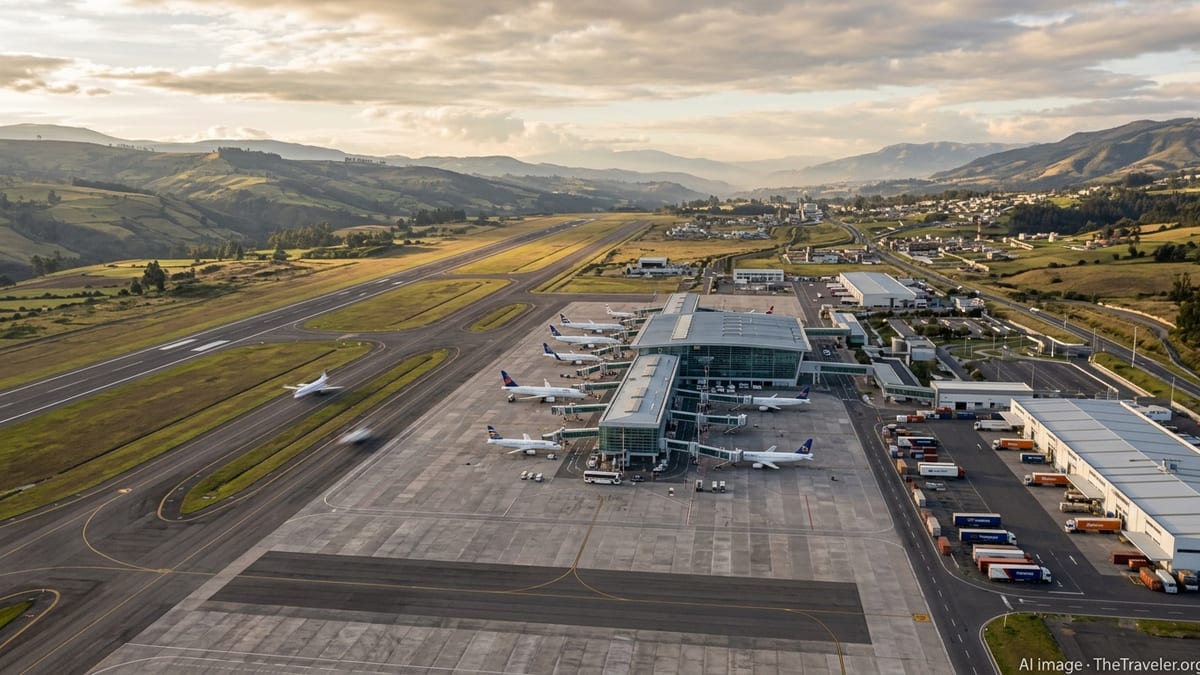
Quito’s Mariscal Sucre International Airport is emerging as a showcase for how airport cities can spur economic growth and global connectivity, as new investments, cargo routes and real estate projects cluster around the high-altitude hub.
Get the latest news straight to your inbox!
Airport Expansion Signals Long-Term Growth Strategy
The relocation of Quito’s main airport to Tababela in 2013 laid the foundation for an airport city model, shifting aviation activity away from the dense urban core and creating space for logistics, commercial and real estate development around the new site. Publicly available information from multilateral institutions describes the project as designed not only to modernize air infrastructure, but also to catalyze jobs, investment and trade facilitation in the wider metropolitan area.
That strategy has entered a new phase with a major expansion program at Mariscal Sucre International Airport. According to information published by operator Corporación Quiport, a 2025 terminal and apron expansion of roughly 74 million dollars is increasing the airport’s nominal capacity from about 5 million to more than 7 million passengers per year. The project adds new terminal space, commercial areas and aircraft positions aimed at supporting both international and domestic growth.
Industry commentary notes that capacity upgrades are arriving as traffic recovers and shifts following the pandemic, with Ecuador positioning itself as a more prominent node in Pacific and inter-American air networks. The expanded facilities are expected to ease peak-time congestion, allow airlines to upgauge aircraft and potentially accommodate new routes, reinforcing Quito’s status as the country’s primary gateway.
The enlargement of terminal and airside infrastructure is also seen as a prerequisite for more ambitious airport city development. Additional passenger flows and cargo volumes create demand for hotels, logistics parks, office space and services in the immediate vicinity of the airport, strengthening its role as a regional business platform.
Cargo and Airport City Logistics Drive Ecuador’s Trade
Quito’s airport city strategy is closely tied to air cargo. At over 2,400 meters above sea level, Mariscal Sucre International Airport operates one of the region’s longest runways, designed to accommodate fully loaded widebody aircraft at high altitude. Sector reports highlight the airport as Ecuador’s main gateway for time-sensitive exports such as flowers, fresh produce and other perishables that rely on cold-chain infrastructure.
Regional logistics analyses point to Ecuador’s Pacific-facing geography and improving air cargo capacity as important components of broader trade integration with North America, Europe and Asia. The airport’s cargo terminals, warehousing and specialized temperature-controlled facilities allow exporters to reach distant markets within strict delivery windows, underpinning thousands of jobs in the Andean highlands and coastal agricultural zones.
Recent network additions from global integrators and freight operators have reinforced Quito’s role. Published corporate announcements describe new routings linking Mariscal Sucre with hubs such as Miami, Buenos Aires and Santiago, providing more frequent lift for exporters and diversified options for importers of high-value goods. These routes deepen Ecuador’s participation in regional supply chains for pharmaceuticals, electronics and e-commerce.
As logistics companies expand footprints around the airport, the surrounding area is gradually assuming airport city characteristics. Freight forwarders, customs brokers, trucking firms and value-added logistics services are clustering in dedicated zones, reducing transit times between airside facilities and nearby industrial areas and enhancing Quito’s appeal as a logistics and distribution base.
New Investment Underscores Growing Strategic Importance
The growing profile of Quito’s airport city has been underlined by new international investment in its operating company. In early 2026, regional coverage reported that Mexican airport operator Grupo Aeroportuario del Sureste agreed to acquire a stake in Corporación Quiport as part of a multi-country portfolio deal spanning 20 airports across Latin America and the Caribbean.
The transaction, which remains subject to regulatory approvals, positions Quito alongside larger regional gateways in Mexico, Brazil, Costa Rica and Curaçao within a single operator network. Analysts suggest that being part of a diversified group could accelerate best-practice sharing in areas such as commercial development, route marketing, cargo strategy and sustainability, components regarded as central to successful airport city models.
Financial disclosures associated with the deal indicate that Mariscal Sucre handles on the order of 5 million passengers per year and maintains a 4,100-meter runway, highlighting its scale within Ecuador’s transport system despite operating in a relatively compact metropolitan market. Integration into a larger portfolio may enhance access to capital for further landside development, from business parks to hospitality projects.
Global investors have previously signaled interest in the airport’s catalytic impact. Development finance institutions have documented guarantees and support tied to the original construction, citing expected benefits that include local employment, infrastructure modernization and facilitation of trade and tourism. The latest ownership changes suggest that those dynamics are increasingly framed in terms of an airport city opportunity rather than a standalone terminal.
Airport Cities as Engines of Connectivity and Urban Change
The concept of airport cities, sometimes referred to as aerotropolises, has gained traction worldwide as hubs evolve into multi-use nodes where aviation, logistics, retail, offices and services intersect. Quito’s experience fits this pattern, with the airport’s relocation and expansion reshaping land use in the eastern outskirts of the capital.
Planning studies focused on the new airport corridor describe a shift from predominantly rural and low-density land toward mixed-use development linked to regional highways and planned industrial zones. As traffic through Mariscal Sucre rises and new logistics activities take hold, property values and employment opportunities in surrounding parishes have increased, raising questions about how to balance growth, environmental management and community interests.
Compared with mega-hubs in larger countries, Quito’s airport city remains modest in scale, but regional observers view it as an example of how a mid-sized Latin American capital can use aviation infrastructure to integrate more deeply into global networks. By coupling a high-altitude passenger and cargo hub with nearby logistics and service clusters, the city is seeking to diversify away from purely commodity-based exports and limited point-to-point tourism.
For policymakers and planners across the region, Quito’s trajectory is being watched as part of a broader conversation about the role of airport cities in future economic strategies. As other Latin American gateways invest in new terminals, cargo cities and free trade zones, Mariscal Sucre International Airport’s evolution illustrates both the opportunities and the coordination challenges that come with turning an airport into a genuine driver of metropolitan development.