

More news on this day
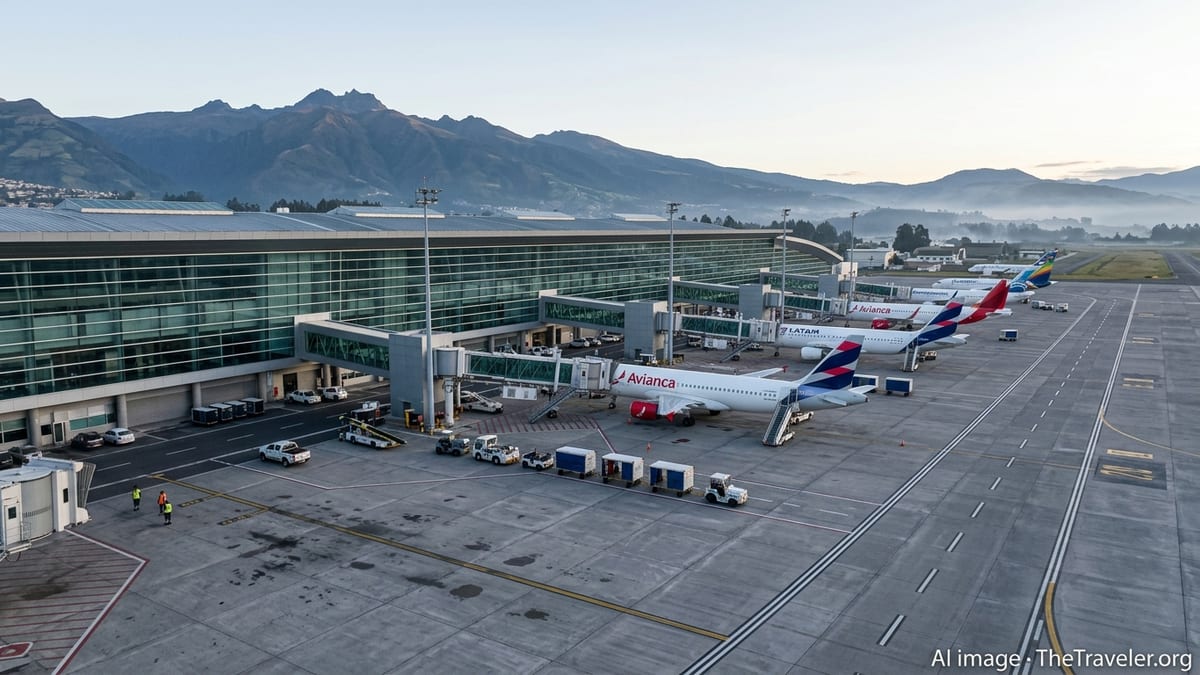
Quito’s Mariscal Sucre International Airport has been named South America’s Best Regional Airport at the 2024 Skytrax World Airport Awards, underscoring the Ecuadorian hub’s growing reputation for service quality, operational efficiency, and passenger experience.
Get the latest news straight to your inbox!
Skytrax Recognition Highlights Regional Leadership
The 2024 Skytrax World Airport Awards placed Mariscal Sucre at the top of its South America regional rankings, recognizing the airport as the continent’s Best Regional Airport. The distinction reflects evaluations of customer experience, facilities, cleanliness, and service consistency across airports that primarily handle regional and medium-haul traffic.
Publicly available information on the awards indicates that more than 500 airports worldwide are considered across multiple categories, with rankings driven largely by passenger satisfaction surveys. Within this competitive field, Quito’s airport has emerged as one of the strongest performers in its class, frequently cited in industry coverage for its combination of modern infrastructure and manageable scale.
The regional title adds to the airport’s existing Skytrax credentials. Mariscal Sucre has previously been certified as a 5-Star Regional Airport, placing it in a select group of terminals globally that meet demanding benchmarks for service quality and facilities. This latest recognition consolidates its reputation as a high-performing hub for Andean and wider South American travel.
While major continental gateways typically attract the most global attention, the Skytrax regional category is increasingly seen as a barometer of how well mid-sized airports are adapting to shifting passenger expectations, from smoother check-in and security processes to more comfortable terminal environments.
A Modern Hub in the Andes
Mariscal Sucre International Airport serves Ecuador’s capital from a relatively new location on the Oyambaro plain near the town of Tababela, about 18 kilometers east of central Quito. The current airport replaced the former inner-city airfield, which was constrained by surrounding mountains and dense urban development, and was opened to improve safety, capacity, and operational reliability.
The move to the new site enabled a longer runway, expanded apron space, and a terminal designed to international standards. Reports indicate that these upgrades have helped the airport better handle a mix of domestic, regional, and selected long-haul routes while maintaining a more compact, navigable layout than some of the continent’s largest hubs.
The airport’s high-altitude Andean setting also shapes its operational profile. Located over 2,000 meters above sea level, Mariscal Sucre must accommodate performance requirements for aircraft operating in thinner air, which in turn influenced runway design and airside planning. Industry analyses often highlight Quito as an example of how newer Latin American airports are taking terrain and weather factors into account from the outset.
Terminal interiors have been developed with a focus on natural light, clear wayfinding, and passenger circulation. For regional travelers, this translates into relatively short walking distances, straightforward transfers, and visibility of key services, elements that are frequently mentioned in comparative assessments of passenger comfort.
Service Quality, Cleanliness, and On-Time Performance
Beyond its Skytrax ranking, Mariscal Sucre has drawn attention in recent years for strong scores in cleanliness and overall service standards. Management reports from the airport operator indicate that Quito has been recognized as one of the cleanest airports in South America, a factor that has become more important to travelers in the post-pandemic environment.
Operational metrics reinforce this perception of quality. Independent on-time performance reviews for 2024 list Quito among the world’s leading small airports by punctuality, with departure and arrival rates around or above the mid-80 percent range. Such consistency can significantly influence passenger satisfaction, especially for regional business travelers and those making onward connections.
Customer-experience surveys cited in public documents show the airport earning high marks on staff courtesy, security processing, and overall comfort. While individual traveler opinions can vary, aggregate data from benchmarking programs outline a pattern of reliable performance and attention to detail across the terminal ecosystem.
These results position Mariscal Sucre as a competitive option for airlines seeking a stable Andean hub and for passengers looking for a smoother alternative to some of the region’s more congested gateways.
Growing Passenger Traffic and Cargo Connectivity
Recent management and transparency reports point to solid traffic growth at Mariscal Sucre, with passenger volumes surpassing 5 million travelers in 2024. Although this is modest compared with the largest Latin American hubs, it is significant for a regional airport serving a city of Quito’s size and geography.
The airport has also become a key node for Ecuador’s export economy, particularly for high-value, time-sensitive cargo such as fresh flowers. Official figures published by the airport show steady increases in freight volumes in recent years, with air cargo recognized as a central pillar of the facility’s operations and infrastructure planning.
This dual role as both passenger gateway and specialized cargo platform has encouraged investment in logistics facilities, cold-chain capabilities, and apron space dedicated to freighters. Industry observers note that such diversification can strengthen an airport’s resilience across economic cycles, while also supporting local employment and regional development.
As airlines recalibrate networks in response to shifting tourism patterns and trade flows, Quito’s ability to offer reliable cargo handling alongside a well-rated passenger experience may further enhance its appeal as a regional stopover and distribution point.
Implications for Ecuador and South American Air Travel
Recognition as South America’s Best Regional Airport reinforces Ecuador’s position on the continent’s aviation map. For Quito, the award arrives at a time when competition among South American cities for airlines, routes, and tourism spend remains intense, and when travelers are paying closer attention to airport quality in their choice of itineraries.
For international visitors, the accolade may draw greater attention to Quito as both a gateway to Ecuador’s cultural attractions and a staging point for trips onward to the Galápagos Islands, the Amazon, and other destinations. Travel industry coverage often highlights the role of airport experience in shaping first impressions of a country, and Mariscal Sucre’s performance gives Ecuador a strong entry point.
Within the wider South American context, the award underscores how regional and secondary hubs are investing to close the gap with larger metropolitan gateways. Quito’s combination of modern infrastructure, punctual operations, and favorable passenger reviews illustrates a broader trend across the continent toward more efficient and traveler-focused airports, even outside the largest capitals.
As Skytrax and other benchmarking programs continue to spotlight performance across distinct categories, airports like Mariscal Sucre are likely to feature more prominently in route-planning decisions and traveler preferences, contributing to a more diversified and competitive aviation landscape in South America.