

More news on this day
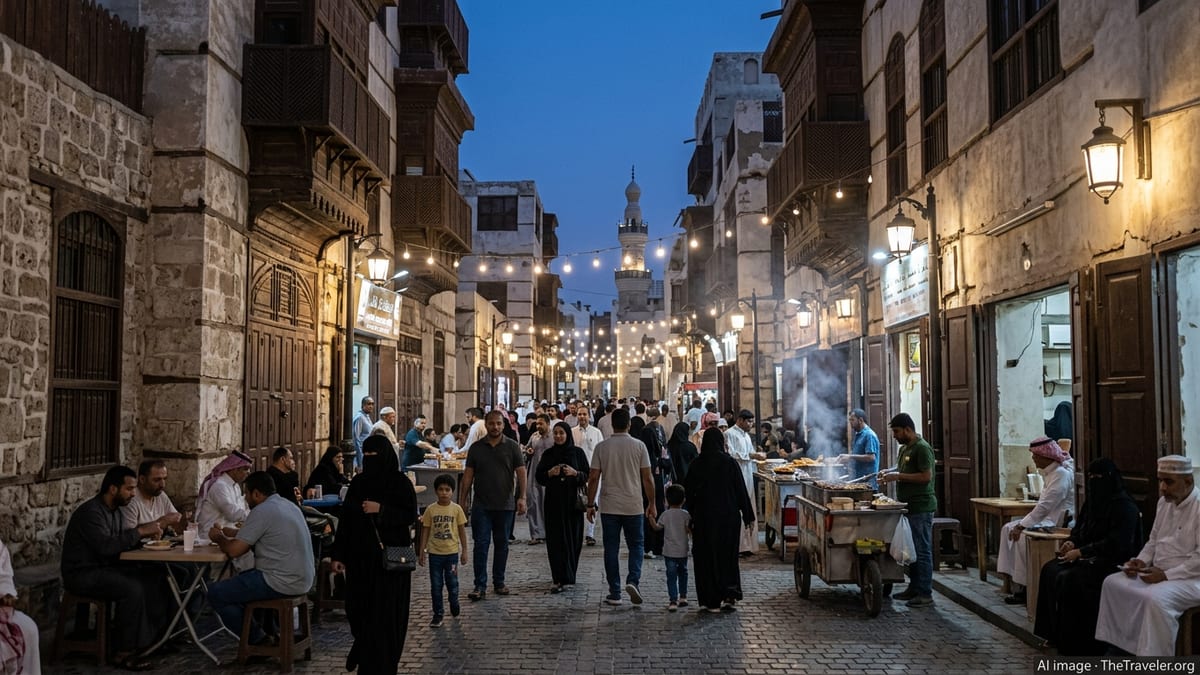
As Ramadan unfolds, Jeddah’s historic Al-Balad district is once again transforming into one of Saudi Arabia’s most atmospheric night-time destinations, where centuries-old coral-stone houses, lantern-lit alleys, and bustling markets converge in a vivid showcase of Hijazi heritage.
Get the latest news straight to your inbox!
A UNESCO-listed Quarter at the Heart of Hijazi Heritage
Al-Balad, Jeddah’s historic center, is recognized by UNESCO as “Historic Jeddah, the Gate to Makkah,” a nod to its role as a coastal entry point for pilgrims traveling to the holy city for centuries. The district’s dense maze of lanes and merchant houses reflects an urban fabric shaped by trade across the Red Sea and the wider Indian Ocean, fusing influences from Arabia, Africa, and South Asia.
Preservation efforts in recent years have focused on restoring Al-Balad’s distinctive coral-stone and limestone buildings, some of which date back several hundred years. International heritage assessments highlight ongoing conservation and urban regeneration programs designed to stabilize fragile structures, catalog hundreds of historic buildings, and reintroduce traditional techniques such as intricate wooden roshan window screens. These measures are helping the neighborhood retain its historic character even as it welcomes rising visitor numbers.
Publicly available reports show that Saudi cultural authorities are positioning Al-Balad as a year-round cultural hub. Art initiatives, heritage festivals, and the Red Sea International Film Festival’s venue in a new cultural square within the district are all part of a broader strategy to bring new life to the old quarter. During Ramadan, these longer-term investments create a vivid backdrop for evening festivities, offering visitors an immersive experience that feels both deeply rooted and newly revitalized.
Ramadan Season Turns Al-Balad into a Nighttime Festival
As the sun sets during Ramadan, Al-Balad’s narrow streets and open squares quickly fill with families, groups of friends, and visitors weaving between illuminated minarets and shopfronts. Coverage from regional outlets describes how the area becomes a focal point of “Ramadan Season,” a nationwide program of after-dark cultural activities, with Historic Jeddah acting as one of its most popular stages.
Recent seasons have featured a coordinated program overseen by cultural initiatives dedicated to the historic district. Reports indicate that the Ramadan Season in Historic Jeddah includes heritage performances, traditional children’s games, storytelling corners, and interactive workshops that run late into the night. The streets around key landmarks, including centuries-old mosques and restored merchant houses, host guided heritage trails and open-air displays that help younger visitors connect with older Ramadan customs.
Media coverage and visitor accounts emphasize how the atmosphere intensifies in the last ten nights of Ramadan, when many residents shift into a nocturnal rhythm. After evening and night prayers, crowds spill into Al-Balad’s central squares, often staying until the early hours. The combination of decorative lights, Ramadan lanterns, and the warm glow from wooden balconies creates a distinctive nightscape that has become one of Jeddah’s signature seasonal scenes.
Markets, Street Food and the Revival of Old Souqs
Market life is at the heart of Al-Balad’s Ramadan appeal. In recent years, initiatives such as themed bazaars and seasonal souqs have turned several of the district’s historic squares into lively trading grounds. Public information on the Ministry of Culture’s Ramadan program highlights events like Al-Balad bazaars and “Souq Al-Mawsim” in Historic Jeddah, which bring together vendors selling traditional sweets, clothing, handicrafts, and homeware.
Food-focused experiences are another major draw. Reports on Ramadan activities in Al-Balad describe lines forming at pop-up stalls for samosas, fried snacks, fresh juices, and classic Hijazi dishes. Popular squares and side streets host informal dining areas where visitors can sample local flavors after the fast, from tamees bread pulled fresh from ovens to trays of luqaimat drizzled with syrup. Street vendors and small-scale entrepreneurs gain a high-visibility platform during the season, contributing to a marketplace atmosphere that recalls earlier decades.
Alongside food and retail, heritage-themed markets introduce visitors to traditional crafts and products. Stalls showcasing oud and perfumes, embroidered garments, calligraphy, and locally produced dates sit beside long-established gold and textile shops. For many residents, Ramadan in Al-Balad offers a chance to combine seasonal shopping with the sensory nostalgia of the old city’s souqs, now framed within an organized cultural program.
Family-Friendly Cultural Experiences After Dark
Al-Balad’s Ramadan programming is structured with families in mind. Coverage of recent seasons notes children’s activities ranging from heritage games and craft workshops to performances that introduce classic Hijazi folklore. Interactive zones are set up in pedestrian-friendly courtyards and streets, where young visitors can learn about traditional dress, music, and storytelling while parents explore nearby stalls and exhibitions.
Publicly available information on the Historic Jeddah District Program indicates that Ramadan events aim to highlight Al-Balad’s role as a living neighborhood rather than a static museum. Residents and visitors share common spaces such as restored courtyards, pedestrianized alleys, and small plazas where community groups host Quran recitation gatherings and charitable initiatives. The resulting mix of leisure, spirituality, and culture gives the district a communal atmosphere that stands out even in a city known for its evening energy.
Organizers have increasingly emphasized accessibility and visitor services. Reports mention improved signage, lighting, and crowd management measures to handle the surge in foot traffic, particularly on weekends and key Ramadan dates. These practical adjustments, combined with extended operating hours for shops and cafes, are helping Al-Balad accommodate both heritage-focused tourists and local families seeking a safe and engaging place to spend the night.
Planning a Visit: What Travelers Can Expect
For travelers heading to Jeddah during Ramadan, Al-Balad has become a centerpiece of many itineraries. Travel advice from regional platforms consistently recommends visiting after iftar, when the district is at its liveliest, and allowing several hours to wander between main squares, side alleys, and waterfront edges. While daytime visits highlight architectural details and quieter courtyards, the Ramadan experience is fundamentally nocturnal, with most activity concentrated between early evening and the pre-dawn suhoor meal.
Visitors can expect a mix of curated events and spontaneous street life. Curated elements include scheduled performances, organized markets, and designated cultural zones, while spontaneous moments might involve watching children chase bubbles in a back street, listening to musicians perform traditional rhythms in a courtyard, or discovering a small cafe serving late-night coffee beside a restored stone facade. The combination helps Al-Balad feel authentic and lived-in, rather than staged purely for tourism.
Public information suggests that the district’s role as a gateway for pilgrims remains an important part of its identity, even as infrastructure across Jeddah evolves. With conservation projects underway and cultural programming expanding, Ramadan continues to be the moment when Al-Balad’s historic buildings, local communities, and visiting pilgrims intersect most vividly. For those seeking to experience the spiritual and cultural texture of Saudi Arabia’s Red Sea coast, an evening in Al-Balad during Ramadan now ranks among the country’s defining travel experiences.