

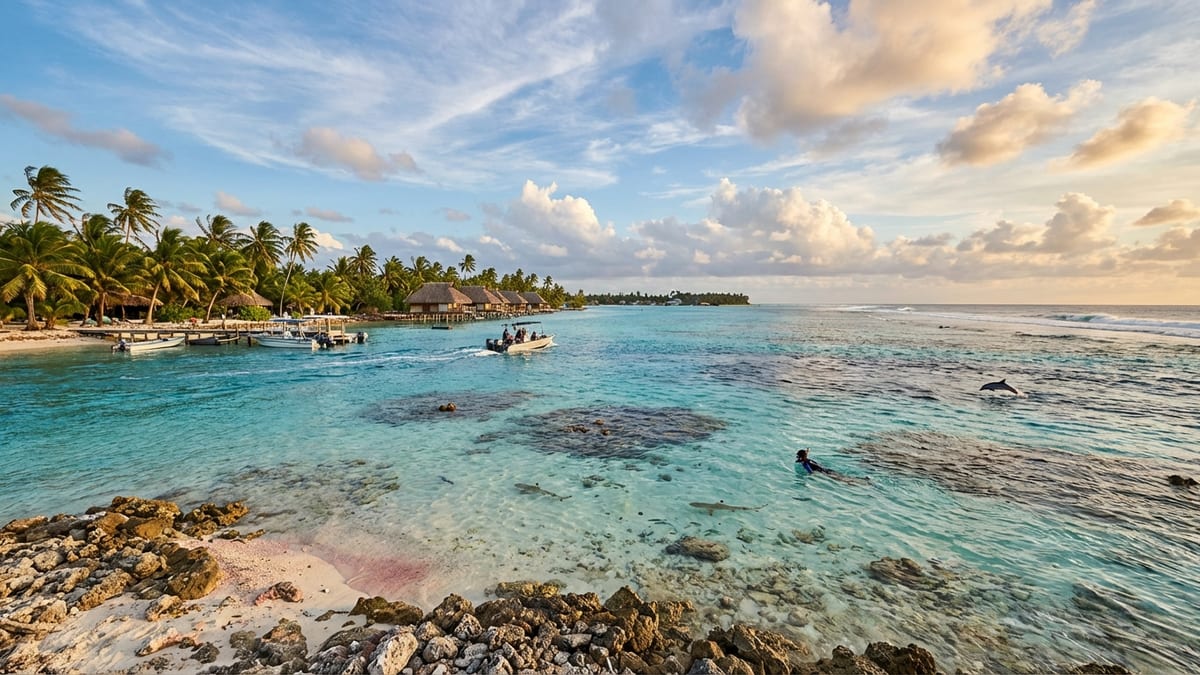
Rangiroa has long held a near-mythic status among divers, but this immense atoll in French Polynesia is far more than a single great dive site. With a lagoon so vast it could swallow the whole island of Tahiti, passes that pulse with sharks and dolphins, and motu fringed in pink and white sand, Rangiroa manages to feel both remote and surprisingly accessible. This guide explores what makes Rangiroa unique, how to experience its legendary lagoon and world-class diving, and how to plan a trip that does justice to one of the planet’s great ocean destinations.
Where on Earth Is Rangiroa and Why It Feels So Remote
Rangiroa sits in the Tuamotu Archipelago of French Polynesia, roughly 350 kilometers northeast of Tahiti. Rather than a single island, it is a vast coral atoll ring: a necklace of low-lying motu surrounding a lagoon that ranks among the largest in the world. From the air, the atoll looks like a thin white thread dropped on a disk of deep blue, with the interior lagoon forming an inland sea.
Despite its geography, reaching Rangiroa is relatively straightforward. Most travelers connect through Faa’a International Airport in Tahiti, then continue on a domestic flight of about one hour with airlines such as Air Tahiti or Air Moana, arriving at Rangiroa’s small airport near Avatoru village. From the airport, most accommodations are only a short transfer away, and dive centers typically offer pick up and drop off as part of their daily logistics.
The sense of remoteness comes not from difficulty of access but from scale. Once there, you are in a sparsely populated atoll with just two main villages, Avatoru and Tiputa, spread along a narrow strip of coral. A modest road and sandy tracks link small pensions, churches and family homes. Beyond them lie uninhabited motu, coconut groves and a lagoon so wide that the far reef is often lost in haze. Night skies are ink-black, ocean swell thunders on the outer reef, and it becomes clear how small human presence is compared with the surrounding Pacific.
This balance between practical access and genuine isolation is part of Rangiroa’s appeal. It makes a rewarding second or third stop in a wider French Polynesia itinerary, yet still offers the “end of the world” feel that experienced travelers and divers seek.
What Makes Rangiroa’s Lagoon and Passes Unique
Rangiroa’s lagoon is its beating heart. Stretching more than 70 kilometers in length, it is often described as an inland sea, and in calm conditions it resembles a vast turquoise lake rimmed by coral and coconut palms. The lagoon’s infamy among divers comes from the two main passes that connect it to the open ocean: Tiputa Pass and Avatoru Pass on the northwest side of the atoll.
These passes funnel powerful tidal currents in and out of the lagoon, creating nutrient-rich upwellings that attract an extraordinary range of marine life. On incoming tides, clear oceanic water floods into the lagoon, often delivering pelagic species like schooling barracuda, jacks and tuna. On outgoing tides, lagoon water spills back to the ocean, sometimes cloudier but teeming with reef fish and hunting sharks. For divers, this means a dynamic environment that changes almost hourly with the state of the tide.
Tiputa Pass, separating Avatoru and Tiputa villages, is the star attraction. During the austral summer months roughly December to March, great hammerhead sharks and manta rays are known to cruise the pass, capitalizing on seasonal plankton surges and spawning events. Throughout the year, resident pods of bottlenose dolphins patrol the channel and often interact with divers hovering along the reef wall, making Tiputa one of the few places on Earth where such encounters are relatively common without baiting or artificial conditioning.
Avatoru Pass, a few kilometers to the west, is narrower and more rugged, favoured by experienced divers and local fishermen. It can deliver dramatic drift dives with strong currents and large numbers of grey reef sharks, whitetips and silvertips. The area around Motu Fara at the mouth of Avatoru Pass holds particularly rich reef systems that some snorkelers consider as impressive as the famous Blue Lagoon excursions. Together, these passes and the immense lagoon form a highly productive ecosystem that supports both tourism and traditional fishing, and that sets Rangiroa apart from many other Pacific atolls.
Diving Rangiroa: Sharks, Dolphins and Drift Adventures
Diving is the primary reason many visitors choose Rangiroa. The atoll consistently ranks among the world’s top dive destinations, especially for large marine life. Conditions are often excellent, with water temperatures around 26 to 29 degrees Celsius (79 to 84 Fahrenheit) and visibility ranging from 15 to 40 meters, sometimes more in peak season. These factors, combined with the flow-through of oceanic water in the passes, create “big animal” dives that can feel more like pelagic expeditions than classic reef tours.
Most diving focuses on Tiputa Pass and Avatoru Pass. Typical days involve two boat dives, one in the morning and one in the afternoon, with dive boats taking only 10 to 15 minutes to reach the sites. This short transit time is a quiet blessing: unlike some far-flung sites that demand long rides in open seas, Rangiroa’s dive operations can run safe, efficient schedules that leave you plenty of time to relax between immersions.
Drift dives on an incoming tide are the signature experience. Divers often descend near the outer reef or pass entrance, then ride the water “inward” while watching a living tableau of grey reef sharks, blacktips, whitetips, tuna, barracuda and tightly packed schools of surgeonfish. On some days a true “wall of sharks” arranges itself along the drop-off. These are not baited dives but natural aggregations around current-swept reef features. In the right season and conditions, manta rays, eagle rays and hammerhead sharks enter the scene, and on many dives dolphins make playful passes, sometimes spinning or bow-riding above you in the blue.
For advanced divers, outgoing current dives and deeper explorations along the pass can offer intense action but also demand strict adherence to local guides’ briefings. Currents can be very strong, and the nearest hyperbaric chamber is in Tahiti, reached by a 75-minute flight, so operators take safety seriously. Nitrox is common and highly recommended for repetitive diving. Live reef health is generally good, though like much of the Pacific it is not immune to bleaching events and storm damage, so the real draw is the concentration of marine life more than delicate coral gardens.
Beyond the Bubbles: Blue Lagoon, Reef Island and Lagoon Life
While diving often dominates the narrative, Rangiroa’s lagoon excursions can be equally memorable, especially for non-divers or for divers taking a surface-interval day. Two of the most celebrated trips are to the Blue Lagoon and to Reef Island, both typically run as full-day boat tours from Avatoru and Tiputa.
The Blue Lagoon is a lagoon within the lagoon, formed by a cluster of motu on the southwestern rim of Rangiroa. In shallow water that scarcely hits your knees at low tide, coral heads, baby blacktip reef sharks and clouds of reef fish surround sandy patches where picnic tables and thatched shelters are set up for day visitors. The water here glows in hyper-saturated shades of turquoise, teal and jade, and even seasoned South Pacific travelers are often surprised by how vivid it appears in person. Many tours include a grill lunch of fresh fish, local fruits and coconut bread, along with demonstrations of traditional coconut husking or pareo-tying.
Reef Island, usually visited on a separate excursion, lies on the southeastern side of the atoll. It is renowned for jagged fossilized coral formations along the outer reef, carved by centuries of wave action into intricate sculptures, pools and channels. Here, the ocean surf thunders just beyond the reef edge, yet inside the lagoon the water can be peacefully calm, punctuated by natural basins that create ideal spots for swimming and snorkeling. Nearby, stretches of pink-tinted sand sometimes called Les Sables Roses add a subtle blush to the shoreline when conditions are right, especially in late afternoon light.
Smaller lagoon outings showcase other aspects of atoll life. Half-day boat trips might combine snorkeling at vibrant coral bommies with visits to pearl farms, where you can learn about the cultivation of the famed black pearls of the Tuamotus. There is also French Polynesia’s only vineyard, where vines grow improbably in coral soil near the lagoon’s edge and wines are produced on site in small quantities. Even a simple sunset cruise through the passes can be unforgettable as seabirds wheel overhead, dolphins surf breaking waves and the setting sun silvers the lagoon.
When to Go and How Long to Stay
Rangiroa is a year-round destination, but conditions and experiences vary with the seasons. The drier months from roughly May to October typically bring slightly cooler air temperatures, more stable weather and very pleasant conditions on land. These months are popular with travelers seeking sunny days and low humidity. The southeasterly Maramu trade winds, most notable between June and August, can create choppier seas and occasionally complicate pass diving, though dives still operate most days.
The wetter season from about November to April brings warmer air and water, higher humidity and more frequent showers or storms. However, this period is often favoured by dedicated divers because marine activity in the passes can be especially intense. Austral summer is when manta rays and great hammerhead sharks are most regularly reported in Tiputa Pass, making it a compelling time for those focused on big animals. Water temperatures peak during this period, which can be more comfortable for long days in the sea.
In practical terms, a stay of four to seven nights in Rangiroa works well for most visitors. Divers who want to maximize encounters and account for potential weather or current variations should lean toward a full week, allowing at least eight to ten dives. This not only increases the chances of seeing rare species like hammerheads and manta rays but also allows you to experience different moods of Tiputa and Avatoru Pass under changing tidal conditions.
For travelers combining Rangiroa with other islands such as Tahiti, Moorea or Bora Bora, three or four nights can still deliver a strong impression, especially if you plan your lagoon excursions carefully. Non-divers might devote one full day to the Blue Lagoon, one to Reef Island, and reserve other days for snorkeling off local motu, biking along the main road, or simply watching the ever-shifting colors of the lagoon from a guesthouse deck.
Practical Travel Logistics, Entry Rules and Getting Around
Because Rangiroa is part of French Polynesia, which is an overseas collectivity of France, entry rules are aligned with French regulations. As of early 2026, citizens of many countries including the United States, most of the European Union, the United Kingdom, Canada and Australia may enter visa-free for tourism stays up to 90 days within a 180-day period, provided they hold a passport valid for at least six months beyond their departure date and proof of onward or return travel. Travel advisories and regulations can change, so it is wise to check government resources or consult with your airline before departure.
Almost all international travelers arrive via Tahiti, then connect to Rangiroa by domestic flight. Air Tahiti operates regular services from Papeete to the Tuamotu Archipelago, with flight durations around one hour. Newer carriers such as Air Moana also serve the route, with Rangiroa’s airport located between the ocean and lagoon a short drive from Avatoru. Advance booking is strongly recommended during high season and around local holidays, as inter-island seats can sell out.
Once on the atoll, distances are small but transport logistics are not quite as spontaneous as on a large island. Many accommodations arrange airport transfers for a fee or as part of a package. On the Avatoru side, bicycles are a popular way to explore, and some pensions provide them free of charge. Car rental options are limited but can be arranged for those who prefer more flexibility. Between Avatoru and Tiputa, a small public boat shuttle runs across the pass on a regular schedule during daytime hours, with guesthouses often helping coordinate timing and payment.
Cash remains useful for local services, especially in small shops, snack bars and for boat transfers. Larger hotels, dive centers and tour operators usually accept major credit cards, but connectivity can be patchy, and occasional outages are not unheard of. Mobile data has improved in recent years, yet signal strength still varies, particularly on more remote motu. Travel insurance that covers diving, medical evacuation and trip disruptions is strongly advisable given the atoll’s isolation and the cost of long-distance evacuations.
Where to Stay and How to Choose Your Base
Accommodation in Rangiroa spans from simple family-run pensions to full-service lagoon resorts. Unlike some more developed islands, the atoll has a relatively small number of properties, which helps preserve its low-key atmosphere but also means that booking ahead is essential, especially for popular months and during school holidays in France and Tahiti.
Avatoru is the main hub, close to the airport and to most dive centers, making it the most convenient base for active travelers who plan to dive daily or join multiple excursions. Here you will find a handful of small hotels, guesthouses and resorts lining the lagoon, often with on-site or nearby dive shops. Staying in Avatoru minimizes transfer times and makes it easy to walk or bike to small grocery stores, churches and snack stands.
Tiputa, across the pass, offers a quieter village feel and excellent proximity to Tiputa Pass for those who want to be close to the action yet slightly removed from the main traffic. Small pensions and homestays dominate, many with direct lagoon access. The boat shuttle between Tiputa and Avatoru generally makes it manageable to stay on one side and dive or take excursions from the other, though you will need to be mindful of schedules and daylight hours.
More remote motu accommodations, including private-island stays and off-grid guesthouses, deliver intense seclusion and direct access to pristine reef environments, often ideal for snorkeling and stargazing. These typically include meals and organized transfers, as there is no independent way to reach them. While undeniably romantic, such stays may be less practical for divers hoping to do multiple daily boat dives from the main passes, though some high-end motu properties can arrange private boats on request at significant additional cost.
Culture, Food and Responsible Travel on a Fragile Atoll
Rangiroa’s cultural fabric intertwines Polynesian heritage and contemporary French influence. On Sundays, church services in Avatoru and Tiputa fill with hymn-singing congregations dressed in bright floral prints and woven pandanus hats. Local festivals, when they occur, might feature traditional dances, handcrafted jewelry, outrigger canoe races and coconut-based dishes passed among neighbors. Even in a place famed for shark dives, daily life still revolves around fishing, copra harvesting and family gatherings.
Food on the atoll reflects both abundance and limitation. Fresh fish is a staple, often prepared as poisson cru marinated in lime and coconut milk, or grilled and served with breadfruit, taro and rice. Lagoon fish, parrotfish and tuna are common, and when conditions allow, lobsters and other crustaceans appear on menus. French imports such as baguettes, pastries, cheeses and wines arrive from Tahiti, giving even small snack stands a hint of cafe culture. Many pensions include breakfast and dinner in room rates, serving hearty home-style meals at communal tables, which can be a highlight for travelers interested in conversation and local stories.
Because Rangiroa is a low coral atoll, environmental pressures are acute. Freshwater is limited, waste management is challenging and reefs are vulnerable to both global climate change and local impacts. Visitors can help by following basic responsible travel practices: using reef-safe sunscreen, minimizing single-use plastics, conserving water in showers and air conditioning, and respecting no-take zones or local fishing rules. Supporting locally owned pensions, tour operators and pearl farms ensures more tourism revenue remains within the community.
Dive and snorkel ethics matter significantly here. Avoid touching or chasing marine life, keep a safe distance from sharks and dolphins, and listen carefully to guides’ briefings about currents and sensitive areas. Booms in “shark tourism” elsewhere in the world have demonstrated how quickly ecosystems can be altered by careless practices. In Rangiroa, the long-term health of shark populations, dolphins and manta rays is essential not only for biodiversity but also for the sustainable future of dive tourism.
The Takeaway
Rangiroa sits at the intersection of accessibility and wildness. It is close enough to Tahiti to be woven into a broader French Polynesia itinerary, yet its immense lagoon and powerful passes still feel like a frontier, where pelagic sharks gather in clear blue water and dolphins surf in tidal bores rolling through ancient coral channels. For divers, it is a destination that can redefine expectations of what a day underwater might hold. For non-divers, it offers a rare chance to spend time on an atoll that remains largely undeveloped, where the horizon is almost always water and sky.
Planning a trip here requires a bit of forethought: coordinating inter-island flights, confirming dive packages in advance, understanding seasonal conditions and choosing accommodations that match your priorities, whether that is maximum diving, tranquil lagoon views or cultural immersion in village life. But the reward is a destination that feels both iconic and personal, where sunrise over the lagoon or a spontaneous dolphin encounter in Tiputa Pass can become anchors in your travel memory.
Ultimately, Rangiroa’s uniqueness lies not just in superlatives about pass dives or lagoon size, but in its atmosphere. It invites you to slow down, align your days with tides and trade winds, and experience a corner of the Pacific that still runs primarily on ocean time. Whether you are ticking off a bucket-list dive site or simply seeking an off-grid escape surrounded by blue, this long atoll more than lives up to its name: “long sky,” stretching seemingly without end above a living sea.
FAQ
Q1. How do I get to Rangiroa from the United States?
Most travelers fly from North America to Tahiti, usually via gateways such as Los Angeles, San Francisco or Honolulu, then connect on a domestic flight of about one hour from Papeete to Rangiroa with an inter-island carrier. Advance booking of the domestic leg is strongly recommended, especially in high season.
Q2. Do I need a visa to visit Rangiroa and French Polynesia?
As of early 2026, many nationalities, including U.S., most EU, UK, Canadian and Australian citizens, may enter French Polynesia visa-free for tourism stays up to 90 days within a 180-day period, provided they hold a valid passport and proof of onward or return travel. Always verify current rules with official government or consular sources before you depart.
Q3. Is Rangiroa suitable for beginner divers?
Yes, but with caveats. Local dive centers can accommodate beginners and offer introductory dives in more sheltered parts of the lagoon. However, the famous pass dives at Tiputa and Avatoru involve strong currents and require good buoyancy and comfort in open water. Many visitors choose to gain some experience elsewhere before attempting the more advanced drift dives here.
Q4. When is the best time of year to see sharks and manta rays?
Sharks are present year-round, with grey reef sharks, blacktips and whitetips commonly seen on most pass dives. Manta rays and great hammerhead sharks are more frequently reported during the warmer, wetter months roughly November to April, especially in the austral summer period when plankton and fish activity peak.
Q5. Can non-divers enjoy Rangiroa?
Absolutely. Non-divers can join lagoon excursions to the Blue Lagoon or Reef Island, snorkel on shallow coral gardens, visit pearl farms and the local vineyard, bike through Avatoru and Tiputa, or simply relax beside the lagoon. Many couples split activities so one partner dives while the other explores or relaxes on shore.
Q6. How many days should I spend in Rangiroa?
For divers, five to seven nights is ideal, allowing for multiple days of diving in different tidal conditions and at least one lagoon excursion. Non-divers can still get a strong feel for the atoll in three to four nights, especially if they plan a full-day trip to the Blue Lagoon and another to Reef Island.
Q7. Is it easy to move between Avatoru and Tiputa?
Yes, during the day a small public boat shuttle crosses Tiputa Pass on a scheduled basis. Guesthouses commonly help guests coordinate rides and advise on the latest timetable. Transfers are short, typically only a few minutes, but the service does not usually operate late into the evening, so planning around the schedule is important.
Q8. What should I pack for a trip to Rangiroa?
Pack light tropical clothing, a hat, sunglasses and a good reef-safe sunscreen, along with sturdy sandals or water shoes for coral beaches. Divers will want their certification cards, logbooks and any personal gear they prefer, though rental equipment is available locally. A light rain jacket, dry bag, insect repellent and a basic first-aid kit are also useful on a remote atoll.
Q9. Are there medical facilities and a hyperbaric chamber on Rangiroa?
Rangiroa has a small local clinic capable of handling minor issues, but serious cases and diving-related injuries are usually evacuated to Tahiti, where the nearest hyperbaric chamber is located. Because of this, comprehensive travel insurance that covers diving and medical evacuation is strongly recommended for anyone planning underwater activities.
Q10. Is Rangiroa very expensive compared with other islands?
Rangiroa is not a budget destination, but it can be more affordable than Bora Bora if you opt for family-run pensions rather than luxury resorts. Accommodation with half-board meal plans helps manage costs in a place with limited restaurant options. Diving and lagoon excursions are significant expenses, so planning a realistic activity budget in advance is key to avoiding surprises.