

More news on this day
A rare mega-storm over Ajman has unleashed what meteorologists describe as a year’s worth of rain in just a few hours, flooding roads, inundating low-lying neighborhoods and battering the coastline as tourists, families and daily commuters across the northern UAE scramble to rewrite their travel plans.
Get the latest news straight to your inbox!
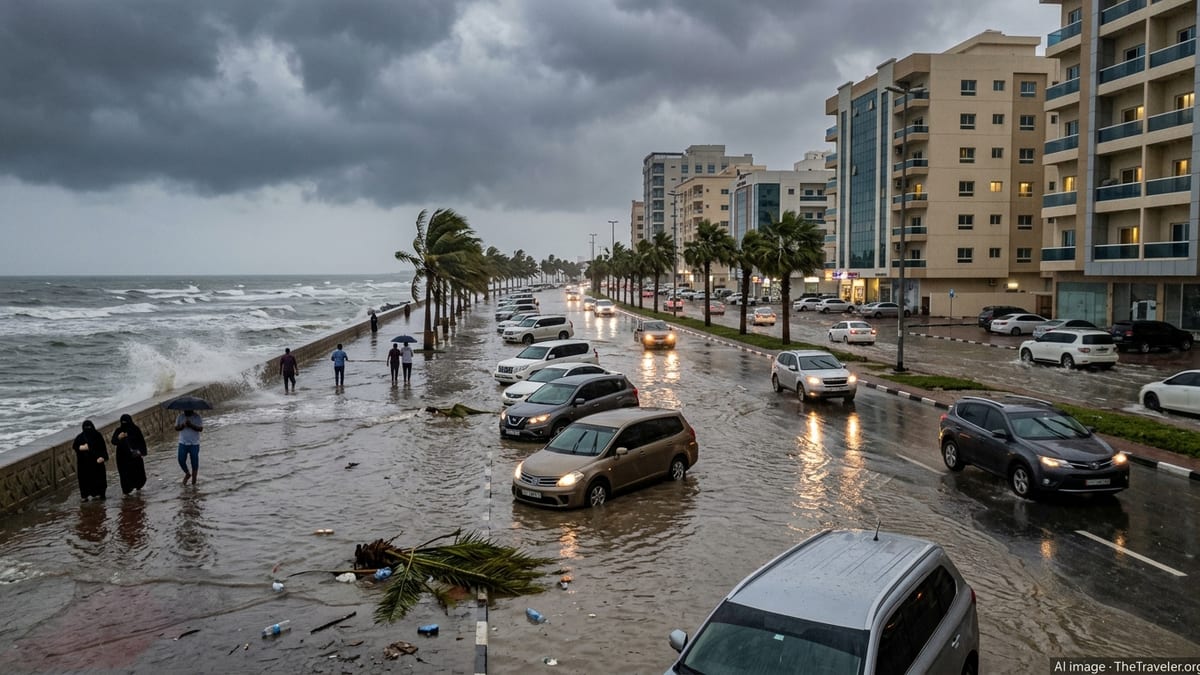
Record-Breaking Rainfall Turns Ajman’s Streets into Rivers
Publicly available climate summaries for the United Arab Emirates show that storms of this intensity are highly unusual in Ajman’s typically arid, coastal environment, where annual rainfall is normally measured in just a few dozen millimetres. During the latest event, monitoring data and eyewitness accounts from across the emirate indicated that accumulations over parts of Ajman in a single day rivalled or exceeded what would normally fall over an entire year.
Across residential districts and commercial corridors, rainwater rapidly pooled on flat terrain and in poorly drained junctions, transforming familiar thoroughfares into waist-deep channels. Social media posts from residents described submerged vehicles, waterlogged parking basements and standing water that lingered long after the heaviest downpours had passed.
Meteorologists tracking the wider Arabian Gulf storm system note that the Ajman deluge formed as part of a slow-moving, moisture-laden weather pattern similar to the one that delivered the UAE’s heaviest rainfall in at least 75 years in April 2024. Regional climate briefs emphasize that such systems can stall over the northern Emirates, dropping exceptional totals over a narrow window of time.
Tourists Face Airport Delays, Hotel Strain and Washed-Out Beach Days
The storm hit at a time when Ajman’s compact waterfront resorts and serviced apartments were hosting a mix of regional weekenders and long-haul visitors tying the emirate into itineraries that also included Dubai, Sharjah and Ras Al Khaimah. As the rain intensified, many travellers reported delayed or diverted flights at UAE airports and extended transfer times on the main highways linking Ajman with nearby hubs.
Beachfront plans were quickly abandoned as powerful squalls whipped up rough seas along the Ajman Corniche and surrounding coastline. Public reports indicate that lifeguards and resort staff discouraged visitors from entering the water amid strong currents and reduced visibility, while sections of the shoreline were left strewn with debris carried in by pounding waves.
Inside hotels, staff shifted focus from leisure programming to basic continuity, moving guests away from leaking terrace areas, securing outdoor furniture and arranging alternative activities under cover. Travel advisories issued by several foreign ministries after previous Gulf-region floods were widely shared again, urging visitors to monitor local weather updates, keep flexible itineraries and avoid driving through flood-prone underpasses and side streets.
Daily Commutes Disrupted as Key Links Between Emirates Suffer
The impact on everyday mobility across the northern UAE was immediate. Reports from local media and commuter forums described long tailbacks on arterial routes connecting Ajman with Sharjah and Dubai, with underpasses, service roads and low-lying roundabouts partially submerged or closed as runoff overwhelmed drainage networks.
Intercity bus routes that typically provide cost-effective links between Ajman, Dubai and other Emirates experienced delays and temporary suspensions on some corridors, mirroring disruptions seen after earlier record storms in 2024. Publicly accessible transport updates highlighted rerouted services and advised passengers to allow significantly more time to reach airports, business districts and industrial zones.
Within Ajman itself, school runs and office commutes were heavily affected as parents and workers weighed the risk of navigating waterlogged streets against staying home. In recent years, government circulars during major rain events have encouraged remote work and distance learning, and residents reported similar shifts this time as businesses and institutions reverted to hybrid arrangements.
Coastal Infrastructure and Small Businesses Bear the Brunt
Along the shoreline, the storm’s combination of intense rainfall and rough seas tested Ajman’s coastal defences and public spaces. Drainage channels struggled to discharge runoff quickly into an already agitated Arabian Gulf, leading to backflow that left some promenades and car parks under water for hours. Street furniture, landscaping and lighting along sections of the Corniche sustained visible damage from both salt spray and standing water.
Small cafes, groceries and family-run restaurants, particularly those with outdoor seating or ground-level storage near the seafront and older districts, were among the most exposed. Accounts shared on community platforms described damaged stock, sodden interiors and temporary closures while owners pumped out water and dried equipment. Insurers and risk consultancies reviewing similar events in 2024 have warned that frequent repeat flooding could raise operating costs for such businesses unless more robust protection is put in place.
Port operations in the region also adjusted to the conditions. Earlier heavy rain episodes prompted Ajman’s port authorities to shift many customer services online, and observers noted comparable remote arrangements this time as logistics operators worked around slick quays, reduced visibility and intermittent power interruptions affecting nearby industrial clusters.
Storm Renews Focus on Climate Resilience and Travel Planning
The Ajman mega-storm comes against a backdrop of broader regional analysis suggesting that intense rainfall events in the Gulf are becoming more impactful as urban expansion, paved surfaces and denser infrastructure alter natural drainage. Hydrologic studies conducted after the April 2024 floods highlighted how short, extreme downpours can translate rapidly into flash flooding in built-up coastal cities.
Urban planners and engineering consultancies have been examining options such as enlarged stormwater networks, upgraded culverts, expanded retention basins and redesigned public spaces capable of temporarily holding excess water. The latest flooding in Ajman is expected to add urgency to those discussions, particularly in rapidly growing residential zones that have recently seen new towers, malls and road projects.
For travellers, the storm is another reminder that even destinations long associated with sun and clear skies can face sudden, severe weather. Travel management firms that assessed the 2024 UAE floods have advocated for more robust contingency planning, including flexible booking policies, clear communication channels with travellers on the ground and real-time monitoring of road and airport conditions.
As Ajman begins the task of draining flooded junctions, clearing debris and restoring normal traffic flows, visitors and residents alike are reassessing how they move around the northern Emirates when heavy clouds gather over the Gulf. In a region where rainfall remains rare but increasingly consequential, this latest storm has shown how quickly a day at the beach or a routine cross-emirate commute can be upended.