

More news on this day
A rare one-way Qantas Airbus A380 flight from Sydney to London has drawn fresh attention to the intense demand on the Australia–UK corridor and the airline’s increasingly tactical use of its superjumbo fleet amid volatile long-haul markets.
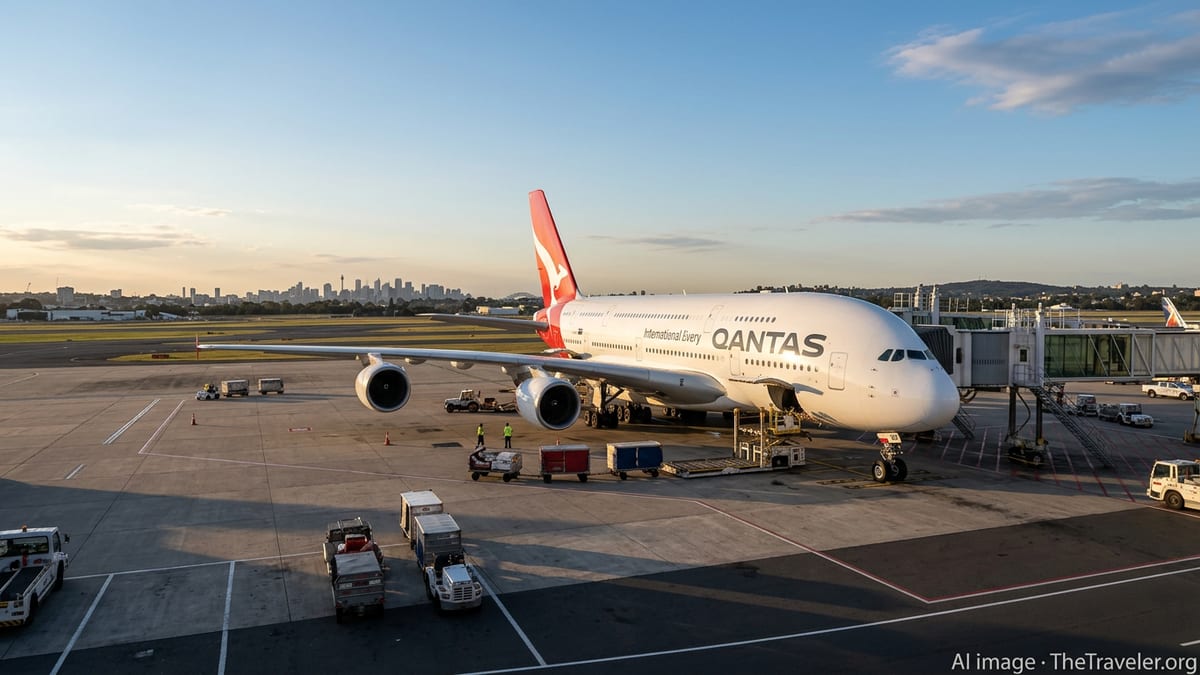
A One-Off Superjumbo That Turned Heads
Spotters in both Australia and the United Kingdom took note this week when a Qantas A380 appeared on flight-tracking screens operating as a one-way service from Sydney to London, outside the carrier’s normal schedule. While Qantas routinely flies the double-decker jet on its flagship Kangaroo Route via Singapore, this ad hoc deployment broke from the usual pattern of paired out-and-back rotations.
Industry sources say the unusual one-way sector was tied to short-term operational needs, including repositioning aircraft and crew while keeping capacity high on one of the world’s most in-demand long-haul markets. Qantas has been using its full A380 fleet more flexibly since completing refurbishment of all 12 superjumbos at the end of 2025, with the aircraft now concentrated on ultra-long routes such as Sydney–London and Sydney–Los Angeles.
For passengers who secured seats, the one-way A380 between Sydney and London provided a rare opportunity to fly on a lightly scheduled variant of a route that is usually heavily booked months in advance, particularly in premium cabins. Frequent flyers reported strong loads despite the off-pattern operation, underscoring the persistent appetite for non-stop or one-stop links between Australia and the UK.
Although Qantas did not heavily market the flight as a special event, its appearance fed into a broader narrative of the A380’s quiet revival, as airlines continue to rediscover the value of very large aircraft on a small number of slot-constrained, high-yield routes.
Context: A380 Revival on the Kangaroo Corridor
The one-way Sydney–London superjumbo flight comes against the backdrop of Qantas steadily rebuilding and then expanding its A380 footprint. After returning the type to Sydney–London and Sydney–Los Angeles, Qantas has also restored A380 services to Johannesburg and Dallas, while ramping up superjumbo frequencies on the busy Sydney–Singapore sector that feeds Europe-bound traffic.([mainlymiles.com](https://mainlymiles.com/2026/02/26/qantas-doubles-a380-singapore-sydney-services/?utm_source=openai))
Timetable filings show that from late 2026 Qantas plans to increase A380 services between Sydney and Singapore to support daily onward flights to London, positioning the route as its primary trunk for Europe connections. That strategy mirrors broader industry trends, with airlines focusing their biggest aircraft on a handful of megacity pairs where slot constraints and robust premium demand justify the extra capacity.([aeroroutes.com](https://www.aeroroutes.com/eng/260226-qfnw26sydsin?utm_source=openai))
Qantas’ investment in refreshed A380 interiors, including upgraded premium economy and business cabins, is designed to keep the aircraft competitive on these marathon sectors until next-generation ultra-long-haul jets arrive under the airline’s Project Sunrise plan later in the decade. For now, the superjumbo remains the workhorse on the classic Kangaroo Route, and occasional one-off flights such as this week’s one-way Sydney–London sector highlight how central the type remains to Qantas’ long-haul strategy.([airtraveler.club](https://www.airtraveler.club/news/qantas-?utm_source=openai))
The move also underlines how Qantas is using the A380 as a strategic buffer: when demand spikes or routing constraints emerge elsewhere, the airline has been willing to rotate superjumbos across the network on a short-notice basis, sometimes yielding unusual patterns that catch the eye of aviation enthusiasts.
Geopolitics, Detours and a Crowded Europe Pipeline
The timing of the unique one-way A380 service also coincides with fresh turbulence across key air corridors linking Australia and Europe. This week Qantas confirmed that its flagship Perth–London flight is being rerouted via Singapore because of airspace closures over parts of the Middle East linked to the escalating conflict involving Iran.([airtraveler.club](https://www.airtraveler.club/news/qantas-perth-london-qf9-singapore-stopover/?utm_source=openai))
The change adds hours to the journey and concentrates even more Australia–Europe demand through Singapore, a hub already operating near capacity for several major carriers. With many Gulf airlines facing their own constraints on routes to and from Australia, analysts say Qantas is seeing elevated pressure on every available seat from Sydney and Perth to Britain and the continent.
In that environment, deploying an A380 on a one-way Sydney–London service gives Qantas extra flexibility to keep passengers moving while its standard patterns are disrupted. Repositioning flights can absorb displaced customers from rerouted services or partner connections, effectively acting as a temporary relief valve in a system where small shocks can quickly cascade into missed connections and extended delays.
For Australian travellers heading to London, the upshot is a patchwork of options: indirect routings via Asia, adjusted itineraries via Perth or Darwin, and, on rare occasions, unusual superjumbo one-offs that appear briefly in schedules before disappearing again. For Qantas, each of these flights is part of a delicate balancing act between commercial demand, operational resilience and rapidly shifting geopolitical risk.
Passenger Experience on an Ultra-Long A380 Flight
On board, the A380 remains Qantas’ flagship for comfort on the long trek between Sydney and London. The double-decker jet carries four cabins, including first class suites, a large business cabin and an upgraded premium economy section that has become increasingly popular with both leisure and corporate travellers seeking a step up from standard economy without the full business-class price tag.([onemileatatime.com](https://onemileatatime.com/news/qantas-a380-flights-dfw/?utm_source=openai))
The refurbished interiors finished in late 2025 brought new seating, soft furnishings and refreshed in-flight entertainment systems across the aircraft. Regulars on the Kangaroo Route report quieter cabins and improved seat ergonomics in premium economy and business, as well as modest tweaks in economy designed to soften the impact of up to 24 hours of total travel time including transit.([airtraveler.club](https://www.airtraveler.club/news/qantas-?utm_source=openai))
Because the one-way Sydney–London flight operated as an off-pattern sector, it also offered an unusually light schedule of connecting passengers in some cabins, giving those on board a slightly less congested experience in areas such as boarding, baggage storage and lounge queues. For a small subset of flyers, it was a chance to sample Qantas’ flagship long-haul hard product in a setting that felt more like a charter than a typical peak-season A380 departure.
Even as Qantas prepares for ultra-long-range A350s capable of flying Sydney–London non-stop in the coming years, many passengers continue to see value in the A380’s spacious cabin layout, onboard social spaces and relatively generous seat width, attributes that help the aircraft retain a loyal following on the route.
Looking Ahead to Project Sunrise and Future Routings
The rare one-way A380 flight from Sydney to London offers a glimpse of how Qantas might manage its long-haul network as it transitions into the Project Sunrise era from late 2026 onward. The airline has indicated that new Airbus A350-1000 aircraft will eventually take over many of the longest sectors, including planned non-stop services from Sydney to London and New York, but industry observers expect the A380 to remain an important player for years on routes where demand is too strong to surrender its capacity.([visahq.com](https://www.visahq.com/news/2026-03-05/au/qantas-reroutes-flagship-perth-london-flight-via-singapore-as-gulf-airspace-closes/?utm_source=openai))
Analysts say the carrier is likely to continue mixing daily scheduled A380 services on Sydney–Singapore–London with occasional ad hoc rotations to respond to disruptions and seasonal spikes, especially while geopolitics and fuel prices remain volatile. Superjumbo one-offs may become a semi-regular feature of that strategy, even if they rarely appear in public marketing material.
For the broader Australia–UK travel market, the episode is another reminder of how dynamic the so‑called Kangaroo Route has become. Eight decades after its first multi-stop services stitched together Sydney and London, Qantas is juggling superjumbos, next-generation ultra-long-range twins and complex detours around closed airspace, all in pursuit of the fastest and most reliable path between the two cities.
As travellers weigh options for upcoming trips, that single unusual A380 flight from Sydney to London stands as a snapshot of a network in transition: old and new aircraft types working side by side, traditional hubs jostling with emerging routings, and Australia’s flag carrier leaning on every tool at its disposal to keep one of the world’s great long-haul links open.