

More news on this day
A rare US E-3 Sentry airborne early warning aircraft, often described as an “eye in the sky” command platform, was heavily damaged during an Iranian missile and drone strike on Prince Sultan Air Base in central Saudi Arabia, according to multiple open reports and defense analyses. The incident highlights the growing vulnerability of high-value command-and-control assets in the intensifying confrontation between Iran and US forces across the Gulf region.
Get the latest news straight to your inbox!
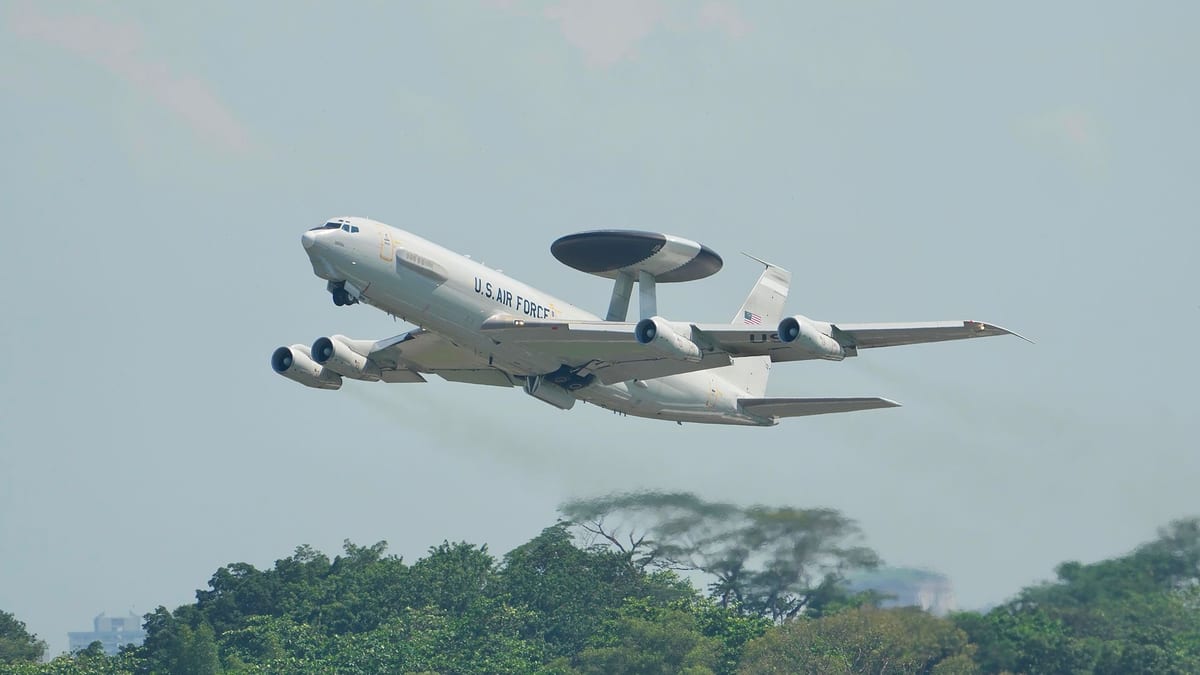
Image by Simple Flying - Aviation News
High-Value Command Plane Hit in Precision Strike
Publicly available reporting indicates that the strike on Prince Sultan Air Base took place on Friday, March 27, involving a combination of ballistic missiles and drones launched from Iran. Open-source satellite imagery and defense commentary circulating over the weekend point to a direct hit on a US Air Force E-3 Sentry airborne warning and control system aircraft parked on the tarmac.
The E-3, with its distinctive rotating radar dome, serves as a flying radar, command post, and air traffic controller for combat operations. Imagery and published coverage suggest the aircraft’s rotodome and upper fuselage suffered catastrophic damage, raising the likelihood that the airframe is a total loss. The same strike also damaged several US refueling aircraft already reported at the base, compounding the impact on air operations.
Earlier accounts of the attack had focused on wounded US personnel and damage to KC-135 Stratotanker refueling aircraft. Only in subsequent days did more detailed assessments emerge indicating that a rare E-3 Sentry was among the most seriously affected assets. Analysts note that the targeting appeared highly precise, with impact points close to or directly on key sections of parked aircraft.
Initial tallies from open reporting describe at least ten injured US service members at Prince Sultan, some seriously, and millions of dollars in damage to aircraft and ground infrastructure. The incident adds to a growing list of strikes on US-linked facilities in Saudi Arabia, Bahrain, Kuwait, Qatar, and the United Arab Emirates during the current conflict.
Why the E-3 Sentry Matters for US Air Operations
The E-3 Sentry is a cornerstone of US and allied air command and control. Based on a modified Boeing 707 airframe, the aircraft’s large dorsal radar dome houses powerful sensors capable of tracking aircraft and missiles across hundreds of miles, directing fighters, and managing complex air campaigns from a single airborne platform.
Public Air Force inventories show that the fleet has steadily shrunk over the past decade as aircraft age and budgets shift toward newer systems. That decline has made each surviving E-3 particularly valuable, especially those forward-deployed to the Gulf. Defense analysts note that only a small number are typically available in theater at any given time, and losing one in combat or to major battle damage has outsized operational consequences.
Beyond its surveillance role, the E-3 acts as a communications hub, linking aircraft, ground controllers, and naval forces across dispersed battle spaces. Damage to one of these aircraft therefore affects not only radar coverage but also the ability to fuse data and coordinate sorties. During sustained operations over the Gulf and into Iran, such airborne command platforms help manage crowded air corridors, deconflict flights, and rapidly respond to new threats.
Because of their importance and limited numbers, E-3s are normally protected by layers of air and missile defenses, and they usually operate at distance from direct threats. Their presence at forward bases like Prince Sultan, however, necessarily exposes them to the risk of long-range precision strikes aimed at high-value targets.
What the Strike Reveals About Iran’s Evolving Reach
The hit on Prince Sultan Air Base forms part of a broader pattern of Iranian attacks on US-linked infrastructure across the Gulf in recent weeks. Public reporting and think tank analysis describe coordinated salvos of ballistic missiles and armed drones targeting runways, fuel depots, radar stations, and aircraft on the ground from Bahrain to Qatar and the United Arab Emirates.
For Iran, the ability to damage or disable an advanced US airborne command platform on Saudi soil carries significant symbolic and strategic weight. The incident suggests that Iranian forces can combine reconnaissance, targeting, and guidance systems well enough to strike specific, high-value aircraft among a crowded ramp of military hardware.
Some open assessments also highlight a shift in Iranian targeting priorities. Early in the conflict, strikes were concentrated on runways, fuel infrastructure, and air defense sites. Recent salvos, including the attack on Prince Sultan, appear to have focused more directly on command-and-control and support platforms such as refueling tankers and airborne warning aircraft, which are essential to maintaining a persistent US air presence over the Gulf.
Observers note that such attacks do not need to destroy large numbers of front-line fighters to have operational impact. By degrading enablers like tankers and airborne command aircraft, Iran can shorten the reach and duration of US sorties, complicate mission planning, and increase strain on remaining assets that must fly more often and from more distant bases.
Regional Ramifications for US Basing and Travel
The damage at Prince Sultan Air Base comes amid heightened concern about the safety of military hubs that sit close to commercial corridors. While the base itself is closed to civilians, it lies within Saudi Arabia’s central plateau, a region linked to major domestic flight routes and overflight paths connecting the Gulf with Europe, Asia, and Africa.
Aviation observers point out that sustained strikes on key military facilities can have knock-on effects for civil aviation. Missile and drone launches increase air defense activity, and temporary airspace restrictions may be imposed while debris, unexploded ordnance, or damaged infrastructure are assessed. International carriers have already been rerouting or adjusting schedules around parts of the Gulf, with some announcing precautionary changes in response to evolving risk assessments.
Travel industry analysts following developments in the region say that while no major tourist hubs have been directly hit in Saudi Arabia, the perception of heightened risk can affect business travel, stopover traffic, and pilgrimage flows. Travelers transiting the Gulf are being advised by airlines and booking platforms to check for changing schedules, routing updates, and any government advisories before departure.
For now, publicly available information suggests that commercial airports across Saudi Arabia and neighboring states remain operational, though authorities and operators are closely watching the security environment. The high-profile damage to a sophisticated US “eye in the sky” aircraft at Prince Sultan underscores how closely intertwined military and civilian airspace have become in the modern Gulf, and how quickly a regional conflict can reshape flight patterns and traveler confidence.
Strain on US Forces and Future Posture in the Gulf
The apparent loss of an E-3 Sentry adds to a mounting bill for US forces in the region. Open-source estimates and media analysis in recent days suggest that Iranian strikes on bases used by the United States have caused substantial damage to aircraft, hangars, radars, and communications infrastructure, with costs measured in the hundreds of millions of dollars.
To compensate for damaged airfields and exposed infrastructure, reports indicate that US commanders have dispersed assets across a wider network of bases, including more remote facilities and temporary operating locations. This dispersal improves survivability against concentrated salvos but can reduce efficiency, increase transit times, and strain maintenance and logistics crews.
Defense commentators are already debating whether the strike on the E-3 will accelerate previously discussed plans to modernize or replace the aging Sentry fleet with newer surveillance and command platforms. Some analysts suggest that the vulnerability demonstrated at Prince Sultan could push the Pentagon toward more distributed systems, including a mix of smaller manned aircraft and advanced drones, rather than relying on a handful of large, conspicuous command planes.
For the wider region and the global travel market that relies on its air corridors, the episode reinforces a broader reality: long-range precision weapons have brought once-distant conflicts uncomfortably close to major transit routes and expatriate hubs. As the confrontation between Iran and US forces evolves, both military planners and civilian travelers will be watching closely to see whether bases like Prince Sultan remain viable anchors of the US presence in the Gulf, or whether risk and cost force a more fundamental reshaping of the regional footprint.