

More news on this day
Ronald Reagan Washington National Airport in Washington, D.C. has switched off its paper-based flight strip system and gone fully digital in the control tower, marking a high-profile milestone in the United States’ long-running effort to modernize air traffic control technology.
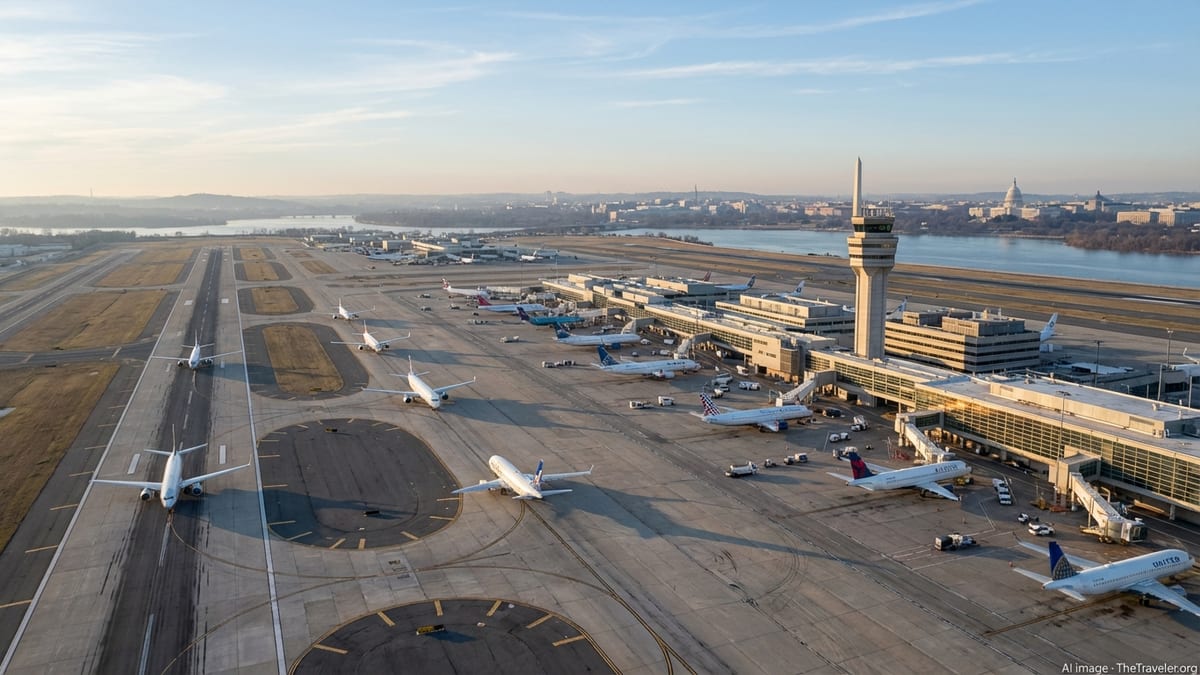
A Quiet Revolution in the Reagan National Tower
The Federal Aviation Administration has activated a new digital flight strip and surface management platform at Reagan National, replacing the narrow paper strips that have been a defining feature of tower operations for decades. The rollout, completed in February 2026, turns one of the country’s most scrutinized airfields into a showcase for how the agency hopes to manage aircraft more efficiently on the ground and in the immediate airspace around the airport.
The technology forms part of the FAA’s Terminal Flight Data Manager program, a tower based system developed with contractor Leidos. Instead of controllers writing clearances and route changes by hand on paper and sliding plastic strip holders across consoles, they now work from shared electronic displays that update in real time. The shift changes the rhythm inside the tower, trading the clatter of printers for glowing screens that mirror the same operational picture across multiple positions.
Transportation Secretary Sean Duffy visited the Reagan National tower in recent days to highlight the change, holding up retired paper strips as a symbol of how analog the system has remained even as airlines and passengers embraced digital tools. For many viewers, the demonstration served as a reminder that some of the most critical decisions in aviation have still relied on pen, paper, and physical choreography until now.
From Paper Strips to Predictive Data
For generations of controllers, the paper flight strip was the heartbeat of the tower. Each slip carried an aircraft’s call sign, route, altitude, and departure or arrival information, then evolved as the controller annotated taxi instructions, runway assignments, and any changes along the way. Arranged in racks and bays, the strips created a living wall of traffic that could be understood at a glance by anyone stepping into the cab.
The new system replicates that situational overview digitally, while adding layers of information that paper simply could not carry. Controllers at Reagan National now see synchronized flight data, updated automatically as airlines file plans, push back from gates, or encounter delays. A shared surface display ties that data to aircraft positions on taxiways and runways, giving both tower and ground controllers a real time map of movements across the airport.
Predictive modeling tools sit on top of this live picture, helping anticipate congestion points before they develop. Instead of reacting to a lineup of jets that suddenly appear on the same taxiway, controllers can see projected demand and make small adjustments earlier, spacing out departures or rerouting aircraft onto alternative paths. The goal is to preserve the intuitive feel of strip handling while using automation to remove blind spots and reduce manual data entry.
Leidos, which designed the Terminal Flight Data Manager platform, says the implementation at Reagan National reached operational status roughly 45 percent faster than the typical 18 month deployment cycle for comparable systems. That accelerated schedule is significant inside an aviation sector where large technology overhauls have often taken years longer than expected.
A Testbed in One of America’s Tightest Airspaces
Reagan National occupies a uniquely sensitive location on the Potomac River, just a few miles from the White House and the U.S. Capitol. Flights operate inside the Washington Special Flight Rules Area, one of the most tightly controlled pieces of airspace in the country, with strict routing and security requirements for every arrival and departure. Runways are relatively short, the airfield is hemmed in by riverbanks and urban development, and traffic must be carefully sequenced with operations at nearby Dulles and Baltimore airports.
Those constraints have long made the airport both a logistical challenge and a bellwether for air traffic procedures. Any disruption can ripple quickly into delays across the Northeast corridor, while even routine operations demand high levels of coordination between the tower, the regional Potomac Consolidated TRACON facility, airlines, and airport operations teams. Digital flight strips are intended to ease some of that burden by giving all stakeholders a more consistent and transparent view of what is happening minute by minute.
Within the tower, the system reduces the risk of misheard radio calls or miscopied clearances, two of the human factors that historically contributed to runway incursions and ground conflicts. When a controller updates a departure time, gate change, or runway assignment in the digital strip, that information propagates automatically to the rest of the system instead of relying solely on voice coordination or the physical movement of paper. In a tightly constrained operating environment like Washington, those seconds and small corrections matter.
For travelers, the benefits are likely to appear in the form of fewer ground holds, more predictable taxi times, and smoother flows during peak hours. While weather, national airspace constraints, and airline schedules will still drive much of the overall delay picture, officials argue that the new tools give controllers more flexibility to keep flights moving safely within the margins they can control.
Part of a 12.5 Billion Dollar Modernization Drive
The changes at Reagan National are one highly visible element of a wider push to modernize U.S. air traffic infrastructure, supported by a 12.5 billion dollar allocation under recent federal infrastructure legislation. Much of that funding is aimed at replacing legacy tower and radar room systems that, in some cases, date back to the late twentieth century and have been patched and upgraded piecemeal over time.
Industry executives and controller unions have long criticized this incremental approach, arguing that the FAA has spent the bulk of its facilities and equipment budget keeping aging systems alive instead of moving decisively to newer platforms. The Terminal Flight Data Manager program is meant to break that cycle in the tower environment by establishing a standardized, upgradeable digital foundation that can be rolled out airport by airport.
Reagan National is currently one of a limited group of U.S. airports to bring electronic flight strips into live service, joining a growing list of sites that serve as early adopters. The FAA and Leidos report that 10 airports now have the system online, with a total of about 15 expected to be operating the technology in this early phase. Each deployment feeds lessons back into the program, with adjustments to interface design, training curricula, and integration with airline and airport operations centers.
Officials describe the Reagan milestone as both a proof of concept and a signal of momentum. With a successful conversion at an airport that handles dense traffic under tight constraints, they hope it will be harder to argue that digital tools are unproven or unsuitable for the American system. At the same time, the agency acknowledges that the nationwide modernization effort will require sustained funding and political support well beyond the current budget cycle.
Controllers Welcome Tech but Warn on Staffing Pressures
Behind the optimism about digital tools lies a more sobering conversation about the human side of air traffic control. Many controllers have long advocated for modern systems that reduce repetitive paperwork and cut down on manual coordination, but they also warn that technology alone cannot compensate for staffing shortages, fatigue, and the training demands that come with each new deployment.
Unions representing controllers have raised concerns that modernization projects can temporarily add to workloads as instructors, supervisors, and line controllers balance daily operations with classroom sessions and on the job system familiarization. At Reagan National, the compressed implementation timeline has been hailed as a success, but it also required intensive preparation and coordination to ensure that safety margins remained intact throughout the transition.
Controllers also stress that digital systems change, rather than eliminate, certain types of risk. Relieved of the physical act of moving strips, they must now monitor more of their environment through screens, bringing interface design and alerting logic to the forefront. Ensuring that displays are intuitive, color schemes are accessible, and key information is never buried has become a central topic in training rooms and simulator sessions.
Still, many front line staff describe the end of paper in the Reagan tower as a clear step forward. The ability to see a common, up to date picture with colleagues in other positions and facilities reduces ambiguity and cuts down on repetitive radio calls. Over time, that may help lower stress levels and support retention in a profession that has struggled to keep pace with rising traffic demands.
What the Upgrade Means for Travelers Passing Through D.C.
For passengers moving through Reagan National’s terminals, the transition to digital flight strips will not be as visible as new check in kiosks or biometric security lanes, yet its effects may be just as important. Ground delays at DCA often stem from a delicate choreography of pushbacks, runway crossings, and departure sequencing compressed into a small footprint. Even minor misalignments can lead to aircraft waiting for long stretches with engines idling near the runway.
With the new system, controllers have more precise tools to orchestrate that choreography. Better estimates of when an aircraft will be ready, improved visibility into which taxi routes are congested, and more accurate departure slot management can all contribute to shaving minutes off individual delays. For travelers, that can mean tighter connections that hold instead of breaking and evenings that end at home rather than at an unplanned hotel near the airport.
The upgrade also dovetails with broader digital trends at the airport, where mobile boarding passes, touchless identity checks, and real time security wait estimates are gradually replacing paper and guesswork in the passenger journey. While each system operates in its own domain, together they signal a shift toward more data driven decision making across the airport campus, from curb to cockpit.
Airlines serving Reagan National are watching the rollout closely. More predictable taxi times can help carriers fine tune schedules, reduce fuel burn associated with holding on the ground, and manage crews and aircraft rotations more efficiently. In a competitive and capacity constrained market like Washington, those small gains can translate into meaningful improvements in on time performance metrics.
Setting a Template for the National Airspace System
The introduction of digital flight strips at Reagan National resonates beyond the Potomac. The U.S. National Airspace System is a vast patchwork of towers, radar rooms, and centers, many of which still rely heavily on paper based tools and voice coordination. As more airports adopt electronic systems, the FAA envisions a future in which surface operations, terminal airspace, and en route traffic share richer data in near real time.
In that vision, an aircraft’s journey from gate to cruise altitude and back again would be tracked consistently by digital records that follow it through each facility. Ground delays at one airport could be better communicated to the next, airlines could see more precisely when slots will open for arrivals, and controllers could rely on shared predictive tools instead of individual mental models. Reagan National’s tower, now fully digital, offers one of the earliest working examples of how that integration might look in practice.
The international context underscores the urgency. Aviation authorities in Canada, the United Kingdom, and parts of Europe moved to electronic flight strips years ago, often citing gains in capacity and safety as traffic volumes climbed. The U.S., operating what is widely regarded as the world’s most complex airspace, has been slower to embrace those changes at scale. Bringing a flagship capital city airport into the digital fold is as much a symbolic move as it is a technical one.
For travelers, the milestone may register only as a brief headline. For the people guiding aircraft over the Potomac and into the heart of Washington, it marks a tangible shift in how the sky above the nation’s capital is managed and a sign that the next era of American air traffic control is finally beginning to take shape.