

More news on this day
Nineteen flight cancellations at Washington’s Reagan National Airport on Tuesday triggered disruptions across some of the United States’ busiest air corridors, as airlines scrambled to rebook travelers bound for New York, Boston, Chicago, Atlanta, Houston and other major cities.
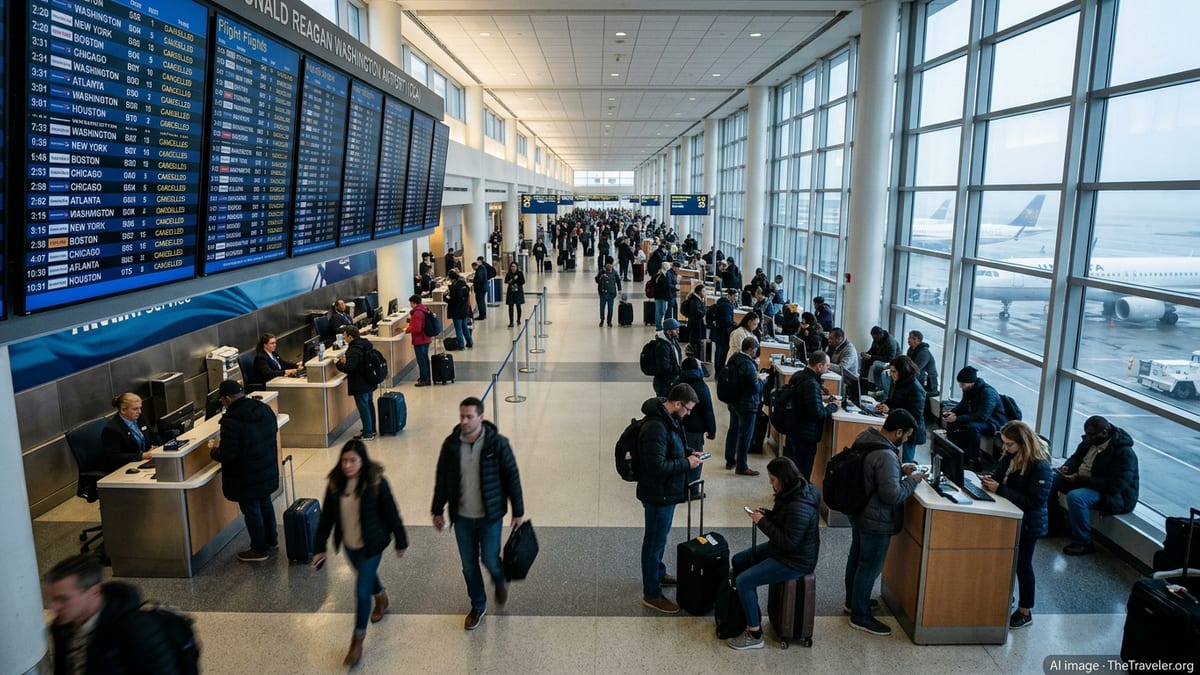
Reagan National Among Hardest Hit in Fresh Wave of Disruptions
Reagan National Airport reported 19 cancellations and more than one hundred delays, placing it among the most affected U.S. airports on Tuesday as poor weather and lingering schedule pressures converged on the Washington region. The cancellations, while a fraction of the day’s national totals, are concentrated on high‑frequency business and political routes that connect the capital with key East Coast and Midwestern hubs.
Operational data from U.S. airport trackers show Reagan National near the top of the nationwide disruption table, alongside New York’s John F. Kennedy, Newark Liberty and Chicago O’Hare, all of which also logged clusters of scrubbed flights and lengthy delays. Miami, Orlando, Anchorage, Honolulu and Fort Lauderdale reported additional disruptions, underscoring the broad geographic reach of the current wave of irregular operations.
At Reagan National, the impact is magnified by the airport’s slot constraints and tightly timed banks of departures, many of them shuttling lawmakers, business travelers and government staff between the capital and other major population centers. When even a small number of those flights drop out of the schedule, it can quickly ripple across the country’s interconnected route network.
According to Federal Aviation Administration status reports, Reagan National was operating under a ground delay program for parts of the morning because of low ceilings and misty conditions, with average delays running more than half an hour and some departures held longer as traffic managers matched arrivals and departures to deteriorating visibility.
Key Business Corridors to New York, Boston and Chicago Affected
The cancellations cut into some of the country’s most heavily traveled short‑haul corridors, including the Washington to New York and Washington to Boston routes that are popular with corporate travelers and commuters shuttling between financial, legal and policy hubs. Flights to and from Chicago, a critical Midwestern connection point for both domestic and international itineraries, also featured among Tuesday’s cancellations and extended delays.
Airlines serving these markets typically operate multiple daily frequencies using a mix of narrow‑body jets and regional aircraft. While that density gives carriers flexibility to rebook passengers, it also means aircraft rotations are closely choreographed. A missed departure from Washington early in the day can lead to a missing aircraft at another airport later in the afternoon, creating knock‑on disruptions far from the original problem.
Travel industry analysts noted that even when capacity reductions are relatively modest on paper, the specific routes hit can define how disruptive an event feels to travelers. The Washington to New York shuttle, for example, is a linchpin for same‑day trips and time‑sensitive meetings; losing just a handful of peak‑hour flights can leave customers with fewer viable alternatives and higher load factors on the remaining departures.
Some services between Washington and West Coast gateways routed via Chicago and other central hubs have also been affected, with passengers on multi‑segment journeys forced to rebook entire itineraries as missed connections compound the initial cancellation.
Weather, Tight Staffing and an Already Strained System
Tuesday’s disruptions at Reagan National come against the backdrop of an air travel system that has been under sustained pressure from a combination of winter weather, ongoing air traffic control staffing challenges and airlines operating near peak utilization of aircraft and crews. The airport’s location along the Potomac River, with tightly controlled airspace and short runways, leaves it particularly sensitive to low clouds and reduced visibility, conditions that were present through the morning.
While the FAA cited low ceilings and drizzle in its latest advisories for Reagan National, industry observers say weather is only part of the story. When staffing levels at control facilities and airline crew bases are already stretched, any slowdown in traffic flow or extended ground delay program can push schedules beyond their margins, forcing carriers to proactively cancel flights rather than risk further cascading delays.
The current disruptions also follow a series of broader national events in recent seasons, from large‑scale winter storms to technology outages and temporary ground stops tied to controller shortages. Each episode has prompted renewed scrutiny of the resilience of the U.S. air travel system, particularly at slot‑controlled airports such as Reagan National where options to add backup flights are limited.
Airlines operating at the Washington airport have in recent months adjusted schedules, consolidated some marginal off‑peak departures and added buffer time into critical banks. However, those measures can only partially blunt the impact when multiple constraints converge, as they did on Tuesday with low clouds, wet runways and a busy early‑March travel day.
Passengers Face Missed Meetings, Tight Connections and Limited Options
For travelers caught up in the 19 cancellations and scores of delays at Reagan National, the consequences ranged from missed morning meetings in New York and Boston to disrupted family trips connecting through Chicago, Atlanta and Houston. Long queues formed at airline customer service counters and gate podiums as passengers sought rebooking options and updated information on their itineraries.
With many of the canceled flights operating on trunk routes that already run near full, same‑day rebooking proved difficult for some customers. Airlines offered a mix of automatic rebooking onto later departures, rerouting through other hubs such as Washington Dulles or Charlotte, and in some cases, travel vouchers or fee‑free changes for those willing to shift plans by a day or more.
Travel advisors urged passengers departing Washington to check flight status repeatedly on airline apps before leaving for the airport and to consider carrying on bags when possible, reducing the risk of being separated from luggage during last‑minute reroutes. For those facing long delays in the terminal, they recommended monitoring seat availability on nearby departures and asking gate agents about standby options even when official rebooking windows appeared tight.
Consumer advocates also reminded passengers that, under U.S. regulations, those whose flights are canceled and who choose not to travel are entitled to a refund rather than only a travel credit, regardless of whether their original ticket was labeled nonrefundable.
Broader Impact Across the U.S. Network
Although the most visible effects on Tuesday were at Reagan National and a handful of other major hubs, the disruption radiated across the wider U.S. network. New York’s JFK and Newark, Chicago O’Hare, Miami, Orlando, Anchorage, Honolulu and Fort Lauderdale all reported clusters of cancellations and a significantly higher volume of delayed arrivals and departures than on a typical early March weekday.
Because large hub airports serve as connective tissue for domestic and international traffic, a canceled Washington departure to Chicago or Houston can lead to empty seats or displaced passengers on flights leaving those hubs for smaller communities and overseas destinations later in the day. Regional airports that rely on a small number of daily connections to big hubs are especially vulnerable to such knock‑on effects.
Airline planners expect some residual disruption to continue into the evening as aircraft and crews reposition and as Reagan National gradually works through its backlog of delayed flights. However, with the weather picture expected to improve into the night, carriers are optimistic that schedules can be normalized before the Wednesday morning rush.
For now, travel experts advise anyone flying into or out of the Washington area to build extra time into connections, remain flexible with routing options and be prepared for last‑minute changes as airlines manage one of the capital’s most challenging operational days so far this year.