

More news on this day
Ronald Reagan Washington National Airport faced a fresh round of disruption today, with 68 flight interruptions testing American Airlines’ busy hub operation and complicating travel plans across the East Coast.
Get the latest news straight to your inbox!
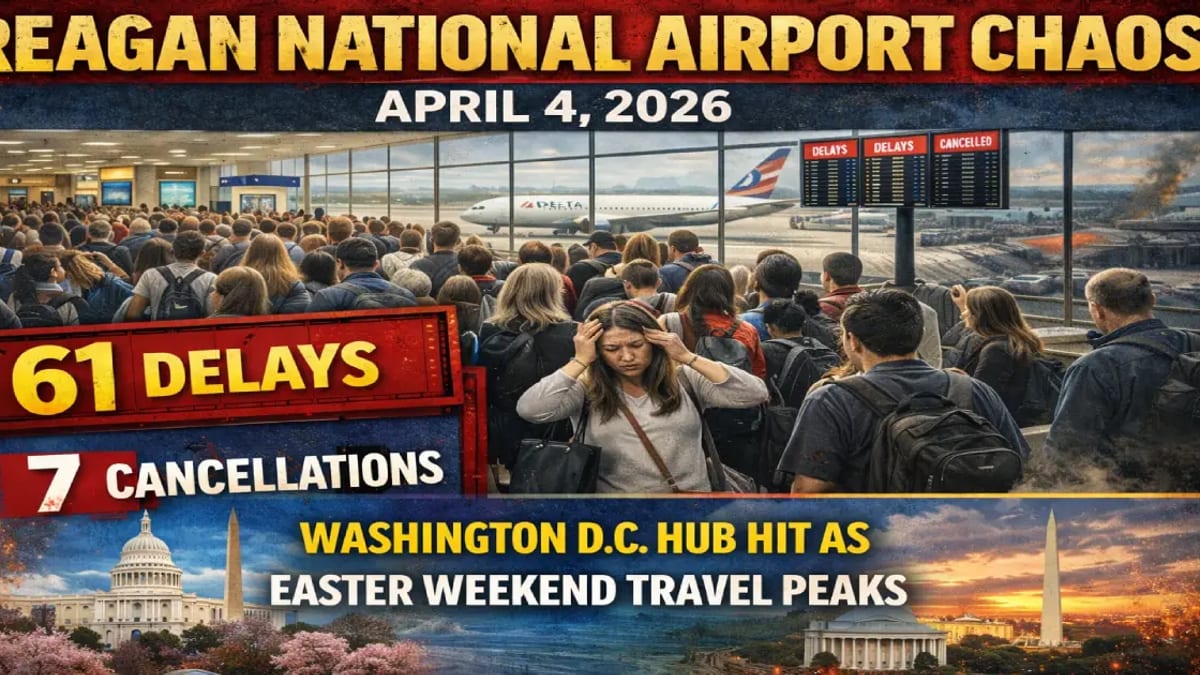
Spike in Delays at a Congested Washington Gateway
Publicly available tracking data and aviation coverage indicate that Reagan National has logged dozens of delays and a handful of cancellations today, contributing to what reports describe as nearly one hundred disrupted movements at the airport. Reagan National serves as a crucial node for domestic business and political travel, and even a relatively modest uptick in late departures can quickly translate into missed connections and crowding throughout the terminal.
Recent reporting on early April disruptions shows that Reagan National is among a group of high volume airports that account for a disproportionate share of U.S. delay minutes in a typical year. Observers note that intense schedule density in the constrained Potomac River corridor leaves little slack when adverse weather or airspace constraints emerge during peak hours. When these factors converge, punctuality at Reagan National can deteriorate quickly, as seen in today’s wave of interruptions affecting roughly 68 flights.
Today’s disruptions also arrive against the backdrop of a broader period of unstable spring operations across the national air network. Aviation trackers have highlighted several hundred cancellations and thousands of delays across the United States in recent days, with Easter and early April travel volumes pushing airlines and airports close to capacity. In that environment, localized problems at Reagan National can more easily snowball into regional knock-on effects.
Operational summaries and flight boards at Reagan National reflect these strains, with rolling delays on short haul routes to major East Coast and Midwest cities. Travelers connecting through Washington are encountering longer than usual dwell times on the ground, even when flights ultimately depart.
American Airlines Hub Under Pressure
American Airlines operates a high frequency schedule at Reagan National, using the airport as a key hub for routes up and down the East Coast and into the Midwest. Today’s 68 disruptions are disproportionately concentrated among American and its regional partners, according to aggregated trackers and recent news coverage focused on the carrier’s spring performance. That pattern mirrors broader national data in which American has featured prominently in recent waves of delay activity.
Industry analysis of American’s network suggests that its hub and spoke structure amplifies the impact of any local disruption. A late arriving aircraft into Reagan National can cascade into multiple subsequent delays on outbound sectors, particularly where tight turn times and limited spare aircraft are built into the schedule. When several such events occur simultaneously, the result is a cluster of delayed flights that can be difficult to unwind over the course of a single operating day.
Published reports on recent holiday and weekend travel periods indicate that American’s hubs at Dallas Fort Worth and Chicago O’Hare have already experienced substantial disruption this month. Delays and cancellations at those airports have rippled into Reagan National, especially on connecting itineraries, contributing to the congestion now visible on Washington routes. Today’s numbers at Reagan therefore appear to be part of a wider pattern of strain across the airline’s network.
At the same time, publicly available policy summaries underscore that American, like other large U.S. carriers, relies on a mix of schedule thinning, rolling rebookings and selective cancellations to manage operational stress. In practice, this means some Reagan National passengers are seeing flights retimed by increments of 30 to 90 minutes, while others are being moved to later services when crew duty limits or air traffic restrictions leave no alternative.
Ripple Effects Across the East Coast and Midwest
The disruption at Reagan National is reverberating across several key domestic corridors. Reports from aviation tracking platforms and regional media outlets show that delays on departures from Washington are affecting arrivals in cities such as Boston, New York, Chicago and Atlanta, where late inbound flights can compress already busy bank structures at other hubs.
These ripple effects are particularly visible on short haul routes, where aircraft cycle through multiple legs in a single day. A morning delay out of Reagan National can compound through successive rotations, turning a minor schedule slip into a significant late arrival by evening. This dynamic is consistent with recent analyses of national delay patterns, which note that airports such as Reagan National often act as intermediaries between larger coastal and interior hubs, spreading disruption beyond the local area.
Travelers on connecting itineraries are feeling the impact most acutely. When Washington bound flights arrive late into Reagan National, onward departures to secondary markets in the Southeast and Mid Atlantic may not be able to wait for all inbound passengers, particularly in tightly regulated airspace with slot and noise restrictions. As a result, some travelers are being rebooked through alternative hubs or routed onto later same day services.
Regional operations operated under the American Eagle banner are also caught in this web of delays. Aviation coverage in recent months has highlighted the vulnerability of smaller markets that rely heavily on regional jets feeding into hubs like Reagan National. Today’s 68 disruptions underscore how quickly service to those communities can be affected when a hub experiences even moderate operational volatility.
Weather, Airspace Constraints and Infrastructure Limits
While no single cause fully explains the disruptions at Reagan National today, published coverage of recent days points to a familiar combination of contributing factors. Spring weather systems in the Mid Atlantic and Midwest have triggered ground delay programs at multiple airports, while lingering thunderstorms and low clouds reduce the rate at which controllers can safely move aircraft along the Potomac approach paths into Washington.
Reagan National’s physical constraints also play a central role. The airport is hemmed in by river, urban development and federal security restrictions, limiting both runway expansion and flexibility in arrival and departure routes. Federal notices and planning documents issued in recent years have acknowledged that capacity management measures at Reagan, including periodic construction and airspace adjustments, can temporarily increase congestion and delay risk.
In addition, national coverage of aviation operations has repeatedly identified air traffic control staffing shortfalls as a structural challenge, particularly in high complexity airspace such as the Washington region. When staffing is tight at area approach facilities, controllers may be required to space aircraft farther apart or sequence arrivals more conservatively, reducing throughput at exactly the times when demand is highest.
These limits intersect directly with American’s hub strategy. High utilization of gates and tight turn schedules at Reagan National leave limited margin when weather or airspace constraints reduce capacity below forecast levels. Today’s 68 disruptions illustrate how quickly a queue can form when several flights require additional time for arrival, ground handling or departure clearance in rapid succession.
What Travelers Can Expect in the Hours Ahead
Aviation trackers and recent media summaries suggest that recovery from a disruption of this scale at Reagan National can take much of the day, especially when aircraft and crews are tightly scheduled. Even if weather conditions improve and air traffic restrictions ease later in the evening, earlier delays may continue to propagate through remaining departures as crews approach duty limits and aircraft arrive out of sequence.
Travel advocates and consumer guidance materials recommend that passengers monitor their flight status frequently on days when disruption levels are elevated. At Reagan National today, travelers on American Airlines and its regional partners are likely to see a mix of gate changes, rolling delay estimates and, in some cases, same day rebookings as the carrier adapts its schedule to available crews and aircraft.
Publicly available information also emphasizes the importance of understanding airline policies and federal rules when disruptions occur. U.S. regulations require cash refunds when a flight is canceled and the traveler chooses not to fly, while individual airline contracts detail what assistance may be offered during long delays that are within a carrier’s control. For many passengers at Reagan National today, these distinctions will shape whether disrupted journeys result primarily in inconvenience or in additional out of pocket expense.
For the broader network, the performance of Reagan National over the next several hours will help determine how quickly East Coast and Midwest schedules return closer to normal. With 68 disrupted flights already logged and American’s hub under visible strain, the airport’s ability to clear departure backlogs and absorb late inbound aircraft will remain a critical test of resilience during this latest bout of spring travel volatility.