

More news on this day
A historic snow siege across the Northeast has pushed Rhode Island into the record books and left major cities from Boston to New York largely paralyzed, as blizzard conditions, hurricane force gusts and whiteout visibility trigger sweeping travel bans and public safety alerts from Massachusetts and Connecticut to New York, New Jersey and Delaware.
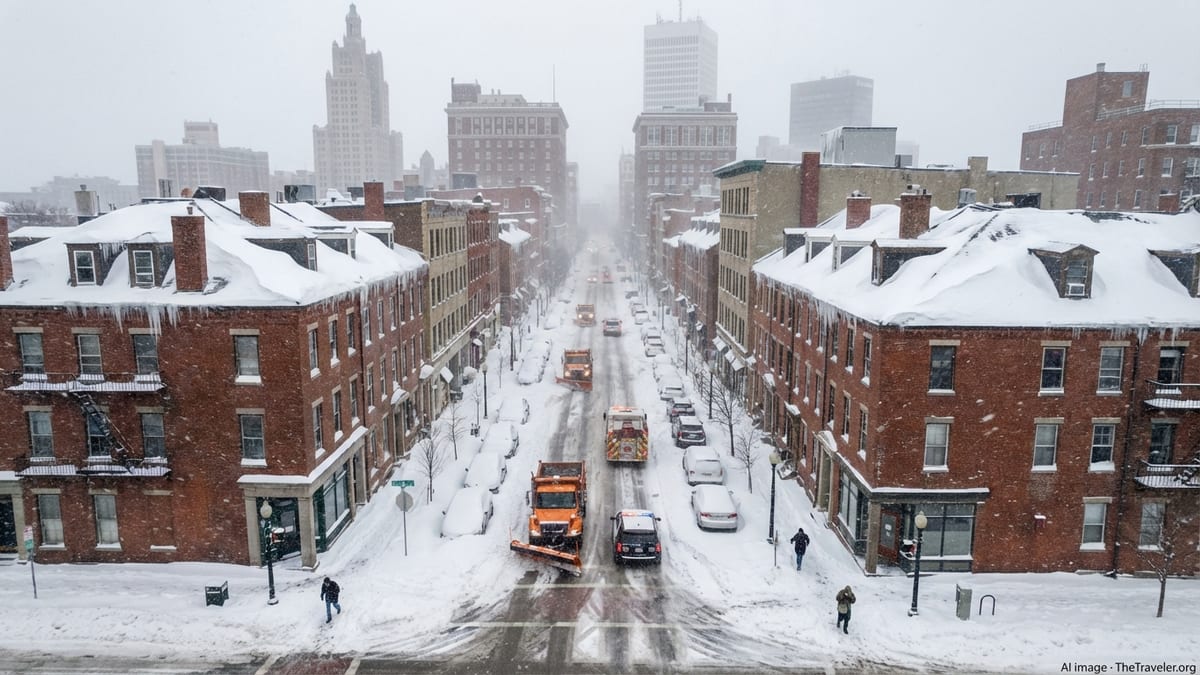
Rhode Island Breaks Snowfall Records as Storm Peaks
Rhode Island emerged as the epicenter of the February 2026 blizzard, with T. F. Green International Airport measuring nearly 38 inches of snow, the highest storm total ever recorded in the state. Providence logged its snowiest single day and snowiest two day stretch on record, surpassing benchmarks set by the legendary blizzards of 1978 and 1996. The sheer volume of heavy, wet snow quickly overwhelmed plow fleets and buried parked cars, sidewalks and neighborhood streets under towering drifts.
State officials responded with one of the most aggressive safety postures in recent memory, imposing a rare statewide ban on nonessential travel as conditions deteriorated into blinding whiteouts. Gusts above 70 miles per hour lashed coastal communities, toppling trees and power lines and creating snowbanks that effectively walled off side streets from main arteries. T. F. Green halted all operations for at least a full day, stranding travelers and closing a key air gateway for southern New England.
In Providence, residents woke to find normally busy arterials transformed into silent corridors of snow, with traffic lights blinking over empty intersections and only the rumble of plows and the wail of emergency sirens breaking the quiet. Pop up warming centers and emergency shelters opened across the city to support residents in older housing and those at risk of losing heat as the storm raked the region.
New England Corridor Locked Down by Bans and Blackouts
Across Massachusetts and Connecticut, the same nor’easter that shattered Rhode Island records delivered a full scale shutdown of normal life. Boston’s Logan International Airport recorded more than a foot of snow and canceled hundreds of flights, while Rhode Island’s totals climbed past three feet and forced airlines to suspend nearly all operations across the eastern seaboard’s busiest corridor. Meteorologists confirmed blizzard conditions from Providence and Boston to coastal Connecticut as snowfall rates reached several inches per hour.
Governors in Massachusetts, Connecticut and Rhode Island declared states of emergency, mobilizing National Guard units and pre positioning utility crews to contend with widespread outages. At the height of the storm, more than half a million customers across New England lost electricity as wet, wind driven snow sheared tree limbs onto lines. Some coastal communities in Massachusetts and Rhode Island reported gusts approaching hurricane strength, with minor to moderate coastal flooding and beach erosion along exposed shorelines.
On the ground, travel restrictions became as notable as the snowfall totals. Massachusetts officials halted nonessential travel in multiple coastal counties and imposed sharply reduced highway speed limits. In Rhode Island, the statewide ban on all noncritical driving effectively turned Interstate 95 and key secondary routes into corridors reserved for plows and emergency vehicles. Local authorities repeatedly warned that stranded cars could block ambulances and fire crews, urging residents to stay home even after the heaviest snow tapered off.
New York, New Jersey and Delaware Grind to a Halt
Southwest of New England, the storm’s broad circulation locked New York, New Jersey and Delaware in its own crippling snow siege. New York City’s five boroughs saw more than a foot and a half of snow in some neighborhoods, with deeper totals in northern suburbs and across Long Island. Plows struggled to keep pace as wind gusts near 50 miles per hour whipped powder back onto newly cleared avenues, repeatedly erasing progress on major travel corridors.
Newark and other New Jersey communities reported more than two feet of snow, with some towns topping 30 inches. The combination of depth and drifting rendered many local roads impassable, prompting mayors and county executives to issue their own travel bans or strict advisories. State officials described near zero visibility on stretches of the New Jersey Turnpike and Garden State Parkway at the height of the storm, while local transit agencies temporarily suspended or sharply curtailed rail and bus service.
In Delaware, bands of heavy snow and gusty winds swept across key north south travel routes, snarling traffic and forcing transportation officials to deploy full plow fleets around the clock. Portions of Interstate 95 through the state saw spinouts and jackknifed trucks as drivers misjudged slick, rutted lanes. Authorities urged motorists to postpone nonessential trips, warning that rapidly changing conditions could strand travelers far from services or assistance.
Air and Rail Networks Suffer Massive Disruptions
The storm’s reach was felt most acutely by travelers as the Northeast’s interconnected air and rail systems ground to a halt. Between Sunday and Monday, airlines canceled thousands of flights across major hubs, with New York’s LaGuardia, John F. Kennedy and Newark Liberty airports among the hardest hit. Schedules at Logan in Boston and T. F. Green in Rhode Island were effectively wiped clean as carriers preemptively suspended operations to protect aircraft and ground crews from whiteout conditions and fierce crosswinds.
By Monday night, cumulative cancellations across the region had climbed into the high thousands, with ripple effects spreading through national and international networks. Passengers bound for Europe, the Caribbean and the West Coast found themselves sleeping on terminal floors or scrambling for scarce hotel rooms as rebooking windows stretched days into the future. Airlines issued broad travel waivers, allowing ticketed customers to change itineraries without fees, but available seats remained limited as carriers prioritized crew repositioning and operational recovery.
Rail and bus systems also felt the full force of the blizzard. Amtrak suspended or curtailed numerous Northeast Corridor trains as drifts covered tracks and blowing snow fouled switches. Regional operators in New Jersey, New York, Connecticut and Massachusetts reduced schedules or shut down entirely during the worst conditions, citing safety concerns for both passengers and workers. For travelers, the result was a patchwork of delays, cancellations and last minute changes that complicated even short distance journeys.
Public Safety Alerts Dominate as Cleanup Begins
As snowfall eased and skies slowly began to brighten, a new phase of the crisis took hold across the affected states: digging out safely. Emergency management agencies in Rhode Island, Massachusetts, New York, New Jersey, Delaware and Connecticut continued to blast out alerts about roof collapses, carbon monoxide risks from improperly vented generators and space heaters, and the dangers of overexertion while shoveling heavy snow. Officials urged residents to check on elderly neighbors and to keep fire hydrants and building exits clear as snow removal moved from highways to residential blocks.
City works crews and private contractors faced the daunting task of hauling away mountains of plowed snow from downtown cores and tourist districts. In Providence, Boston and New York, temporary snow storage lots filled rapidly, sparking debates over where to deposit the next round of truckloads without disrupting neighborhoods or sensitive waterfront areas. The massive cleanup effort promised to last well beyond the storm’s official end, with narrowed streets, icy sidewalks and intermittent transit outages expected to affect daily life and travel plans throughout the week.
Looking ahead, forecasters warned that a trailing disturbance could bring additional snow to a region already straining under the weight of Winter Storm Hernando’s output. For travelers and residents alike, the message from officials across Rhode Island, Massachusetts, New York, New Jersey, Delaware and Connecticut remained consistent: expect prolonged disruptions, avoid unnecessary journeys, and give plow crews and emergency workers the space and time they need to restore the Northeast’s critical arteries.