

More news on this day
Florida’s famed white-sand beaches are confronting an early and intense surge of foul-smelling sargassum seaweed in 2026, forcing emergency cleanups, deterring visitors and sharpening concerns about how the state’s tourism engine will cope with a problem scientists say is becoming both larger and more unpredictable.
Get the latest news straight to your inbox!
Record-Breaking Bloom Puts Florida on the Front Line
Satellite monitoring from the University of South Florida and federal partners shows the Great Atlantic Sargassum Belt swelling to record levels for this time of year, with more than 10 million metric tons estimated across the tropical Atlantic in February 2026. Preliminary outlooks indicate that the belt is forming earlier and at higher density than in previous years, increasing the likelihood of heavy landings along parts of the Florida coast in the months ahead.
Experts caution that not every Florida beach will be hit equally, but the pattern is clear. The latest bulletins flag the Florida Keys as the first likely trouble spot in late March, followed by higher risks for Miami-Dade and Broward beaches in April and May as winds and currents push the floating mats toward shore. Local tourism boards, already in peak spring marketing mode, are racing to update messaging while avoiding panic among would-be visitors.
While some pockets of the coast, including stretches of the Panhandle and parts of the Treasure Coast, remain relatively clear for now, coastal managers say they are planning for “on-off” episodes of heavy landings through summer. That stop-start pattern makes staffing, budgeting and visitor communication significantly harder than during a single, short-lived event.
Tourism Hotspots Grapple With Mounting Cleanup Costs
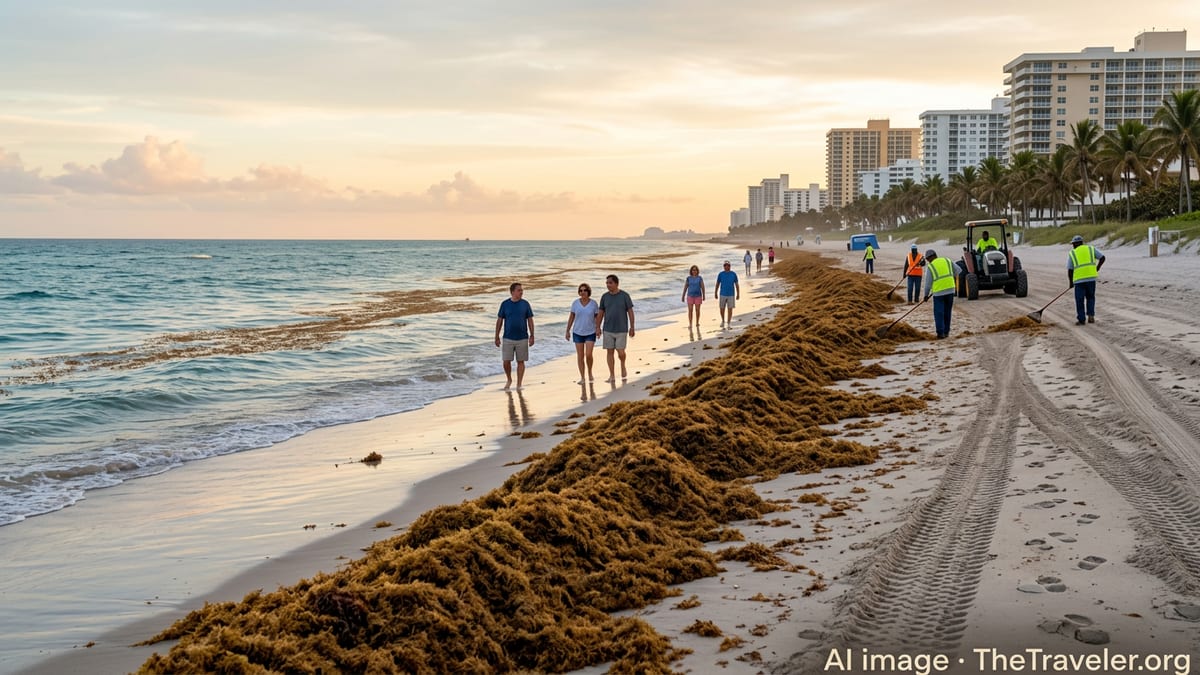
From the Keys to greater Miami and up the Gold Coast, local governments and hotel operators are ramping up cleanup operations as the early season surge begins to wash ashore. Mechanical rakes and front-end loaders work at daybreak to clear thick brown windrows before beachgoers arrive, but many communities report that fresh mats can reappear within hours, especially after windy nights.
Municipalities in Monroe, Miami-Dade and Broward counties describe a familiar but intensifying squeeze. Sargassum removal is considered a local responsibility, and budgets set months ago did not anticipate the scale suggested by 2026 forecasts. Tourism development councils warn that line items for beach grooming, already running into the millions of dollars in recent heavy-sargassum years, could climb significantly if current trends hold into summer.
Hotel managers say they are torn between absorbing higher costs or passing them on to guests. Some oceanfront properties have brought in additional staff and equipment to maintain “clean corridor” access to the water, while others are experimenting with containment booms offshore to deflect incoming mats. Smaller, family-run inns in the Keys and on less developed stretches of coast have fewer options, heightening concerns about an uneven economic hit.
Visitor Experience Tarnished as Resorts Race to Reassure
For travelers arriving this spring, the experience along affected beaches can be jarring. Instead of clear turquoise water and powdery sand, visitors may find knee-high ridges of drying seaweed at the high-tide line, with a sharp odor as the vegetation decomposes. While sargassum itself is not toxic, rotting piles can harbor insects and release gases that irritate some people with respiratory sensitivities, prompting occasional advisories from local health officials.
Tour operators report a rise in last-minute questions about beach conditions, particularly from international visitors who remember headlines about “seaweed invasions” in previous years but may not grasp how localized the problem can be. Some resorts are responding with real-time beach photos in marketing emails, dedicated seaweed FAQs on their booking pages and staff trained to suggest alternative activities when conditions deteriorate.
Coastal communities are also working to protect their broader brand. Destination marketers in the Keys and South Florida emphasize that even during heavy sargassum events, nearby bayside beaches, pools, marinas and inland attractions remain unaffected. Cruise lines calling at South Florida ports are adjusting shore excursion descriptions to highlight options less dependent on wave-exposed beaches, such as snorkeling from boats beyond the seaweed line, eco-tours in mangrove channels and visits to cultural districts.
Science Points to a New Normal in the Atlantic
Behind the immediate disruption lies a deeper shift in the Atlantic. Research teams using long-term satellite data and ocean sampling have documented the emergence, since 2011, of a persistent Great Atlantic Sargassum Belt stretching from the west coast of Africa across the tropical Atlantic into the Caribbean Sea and Gulf of Mexico. In recent years the belt has repeatedly reached record size, and scientists say the 2025 and early 2026 blooms continue that pattern.
The drivers are complex but increasingly well understood. Nutrient-rich runoff from major rivers, including the Amazon and Orinoco, changes in ocean circulation linked to climate variability, and warming surface waters all appear to be fueling larger and more frequent blooms. Studies released in late 2025 suggest that while traditional sargassum habitats such as the Sargasso Sea may be in decline, newer “southern” source regions are feeding the belt that now threatens Caribbean and Florida shorelines.
Forecasting landfalls at specific beaches weeks or months ahead remains difficult, but scientists note rapid progress. New models are blending ocean current simulations with satellite imagery and machine learning to provide more granular seasonal outlooks. Public-facing tools, including interactive maps showing recent landings, are increasingly used by coastal residents, visitors and tourism businesses to plan around the worst arrivals.
Communities Test Long-Term Strategies as Pressure Builds
As the 2026 season unfolds, Florida communities are debating how to move beyond reactive cleanups. Environmental managers warn that simply removing sargassum from beaches and dumping it inland or at sea is costly and can create new problems. Some pilot projects are exploring ways to compost or process seaweed for use in agriculture and construction materials, though regulatory, odor and contamination challenges remain significant at scale.
State and local officials are also reexamining beach management rules that were originally written with erosion and hurricane recovery in mind. Questions now include how often heavy machinery should be allowed on the sand without harming nesting sea turtles and dune vegetation, and whether dedicated funding streams are needed to support sargassum response in the same way Florida treats red tide and hurricane cleanups.
For the tourism sector, the latest seaweed surges are reinforcing a hard reality. Florida’s beach economy, central to millions of jobs and billions of dollars in visitor spending, is increasingly exposed to a form of climate-linked disruption that does not fit neatly into traditional disaster categories. Hoteliers, destination marketers and local leaders say that adapting to that new normal will require better forecasting, flexible operations and frank communication with travelers who may find their dream beach holiday shaped as much by drifting seaweed as by sun and surf.