

More news on this day
As U.S. air travel surges to unprecedented levels, a coast-to-coast web of high-volume flight corridors linking North Carolina, Florida, Nevada, California, Illinois, Georgia, Colorado and Texas is transforming how and when Americans move through the skies, creating both new opportunities and new pressure points for anyone trying to beat the crowds.
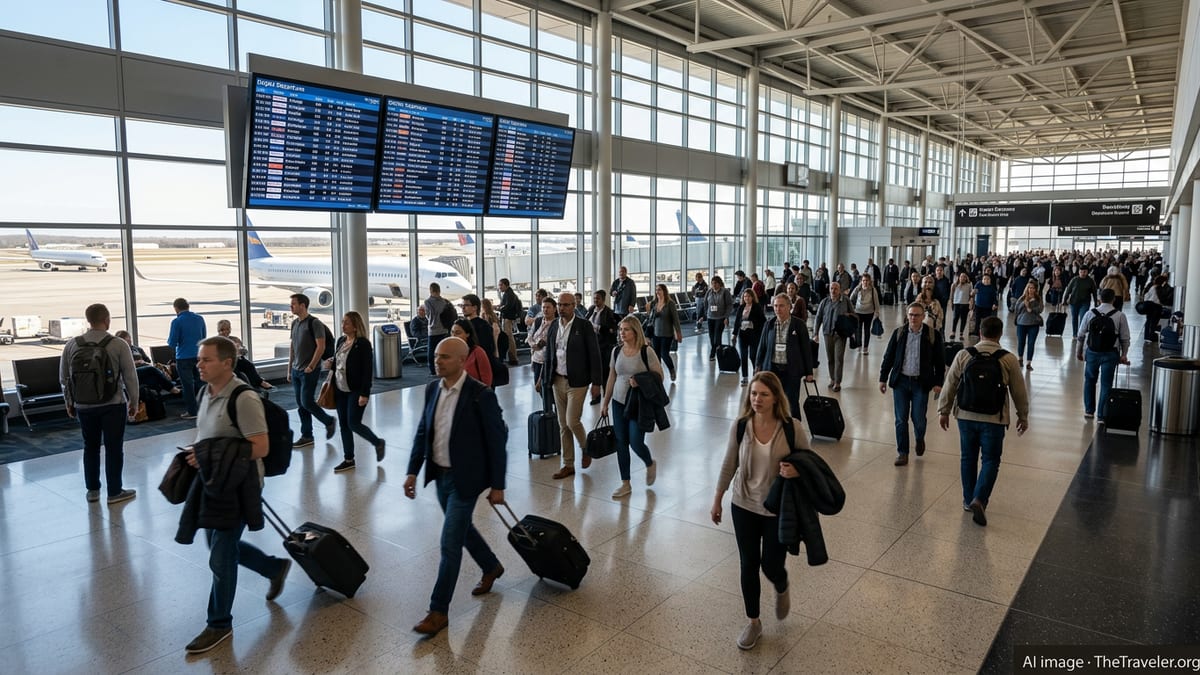
Record-Breaking Volumes Reshape the U.S. Flight Map
Aviation data and federal screening figures show that the United States is in the middle of a historic demand spike, with the Transportation Security Administration repeatedly breaking its single-day screening record since mid-2024 and again around peak holidays in 2025. Thanksgiving weekend 2025 set a new all-time high for passengers processed in a single day, underscoring how sustained the surge has become rather than a one-off rebound.
That wave of demand is concentrated in a lattice of hub and “super-connector” airports stretching from the Southeast to the Mountain West and Pacific Coast. North Carolina’s rapidly expanding Raleigh–Durham International Airport sits on key corridors to Florida, Texas, Illinois, Colorado, Nevada and California, while legacy mega-hubs in Atlanta, Dallas–Fort Worth, Denver and Chicago continue to push capacity higher. Together, they form a network that is carrying more people, more frequently, than at any point in U.S. aviation history.
The ripple effects are visible beyond the largest coastal gateways. Secondary and regional airports in Colorado, Texas and the Carolinas have reported their strongest passenger tallies in decades as airlines funnel travelers onto connecting banks that crisscross these eight states. For travelers, that means fuller flights, tighter connections and crowded terminals, even at airports that once offered a quieter alternative to major hubs.
North Carolina’s Ascendance as a National Connector
North Carolina has emerged as a pivotal link in this record-setting network, with Raleigh–Durham International Airport recording back-to-back passenger records and expanding its roster of nonstop domestic and international routes. Airport officials have approved terminal expansion plans and are investing in gate and security capacity as traffic climbs into the mid-teens of millions of passengers per year.
At the same time, Charlotte, already one of the nation’s busiest connecting hubs, continues to channel flows between the Northeast, Midwest, Florida and the booming Sun Belt markets of Texas and Georgia. The result is a state that punches well above its weight in national aviation, providing one-stop access from secondary cities in the Midwest and Mid-Atlantic to leisure hot spots in Nevada and California and to business centers in Colorado and Texas.
For travelers, North Carolina’s rise brings both convenience and congestion. More nonstop options to destinations like Las Vegas, Denver, Dallas and major Florida airports mean fewer long-haul drives to distant hubs, but they also mean morning and late afternoon waves where security queues and boarding areas swell. Savvy flyers increasingly treat Raleigh–Durham and Charlotte with the same crowd-avoidance strategies they once reserved only for New York or Atlanta.
Sun Belt Gateways Lead the Surge
Nowhere is the travel boom more visible than in the Sun Belt, where Florida, Georgia and Texas each host multiple high-volume airports that handle enormous flows of domestic and international passengers. Atlanta’s Hartsfield–Jackson has retained its title as the world’s busiest passenger airport by scheduled capacity, and it anchors an intricate web of routes north into the Carolinas and Midwest and west into Colorado, Nevada and California.
Florida’s major gateways, from Miami and Orlando to Tampa and Fort Lauderdale, report robust leisure demand and heavy holiday surges, driven by theme parks, cruise traffic and year-round warm weather. Texas airports in Dallas–Fort Worth, Houston, Austin and San Antonio have simultaneously grown into crucial transfer points on east–west and north–south itineraries, soaking up demand that might previously have routed through coastal hubs.
These routes intersect heavily with flights to and from Nevada and California, where Las Vegas, Los Angeles and other airports are handling some of the country’s densest leisure and convention traffic. As airlines add more point-to-point services such as Dallas to Las Vegas or Orlando to Denver, they reinforce a Sun Belt axis that keeps planes full and terminals busy in every season.
Mountain and Midwest Hubs Feel the Pressure
Colorado and Illinois, anchored by Denver and Chicago, function as central spines in the national air system, and both have seen volumes climb alongside the broader surge. Denver has grown into one of the busiest airports in the world by departures and connections, serving as a stepping-stone from East Coast and Southern cities like Charlotte, Atlanta and Dallas to West Coast destinations in California and beyond.
Chicago’s O’Hare and Midway airports, meanwhile, remain vital for flows between North Carolina, Georgia, Texas and western states. Record traffic through the broader Midwest is bolstered by a mix of business travel, connecting passengers bound for the coasts and a steady rise in domestic tourism to mountain and national park destinations accessible via Denver and regional Colorado airports.
This centralization creates significant pinch points. Weather disruptions in Colorado or Illinois can cascade quickly across the map, stranding passengers in Sun Belt and coastal airports that are already operating near maximum capacity. Travelers routing through these hubs report fuller gate areas at almost all hours and more frequent calls for volunteers to accept travel credits in exchange for giving up oversold seats.
How to Beat the Crowds in an Era of Permanent Peak
With record travel days now arriving regularly rather than rarely, industry analysts increasingly describe the United States as entering an era of “permanent peak” for air traffic. Federal officials have even taken the step of temporarily ordering flight reductions at dozens of high-volume airports during periods of strain to protect safety, a sign of how tight the system has become at the busiest hubs.
Beating the crowds in this environment starts with timing. Data from ticketing platforms and airport authorities consistently show that very early morning departures tend to face shorter security lines and fewer delays, while mid-morning to early evening banks are thick with connections from across the country. Flying on Tuesdays or Wednesdays, avoiding the Friday outbound and Sunday return pattern, still gives travelers a measurable edge.
Routing choices matter almost as much as timing. When possible, selecting itineraries that connect through less strained secondary hubs, even at the cost of a slightly longer journey, can reduce the risk of missed connections and hours spent in packed gate areas. Travelers departing from states like North Carolina, Colorado or Texas often have the option of choosing between multiple hubs; favoring the one with a reputation for operational resilience and more spacious terminals can pay dividends during peak periods.
Finally, preparation has become an essential crowd-beating tool rather than a convenience. Enrolling in trusted traveler programs that offer expedited screening, checking in as early as airline systems allow, traveling with carry-on luggage only when feasible and building longer connection times into complex itineraries all help travelers navigate the new reality of record-breaking passenger volumes across America’s busiest flight corridors.