

More news on this day
Greece is entering April under mounting travel disruption as a rare combination of red-sky Saharan dust storms, the powerful weather system Erminio and wider regional airspace upheaval converge to cancel flights, strand visitors and cast uncertainty over the country’s crucial early tourism season.
Get the latest news straight to your inbox!
Storm Erminio Turns Greek Skies Apocalyptic
The most dramatic scenes have unfolded over Crete and parts of southern Greece, where a dense Saharan dust cloud driven by the storm system known as Erminio transformed the sky into an intense orange-red on April 1. Publicly available meteorological analyses describe the event as an exceptionally strong dust advection from North Africa, funnelled across the eastern Mediterranean and concentrated over Crete.
Images and videos shared across social platforms from cities such as Heraklion and Rethymno show streets, vehicles and buildings coated in fine dust while the sun appears as a dim red disc behind a thick, ochre haze. Local outlets report that visibility plunged to levels rarely seen outside severe wildfire smoke or heavy fog, with air quality indices spiking into unhealthy territory for much of the afternoon and evening.
Saharan dust intrusions are a recurring feature of Greek spring weather, but this episode is being described in domestic coverage as one of the most intense in recent years in terms of both concentration and visual impact. For many arriving visitors, especially those heading to Crete for early-season holidays, the timing has been unsettling: a Mediterranean island better known for bright blue skies framed instead by what some observers have compared to a cinematic post-disaster backdrop.
The dust load has practical implications beyond the surreal skyline. Fine particulate matter infiltrates buildings, irritates respiratory conditions and reduces visibility for road and air transport, compounding risks already heightened by the associated high winds and unstable weather patterns linked to Erminio.
Flight Cancellations Cascade Across Greek Airports
At ground level, the combined effects of storm Erminio, chronic winter-season weather volatility and regional airspace disruption are translating into mass flight cancellations and delays. Greek and international aviation tracking data point to thousands of cancellations affecting routes into and within Greece since late January, beginning with a radio communication failure that temporarily grounded flights nationwide and continuing through a series of severe windstorms and dust events.
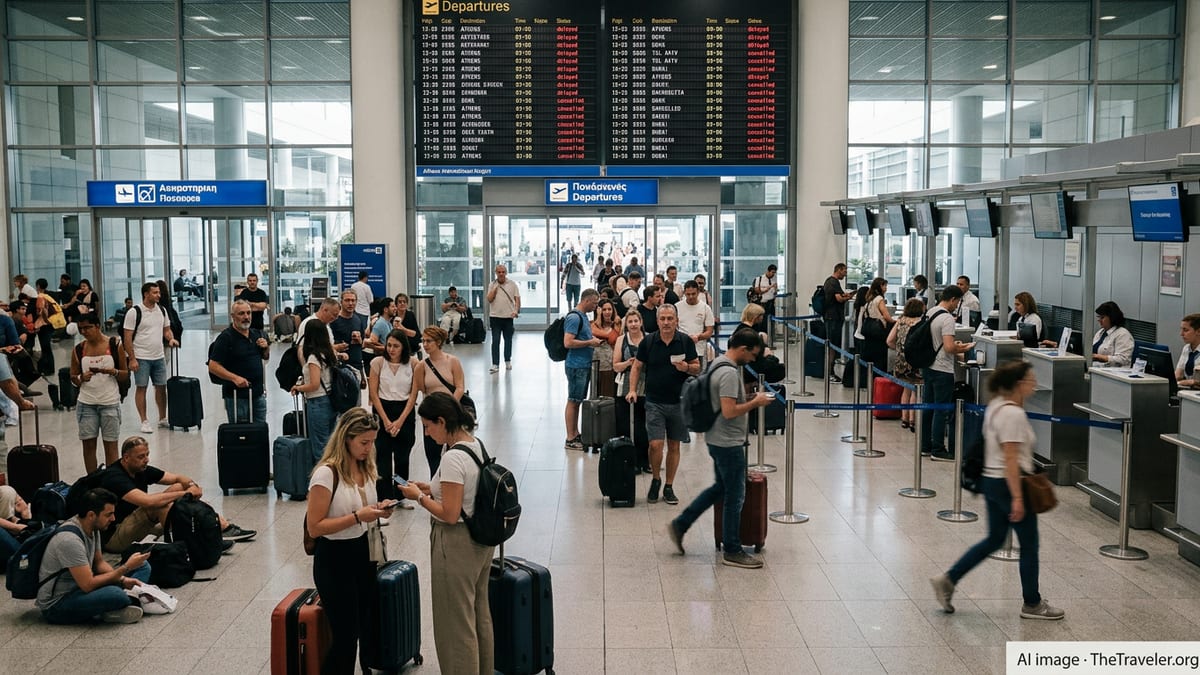
In recent days, Heraklion’s Nikos Kazantzakis Airport on Crete has emerged as one of the worst-affected hubs, with local media describing hours-long queues, repeated takeoff and landing suspensions due to poor visibility, and passengers forced to sleep on terminal floors as aircraft are repositioned or held elsewhere. Airlines have been diverting or cancelling services when dust levels push beyond operating thresholds, while cleanup crews race to keep runways and sensitive equipment clear of accumulated grit.
Athens International Airport has also seen rolling disruption across domestic and regional flights, heavily influenced by knock-on effects from the wider Middle East conflict and related airspace closures. Global aviation tallies compiled by industry analytics firms indicate that carriers serving Greek destinations are among those scrapping or rerouting services to avoid no-fly zones, congested detours and unpredictable fuel and crew logistics.
Travelers transiting through Athens, Thessaloniki and island airports report missed connections, short-notice schedule changes and limited rebooking options as carriers juggle aircraft availability. Public information issued by airlines and airport operators stresses that safety considerations, including dust-induced visibility drops and strong crosswinds tied to Erminio, remain the determining factor in whether flights can depart or land.
Tourism Sector Squeezed by Weather and Geopolitics
The timing of this latest disruption is particularly sensitive. Greece has been anticipating another robust summer season, with analysis from Greek and international tourism bodies pointing to strong demand from North American and European markets despite higher airfares and geopolitical tension in the broader region.
Yet booking and cancellation data for March indicate rising uncertainty. Travel and lodging analytics cited in Greek-language business coverage show notable spikes in cancellations for short-term rentals and package tours across the eastern Mediterranean following the recent escalation in the Iran-related conflict and the closure or partial shutdown of key Gulf hubs. While Greece remains physically distant from the direct military activity, its position as a junction for flights skirting the conflict zone exposes it to second-order disruption.
Hotel and tour operators in Athens, Crete and the Dodecanese are now contending with a double squeeze: nervous would-be visitors reconsidering trips because of regional instability, and those who do travel facing weather-induced chaos when they arrive. Industry representatives quoted in domestic media describe an uptick in last-minute itinerary changes, shortened stays and requests to switch islands or dates as travelers attempt to outrun storms and ferry or flight cancellations.
At the same time, analysts note that longer-term demand indicators remain relatively resilient, particularly from markets such as the United States, where airlines have already launched expanded transatlantic schedules for 2026. The concern within the sector is that a perception of persistent “travel nightmares” could discourage more risk-averse visitors if high-profile images of red skies and stranded passengers dominate international coverage.
Island Infrastructure Strains Under Successive Shocks
Beyond airports, Greece’s transport infrastructure is grappling with cumulative stress from successive weather systems over the 2025 to 2026 winter and early spring. Ferry routes across the Aegean and Ionian seas have repeatedly been suspended due to gale-force winds, with gusts above 8 or 9 on the Beaufort scale prompting authorities and operators to halt sailings for safety reasons. These suspensions, recorded several times since January, have left island residents and travelers stranded and disrupted supply chains.
Storm Erminio has brought a new round of warnings, with regional administrations in the Cyclades and Dodecanese closing schools and cautioning against non-essential travel on April 1 as forecasts flagged dangerous conditions at sea and on exposed roads. Visitors already island-hopping or planning to depart for mainland connections face renewed uncertainty over whether ferries will run as scheduled, compounding the risk of missed flights and additional accommodation costs.
Smaller ports and island airports, which often operate at the limits of capacity during peak summer months, are particularly vulnerable when extreme weather events cluster closely together. Repeated cancellations can leave limited windows for rescheduling, and backup options such as alternative ferry routes or inter-island flights may already be fully booked during holiday periods.
Local reports highlight that such vulnerabilities are not new but are being amplified by the frequency and intensity of recent storms, as well as by the sheer number of travelers now relying on tightly timed connections between flights and ferries to maximize short stays.
What Travelers to Greece Should Expect Now
For travelers currently in Greece or preparing to depart in the coming days, publicly available guidance from airlines, airports and tourism agencies converges on a few key points: expect disruption, build in extra time and monitor conditions closely. Storm Erminio and lingering Saharan dust are forecast to influence weather patterns in parts of the country beyond April 1, even as immediate red-sky conditions begin to ease.
Air passengers are being advised to check flight status frequently on the day of departure, as decisions to operate can shift within hours based on visibility, wind and updated airspace advisories. Those connecting via hub airports affected by the Middle East conflict should be prepared for reroutings or extended layovers, and in some cases may find it more reliable to book itineraries that avoid the most congested corridors altogether.
On the ground, travelers moving between islands would be prudent to allow buffer days at key points in their itinerary, particularly ahead of international flights home. Observers in the Greek travel community emphasize that while outright cancellations of entire holidays remain relatively rare, missed ferries or a single cancelled domestic leg can trigger a chain reaction of costs and stress if schedules are too tight.
Despite the current turmoil, tourism analysts underscore that Greece’s core appeal and infrastructure remain intact, and that severe events like the Erminio dust storm, though striking, are episodic. The challenge for visitors in early 2026 is navigating a period in which weather extremes and geopolitical tensions are intersecting more sharply than usual, turning a dream trip into a logistical test for even the most seasoned travelers.