

More news on this day
Travelers moving through Bangor International Airport are facing a day of mounting frustration after a cluster of regional carriers grounded nine flights and triggered widespread delays on routes connecting to major East Coast hubs including New York, Washington, Newark, Philadelphia and Orlando.
Get the latest news straight to your inbox!
Grounded Flights Ripple Across Key East Coast Connections
Airport officials confirmed that a total of nine departures and arrivals operated by Piedmont Airlines, GoJet Airlines, Endeavor Air and PSA Airlines were grounded, with additional services experiencing rolling delays. The affected flights primarily connect Bangor with larger hub airports, creating knock-on disruption for passengers with onward connections across the United States and internationally.
The cancellations involve regional services marketed by major network carriers and routed through airports such as New York, Washington, Newark, Philadelphia and Orlando. With many Bangor passengers relying on those hubs for same-day connections, even a small number of grounded flights can quickly cascade into missed links and extended unplanned stopovers.
Bangor International, which handles a mix of regional and seasonal long-haul traffic, has been working with airline station managers to re-time departures where possible and to coordinate rebooking options. Displays in the terminal have shown a growing list of delayed services through the morning, and staff have been deployed to help re-accommodate travelers at check-in counters and gate podiums.
The airport advised passengers to arrive early and to stay closely in touch with their airlines’ mobile apps, email alerts and customer service channels, particularly if they are connecting in larger hubs later in the day. With aircraft and crews out of position, recovery from the disruption is expected to extend into the evening schedule.
Operational Strains for Piedmont, GoJet, Endeavor and PSA
The four regional carriers at the center of the disruption each operate as feeders for major airlines, linking smaller markets like Bangor to coastal hubs. Piedmont and PSA typically fly under the American Airlines brand, while Endeavor Air and GoJet operate flights marketed by Delta Air Lines and United Airlines on select routes. When multiple regional partners are forced to ground aircraft on the same day, the impact on connectivity can be magnified for travelers in smaller cities.
Industry data in recent years has highlighted the sensitivity of regional operations to crew availability, maintenance requirements and national airspace constraints. Because these carriers operate tight schedules with small fleets, a single aircraft or crew out of position can affect several rotations in one day, especially on routes linking to high-traffic hubs such as Newark, Philadelphia, Washington and Orlando.
Travel analysts note that regional affiliates have been under sustained operational pressure, balancing pilot staffing challenges with rising demand for seats into major hubs. That strain can leave little spare capacity to absorb unexpected delays or groundings, which is particularly visible at non-hub airports that depend on just a few daily departures to each major city.
For Bangor passengers booked on these carriers, options to reroute are constrained by the limited number of daily frequencies. As a result, even short ground holds can turn into overnight stays when the last available connection of the day is missed at a hub airport.
Weather, Airspace and Infrastructure Challenges Combine
The Bangor disruption unfolded against a backdrop of ongoing weather and airspace challenges along the Eastern Seaboard. Major airports serving New York City, Washington, Newark and Philadelphia have all recently recorded extended departure and arrival delays due to storms, visibility issues and air traffic management programs designed to slow the flow of traffic into congested airspace.
In Orlando, one of the nation’s busiest leisure gateways, traffic management initiatives and high volumes have produced recurrent departure delays, especially during peak travel days. When regional flights from smaller cities are scheduled to feed into already congested hubs, they are particularly vulnerable to being held on the ground or cancelled altogether when weather or airspace restrictions tighten capacity.
Aviation experts say that the national system’s interdependence means even limited disruption at one or two major hubs can create widespread knock-on effects. Smaller airports like Bangor sit at the end of that chain, experiencing cancellations and delays that often originate with conditions hundreds of miles away rather than with any local weather or infrastructure issue.
While Bangor’s own runways and facilities remained open, the airport was nevertheless forced to manage the consequences of system-wide constraints, highlighting how vulnerable regional travelers remain to decisions taken at distant control centers and hub operations rooms.
Stranded Passengers Confront Missed Connections and Long Waits
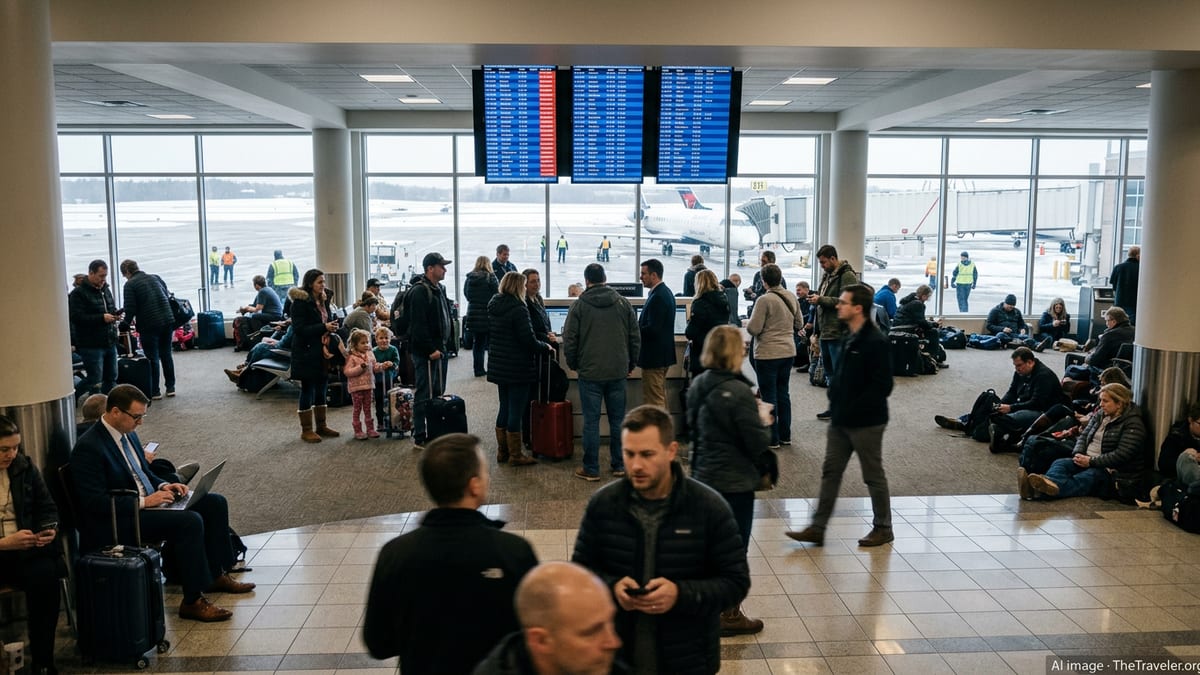
Inside Bangor International Airport, the impact of the grounded flights was most visible at check-in counters and gate areas, where queues built as travelers sought rebooking options. Families destined for Orlando theme parks, business travelers bound for meetings in New York and Washington, and students connecting to flights through Newark and Philadelphia all faced the prospect of missed connections and improvised overnight stays.
Airline staff worked to rebook affected passengers onto later flights where seats were available, but limited capacity on regional services meant that some travelers were offered routings that required extended layovers or departures a day or more later than planned. For those on tight schedules, particularly those connecting to long-haul departures from East Coast hubs, the grounded flights from Bangor effectively ended their trips before they had even begun.
Across the concourse, some passengers reported spending hours on hold with airline call centers while simultaneously standing in line at airport counters in search of faster solutions. Others turned to travel insurance policies or credit card protections to seek reimbursement for unexpected hotel stays and meals.
For inbound passengers attempting to return to Bangor, the disruption at hubs like Newark and Philadelphia meant flights were either delayed at the gate or cancelled outright, leaving travelers scattered across multiple cities and dependent on standby lists as the evening progressed.
Advice for Travelers Navigating the Ongoing Disruption
With aircraft and crews out of sequence, operations staff warned that delays could persist beyond the initial wave of cancellations, even if weather or airspace conditions improved later in the day. Travelers scheduled to depart Bangor on Piedmont, GoJet, Endeavor Air or PSA Airlines were urged to check their flight status repeatedly and to consider adjusting plans proactively where possible.
Frequent fliers recommend booking the earliest departure of the day on regional routes to improve the odds of avoiding rolling delays and missed connections. Early flights are more likely to have their aircraft positioned overnight at the airport, which reduces exposure to upstream disruptions elsewhere in the network. For Bangor passengers with critical same-day connections in New York, Washington, Newark, Philadelphia or Orlando, allowing extra connection time can also provide an important buffer.
Passengers already affected by today’s disruptions are being encouraged to keep all receipts for hotels, meals and ground transportation, in case they are eligible for compensation or reimbursement under airline policies or travel insurance coverage. Advisers caution, however, that coverage rules vary widely depending on whether the disruption is attributed to weather, air traffic control restrictions or airline operational issues.
As Bangor International works through the backlog, airport leaders have reiterated their call for travelers to build flexibility into their plans, especially during seasons when storms, airspace constraints and heavy demand combine to test the resilience of regional airline schedules.