

More news on this day
An extreme polar storm blasting a remote North Atlantic island has spiraled into a cascading aviation crisis, disrupting transatlantic routes linking the United States, United Kingdom, Canada, Australia, New Zealand and Iceland, and leaving hundreds of travelers stranded at small airports pushed beyond their limits by snow, ice and subzero wind chills.
Get the latest news straight to your inbox!
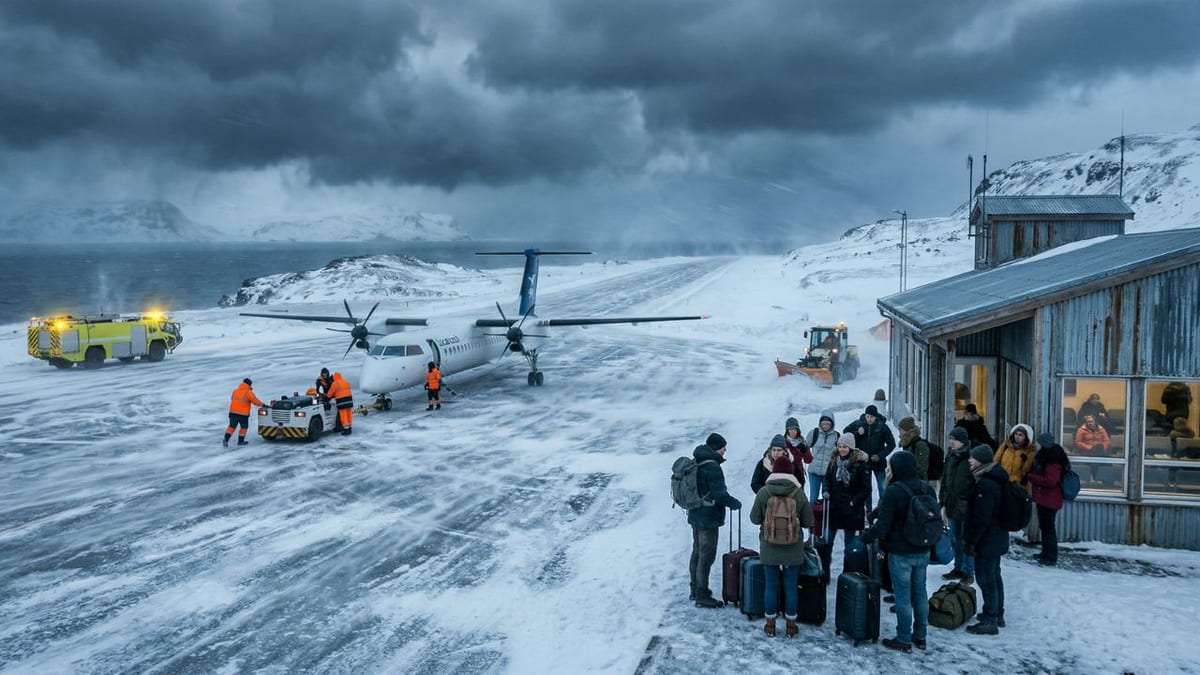
Remote Island Becomes Flashpoint for Transatlantic Disruption
Publicly available flight-tracking data and meteorological reports point to a powerful Arctic system that rapidly intensified over a sparsely populated North Atlantic island, sitting beneath several of the main great-circle corridors that connect North America and Europe. As conditions deteriorated, aircraft already en route began diverting away from the storm core, while others were forced into extended holding patterns or last-minute returns to origin airports.
According to aggregated airline operations updates, the sudden loss of predictable routing options in this narrow slice of airspace had an outsized impact on long-haul flights between the United States, Canada and the United Kingdom, with knock-on effects for connecting services to Australia and New Zealand. Aviation analysts note that even a localized weather emergency can act as a chokepoint when it affects the limited diversion and fuel-planning options available on ultra-long sectors over the North Atlantic and Arctic regions.
The island’s primary airfield, a modest facility more accustomed to turboprops and occasional charter jets, quickly became the focal point of the disruption. Multiple widebody aircraft sought to use it as an emergency alternate, only to find runways crusted with ice, snowbanks encroaching on taxiways and critical ground equipment freezing or failing in the extreme cold.
Ground handling capacity, already constrained by the airport’s remote location and limited staffing, was rapidly overwhelmed by diversions and unscheduled technical stops. Passengers stepping off diverted flights encountered terminal buildings strained by crowding, intermittent power interruptions and heating systems struggling to keep interior spaces above freezing.
Small Airports Across Six Nations Struggle in the Freeze
The storm’s influence was not confined to the island itself. As aircraft diverted or repositioned, smaller regional airports in the United States, Canada, the United Kingdom, Iceland, Australia and New Zealand were pushed into roles they are rarely asked to play in the global network. Public data from airport operations centers showed waves of unscheduled long-haul arrivals, all seeking fuel, crew changes or safe harbor from deteriorating conditions along their planned routes.
In northern New England and Atlantic Canada, compact facilities that typically handle short-haul domestic services saw widebody jets lining up on ramps never designed for that scale of traffic. De-icing rigs cycled continuously in temperatures well below seasonal norms, while limited stores of de-icing fluid, fuel and catering supplies came under pressure as more diversions arrived than planners had anticipated.
In the United Kingdom and Iceland, where winter storm planning is more routine, the stress point emerged in the smaller satellite airports rather than major hubs. Reports from regional locations indicated that stand space, snow-clearing equipment and staff shifts calibrated for typical winter traffic struggled once multiple intercontinental flights diverted simultaneously. Some aircraft were forced to remain on remote stands for hours while teams cleared ice, refueled tanks and arranged for basic passenger services.
Even in Australia and New Zealand, situated far from the storm center, the knock-on effects were visible. Long-haul departures bound for North America and Europe were held on the ground while dispatchers recalculated routes and alternates, sometimes shifting potential diversion points to smaller Pacific or North American fields that then had to brace for possible surges in traffic.
Hundreds Stranded as Emergency Diversions Ripple Through Networks
The immediate human impact of the crisis emerged in reports of passengers stranded overnight or longer as crews hit duty-time limits and aircraft scattered across unfamiliar airports. With accommodation near remote airfields quickly exhausted, some travelers remained in terminals where cots, blankets and basic refreshments were distributed while airlines worked through rebooking and crew repositioning plans.
At the remote island airport at the heart of the storm, the challenge was magnified by limited hotel capacity and harsh outdoor conditions that complicated transport away from the airfield. Publicly available social media posts and local coverage described travelers clustered in crowded waiting areas, as staff attempted to manage flight information screens that shifted repeatedly between new departure times and rolling delays.
In North America and Europe, even passengers far from the storm perimeter felt the disruption. Aircraft and crews temporarily trapped at diversion points could not be returned to their normal schedules quickly, leading to a wave of cancellations and missed connections at large hubs. Industry commentators noted similarities with earlier weather-driven crises in which a relatively contained meteorological event triggered multi-day schedule instability as carriers tried to rebalance fleets and staffing.
Airline operations updates indicated that some long-haul passengers were rerouted through entirely different continents to complete journeys, including itineraries that added unscheduled stops in Asia or the Middle East to bypass congested or weather-affected North Atlantic corridors. These detours lengthened travel times substantially and strained baggage-handling systems as luggage followed more complex paths to reach final destinations.
Fragile Cold-Weather Infrastructure Exposed
The freezing collapse of local infrastructure across affected small airports has drawn attention from aviation safety and climate resilience specialists. In many locations, facilities were built for historical climate patterns that assumed shorter or less intense cold snaps, and investment decisions prioritized typical traffic loads over rare, high-impact events.
The storm exposed particular vulnerabilities in power supply and heating systems at smaller terminals, where backup generators and fuel stocks were sometimes sized for brief outages rather than prolonged subzero conditions. In a few documented cases, terminal heating struggled to keep up with repeated door openings and surges in occupancy, leading staff to consolidate passengers into fewer zones while nonessential areas were shut to conserve warmth.
On the airfield side, snowfall rates and wind-driven drifting exceeded the capacity of compact fleets of plows and sweepers, contributing to temporary runway closures and length restrictions that complicated landing and takeoff performance for heavily loaded long-haul jets. De-icing operations also became a pinch point, as aging or single-string equipment faced near-continuous use in temperatures that pushed hydraulic and electrical systems to their limits.
Analysts observing the event have linked these failures to broader discussions about how smaller airports, particularly in remote or harsh environments, can adapt to more volatile weather patterns. While large hubs in North America and Europe often maintain redundant systems and deep staffing pools, the latest crisis suggests that the broader network’s resilience is increasingly defined by its weakest points rather than its flagship facilities.
Calls Grow for Rerouting Strategies and Resilience Planning
As airlines, regulators and airport operators review the chain of events, industry commentary has focused on the need for more flexible routing strategies and improved infrastructure at diversion-capable airports. Flight-planning practices that rely on a narrow set of alternates along polar and North Atlantic routes are under renewed scrutiny, particularly when several of those alternates share similar exposure to extreme cold or storms.
Some aviation researchers are highlighting the potential benefits of broadening the pool of viable diversion airports, combined with targeted investments in cold-weather resilience at key remote locations. Suggested measures in public policy discussions range from upgraded de-icing facilities and additional snow-clearing equipment to more robust energy systems and improved passenger accommodation plans in case of prolonged disruptions.
The crisis is also feeding into a wider debate about how climate variability may interact with the aviation system in coming years. While global temperatures are rising, episodes of severe cold and intense winter storms are expected to remain a feature of high-latitude weather, especially where disrupted atmospheric patterns can funnel Arctic air far south. For airlines operating some of the world’s longest routes between the United States, the United Kingdom, Canada, Australia, New Zealand and Iceland, this latest episode underscores that single-point failures at small, remote airports can reverberate across entire hemispheres.
Travelers, meanwhile, are being reminded of the importance of contingency planning when connecting through weather-sensitive regions, including building longer buffers into itineraries and preparing for the possibility of unplanned overnight stays. As schedules gradually normalize, the event is likely to serve as a case study in how a localized extreme weather catastrophe on a remote island can cascade into a global aviation challenge.