

The Keweenaw Peninsula has become shorthand among Great Lakes travelers for wind-swept Lake Superior beaches, copper country ghost towns, and long, lonely roads. Yet across the wider Great Lakes basin, there are other remote peninsulas, islands, and shoreline hamlets that offer the same sense of distance from daily life without sacrificing those big-water views. From Michigan’s less-traveled bays to Ontario’s rugged North Shore and forgotten islands on Lake Huron, these are places where you can still hear the waves, not the traffic.
What Makes the Keweenaw a Benchmark for Remote Great Lakes Travel
Ask serious Great Lakes road trippers to name one place that still feels genuinely remote and the Keweenaw Peninsula tends to sit near the top of the list. Jutting like a crooked finger into Lake Superior from Michigan’s Upper Peninsula, the Keweenaw is framed by long drives through forest, small harbor towns, and stretches of shoreline where the only sounds are wind and water. It is not wilderness in the purest sense, but the combination of sparse development, rough-weather coast, and long winter isolation gives it a frontier mood that is increasingly rare around North America’s inland seas.
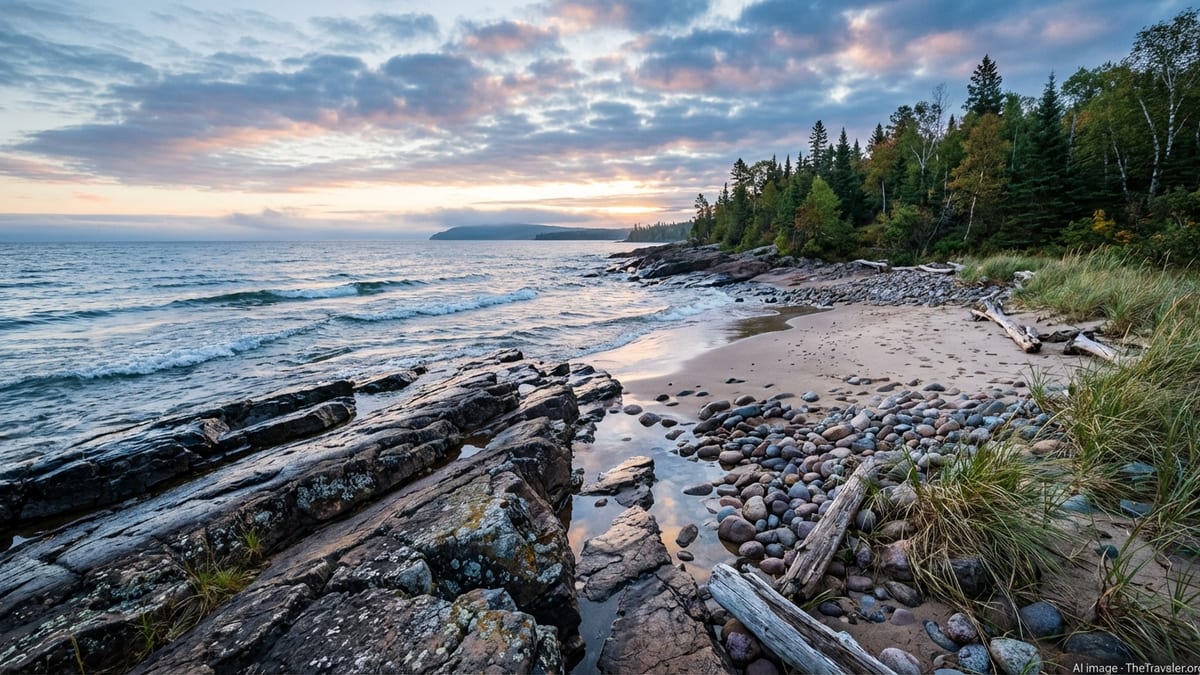
Much of the Keweenaw’s character comes from its geography. Lake Superior surrounds the peninsula on three sides, and the interior is a mix of rocky ridges, bogs, and second-growth forest. Old mining roads lead to forgotten beaches like Misery Bay and Bete Grise, while overlooks such as Brockway Mountain reveal an almost oceanic sweep of water and sky. Protected pockets such as Black Creek Nature Sanctuary preserve quiet segments of cobble beach, wetlands, and birch-fringed dunes, giving visitors a chance to experience Superior’s shoreline as it once was across much of the basin.
The region is also defined by what is missing. There are no major cities on the peninsula itself, and even in peak summer the traffic thins within a few miles of the main highway. Many of the best views require at least a short walk, and winter conditions regularly close minor roads. For travelers who value silence, self-reliance, and a night sky unmarked by city glow, this blend of rugged landscape and limited infrastructure is exactly the draw. It sets a useful benchmark when searching for other Great Lakes locations that promise the same kind of escape.
When you look beyond the Keweenaw with this lens, certain patterns emerge. Remote feeling within a day’s drive of the Midwest’s big metros often means dead‑end peninsulas, islands reachable only by boat, or shorelines buffered by conservation land and rough roads. The destinations that follow share that DNA: they are not impossible to reach, but they demand some effort, reward patience over planning, and quietly encourage you to linger longer than you expected.
Lake Superior’s Other Quiet Corners: Ontario’s Rugged North Shore
If Lake Superior is the spiritual home of Keweenaw-style scenery, its Canadian North Shore is where the sense of scale truly multiplies. Between Thunder Bay and Sault Ste. Marie, long gaps appear on the map where the Trans‑Canada Highway hugs cliffs high above the water and side roads wander down to tiny villages or trailheads. The shoreline is a mix of headlands, cobble beaches, and islands, with large sections bordered by provincial parks and nature reserves that limit development and preserve dark skies.
Near the entrance to Nipigon Bay, offshore islands create a maze of channels and open water that feels far removed from the busier parts of Superior. Some, such as Simpson Island, are uninhabited and protected as rugged natural areas, drawing small numbers of experienced paddlers and boaters rather than casual beachgoers. On calm mornings the lake can appear glass-smooth around these islands, reflecting pine-studded cliffs and low, weather-beaten shorelines that echo the Keweenaw’s wilder points.
On the mainland, low-key communities such as Rossport, Red Rock, and Schreiber serve as gateways to this quieter side of Superior. Modest marinas, small motels, and basic campgrounds support a style of travel that revolves around hikes, shoreline picnics, and long drives at unhurried speeds. Many trailheads lead quickly into boreal forest where the only consistent noise is wind in spruce branches and the distant hiss of surf. It is not unusual to hike for hours while meeting only a handful of other visitors, especially outside the peak of summer.
For those who love the Keweenaw’s mix of rocky shoreline and solitude, Superior’s North Shore offers a familiar palette on a larger canvas. The key difference is the overall sense of distance. Services can be spread thin, particularly between towns, and weather rolling in off the lake can feel even more exposed than on Michigan’s side. Travelers comfortable with that extra degree of remoteness often find that the North Shore becomes a favorite place to sit with a thermos of coffee and simply watch Superior breathe.
Michigan’s Hidden Bays and Peninsulas Beyond the Keweenaw
Within Michigan’s Upper Peninsula itself, there are peninsulas and bays that fly just under the radar of the Keweenaw’s growing reputation. One such place is the Abbaye Peninsula north of the village of L’Anse, which juts into Lake Superior on the south side of Keweenaw Bay. A long gravel approach road, patches of old-growth character forest, and exposed rock headlands give the area a distinctly end-of-the-road feel. Modest public access points and low-key conservation properties line parts of the shoreline, offering a subdued version of the Keweenaw experience with even fewer people around.
At the tip of this peninsula the forest breaks onto slabs of ancient bedrock that taper into Superior’s cold surf. Standing there feels remarkably similar to standing at the outer edges of the Keweenaw, with the same sense of big water, changeable weather, and limited human presence. Yet because Abbaye lies a short jog off the main highway, it often receives a fraction of the visitors. Simple cabins, rustic camp spots, and informal pullouts are the norm here rather than full-service resorts, a welcome reality for travelers who prefer the hum of wind to the buzz of a campground generator.
Farther east along the Upper Peninsula’s Lake Superior shore, the mouth of the Huron River marks another spot that locals quietly praise for its sense of separation. Accessed via a long secondary road that leaves paved routes far behind, the river spreads into a sandy opening framed by tall pines before it meets Superior. The scene is minimalist: river, sand, wind, water, and a horizon that feels almost oceanic. Amenities are scarce and conditions can be raw, especially in shoulder seasons, but for travelers who value solitude the lack of infrastructure is part of the charm.
Even Keweenaw Bay itself, particularly away from its small towns, provides pockets of the same calm that draws people up the peninsula. Modest pullouts, unmarked shoreline paths, and forest service roads deliver you to driftwood-lined beaches where waves roll in from the open lake and loons call in the distance. The important thread connecting these places is the way roads narrow, cell signals fade, and time seems to stretch, echoing the Keweenaw without completely repeating it.
Islands and Reefs: Quiet Worlds in the Middle of the Lakes
For travelers willing to board a boat or ferry, the Great Lakes hold a scattering of islands and offshore reefs that rival the Keweenaw’s sense of isolation. On Lake Superior, a handful of forested islands near the Keweenaw’s tip, including Manitou Island, draw small numbers of boaters, paddlers, and lighthouse enthusiasts. These islands are close in mileage but feel far in spirit from the mainland. Shorelines are rough, currents can be strong, and human structures are scarce, leaving birds, wind, and water to set the soundtrack.
Across the Great Lakes, islands that feel comparable to the Keweenaw tend to share certain traits: modest or nonexistent year-round populations, basic services at best, and a strong sense that the surrounding water is both highway and barrier. Development is often clustered near small harbors, leaving the rest of the shoreline to pine, rock, and dune. Trails cross interior forests thick with moss and undergrowth, and shore walks reveal layers of wave-polished stones. Night skies here can be exceptional, with little artificial light to compete with starfields and, in the right conditions, the flicker of aurora on the northern horizon.
In Lake Huron, the maze of channels around Drummond Island in Michigan’s eastern Upper Peninsula reveals a different, yet equally quiet island character. Here, broad shoals, small uninhabited islands, and a mix of protected bays and exposed passages produce a sense of navigating a watery backcountry. Among them, Harbor Island, protected as a national wildlife refuge, has no bridge access and is known more to boaters seeking a sheltered anchorage than to casual tourists. Stepping ashore means trading dock chatter for the rustle of leaves and the splash of fish in the shallows.
Because these islands require effort and planning, they naturally filter their visitors. Supplies must be considered in advance, weather windows watched, and exit plans kept flexible. In return, they offer a kind of quiet that is difficult to find on road-accessible stretches of shoreline. For travelers who cherish the Keweenaw’s storm-lashed beaches and small-town scale but want to push further into the realm of water and sky, time on these islands can feel like discovering a secret chapter of the Great Lakes story.
Ontario’s Inland-Lake Backroads and Shield Country Shorelines
Move inland from the Great Lakes proper and another landscape emerges that will feel familiar to anyone who loves the Keweenaw’s rock, water, and forest combination. Across much of northern Ontario, thinly populated shield country spreads out in a pattern of lakes, low hills, and jack pine ridges. While these lakes may not all connect directly to Superior, Huron, or the other Great Lakes, many sit within their watersheds and share the same cool climate, strong seasonal shifts, and resilient ecosystems.
Backroads in this region often turn from pavement to graded gravel and then to narrower tracks, passing fire towers, small sand beaches, and rustic boat launches. Modest cabins and fishing lodges appear at intervals along these lakes, typically focused on quiet angling rather than loud group gatherings. In the shoulder seasons between summer vacation and winter snow, some of these areas see more visits from migrating birds than from people. The atmosphere can be remarkably similar to wandering down a side road in the Keweenaw and discovering a lonely beach at the end.
What sets these inland-lake regions apart is their emphasis on long-term quiet rather than quick-hit viewpoints. Travelers who come here generally stay for days at a time, renting a remote cabin or pitching a tent at a small, out-of-the-way campground. Days follow a rhythm of paddling, walking, reading, and watching weather drift across the water. Even a simple task like driving out for supplies feels like a meaningful excursion, reinforcing the sense that you are based in a pocket of calm separated from the faster world beyond.
For Great Lakes visitors fixated on shoreline views, venturing inland can feel like a departure. In practice, it often deepens the experience. The same storm systems that pound Superior and Huron ripple across these lakes, the same migratory routes cross their skies, and the same bedrock underpins both coasts and interior. It is all part of one continuous landscape, and seeking out its quietest corners can be as rewarding as chasing the most iconic views.
Planning a Low-Impact Trip to Remote Great Lakes Shores
Remote destinations around the Great Lakes may look empty, but they are seldom untouched. Small communities, conservation groups, and Indigenous nations have long histories with these lands and waters, and travelers who arrive with respect help keep them special. Planning a low-impact trip starts with recognizing that infrastructure is intentionally limited in many of these places. Parking lots are modest, signage is understated, and services such as garbage collection or restroom facilities can be minimal or absent.
Before setting out, it is worth checking land ownership and any current advisories. Many of the quietest Keweenaw-style locations are a patchwork of public land, private parcels, and conservation easements. Understanding which stretches of shoreline are open to the public and which are not helps avoid conflicts and protects sensitive habitats. When in doubt, local tourism offices, nature centers, or community boards can often clarify current conditions, seasonal closures, or cultural considerations.
On the ground, familiar leave-no-trace habits go a long way. Pack out all waste, tread lightly on dunes and vegetation, and keep campfires small and within local regulations. Sound carries clearly over water and open rock, so keeping noise levels down preserves the quiet for wildlife and for other visitors who have come for the same reason you have. Even something as simple as parking thoughtfully on narrow access roads can make a difference for local residents and emergency vehicles.
Finally, remember that remoteness often means slower response times in the event of an emergency. Weather can change quickly on all of the Great Lakes, and roads may not be plowed or maintained at the same level as busier destinations. Traveling with basic safety gear, letting someone know your plans, and being willing to adjust or turn back when conditions deteriorate help ensure that your search for solitude remains a story of calm rather than crisis. Done thoughtfully, these trips support a style of tourism that aligns more closely with the quiet landscapes that make places like the Keweenaw so compelling in the first place.
The Takeaway
The Keweenaw Peninsula has earned its reputation as one of the Great Lakes’ signature remote escapes, but it is far from alone. Across Superior, Huron, and the wider basin, there are other peninsulas, islands, bays, and backroad hamlets that echo its blend of rugged shoreline, sparse development, and wide horizons. Some lie just off the main tourist circuits; others require serious commitment to reach. What they share is a sense that the modern world has loosened its grip, at least for a while.
In choosing which of these places to visit, the most important step is clarifying what kind of quiet you are seeking. Is it the rocky drama of Superior’s outer headlands, the subtle calm of an inland bay, or the total immersion that comes with crossing over to an island? Each destination offers its own version of solitude, its own mix of challenge and comfort. With realistic expectations, thoughtful planning, and a willingness to travel slowly, you can find Great Lakes settings that feel every bit as compelling as the Keweenaw while remaining a little more under the radar.
Ultimately, the value of these remote shorelines is not measured only in vistas but also in what they allow you to leave behind. Cell signals fade, background noise drops, and days stretch around simple routines of walking, watching, and resting. Whether you are standing on a wave-washed point of basalt, listening to wind over dune grass, or watching a distant freighter slide along the horizon, the effect is similar: a reminder that the Great Lakes are still large enough to hold pockets of true stillness, if you are willing to go looking.
FAQ
Q1. How remote is the Keweenaw Peninsula compared with other Great Lakes destinations?
The Keweenaw is relatively easy to reach by car yet feels remote because of sparse development, long winter closures on side roads, and miles of lightly visited Lake Superior shoreline.
Q2. When is the best time to visit remote Great Lakes areas for quiet scenery?
Late spring and the shoulder weeks of early autumn usually provide the best balance of open facilities, manageable weather, and fewer visitors than peak summer.
Q3. Do I need special gear to explore peninsulas and islands like those described?
For road-accessible spots, basic outdoor clothing, layers, and rain gear are usually enough, while island trips may require marine safety equipment and more detailed contingency planning.
Q4. Are these remote Great Lakes destinations suitable for families?
They can be, provided adults are comfortable with limited services, plan conservative driving and hiking days, and keep a close eye on children near cold, rapidly changing water conditions.
Q5. How can I minimize my impact when visiting quiet shorelines and sanctuaries?
Stay on established paths, pack out all waste, keep group noise low, follow local fire regulations, and respect any closures or cultural sites identified by land managers or nearby communities.
Q6. Is it possible to rely on mobile navigation in these remote regions?
Coverage is often intermittent, so it is wise to download offline maps, carry paper backups, and mark key junctions or trailheads before signals become unreliable.
Q7. What kind of wildlife might I see in Keweenaw-like Great Lakes environments?
Common sightings include loons, eagles, migratory waterfowl, deer, and smaller mammals, along with diverse plant communities ranging from boreal forest to dune grass and wetland habitats.
Q8. Are there lodging options that still preserve a sense of remoteness?
Yes, many areas offer small lakeside motels, rustic cabins, and basic campgrounds that keep lighting and infrastructure modest so the night sky and natural soundscape remain prominent.
Q9. How should I prepare for rapidly changing weather on the Great Lakes?
Pack layers, windproof and waterproof outerwear, extra food and water, and always check local marine or coastal forecasts, adjusting plans if strong winds or storms are predicted.
Q10. Can I visit these areas without a car?
In most cases a vehicle is the most practical option, although some towns and islands can be combined with regional buses, shuttles, or ferries if you plan schedules carefully and remain flexible.