

More news on this day
Northern Nevada’s long frustration with Interstate 80 congestion between Reno, Sparks and the Tahoe Reno Industrial Center is sharpening political and public interest in a potential commuter rail link that could, over time, redefine how thousands of residents move across the region each day.
Get the latest news straight to your inbox!
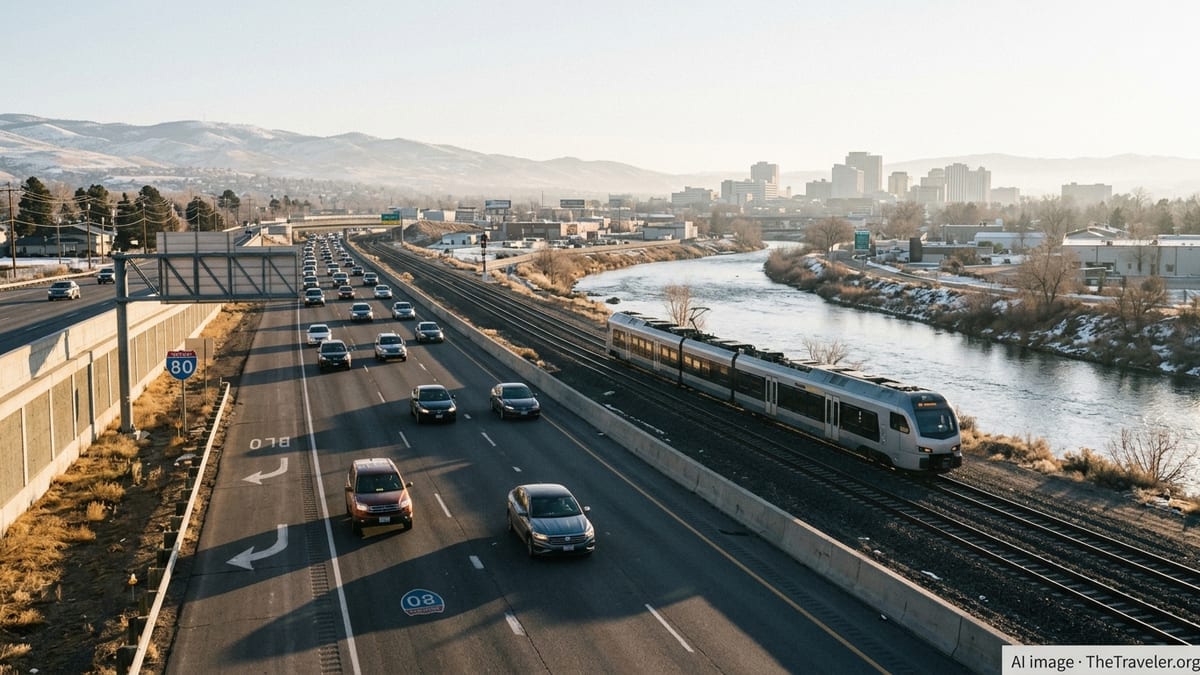
Rising Pressure From I‑80 Traffic And Regional Growth
Interstate 80 is the primary east–west spine across northern Nevada, carrying heavy commuter, freight and visitor traffic through the Truckee River corridor between Reno and Sparks. Publicly available information shows that volumes have climbed sharply in the past decade, particularly since large employers began filling the Tahoe Reno Industrial Center along USA Parkway, drawing workers from across Washoe and Storey counties.
Reports indicate that recurring congestion, crashes and winter closures now routinely disrupt travel, with backups stretching from Sparks toward the canyon and adding significant time to daily commutes. Discussions in local media and public forums increasingly link those delays to limited alternatives for workers who must drive alone, even for predictable, peak-hour trips.
Regional planning documents from state and local transportation agencies describe a mix of near-term highway widening and operational upgrades, but also acknowledge physical and environmental constraints in the narrow river corridor. That has opened space for a broader mobility discussion, including renewed attention to passenger rail as a long-range complement to road projects.
While no dedicated commuter rail line is under construction today, the scale of I‑80 congestion and the pace of regional population and employment growth are helping to move rail concepts from speculative ideas into the realm of formal feasibility studies and corridor preservation efforts.
From Concept To Corridor Study
According to published coverage of recent transportation planning efforts in Washoe County, agencies have begun to evaluate new high-capacity east–west connections to relieve pressure on I‑80. One example is the Northeast Connector feasibility study, which analyzes a new roadway between east Sparks and the Tahoe Reno Industrial Center as a way to distribute commuter traffic more evenly across the network.
Although that particular study is road-focused, it illustrates how planners are increasingly framing mobility challenges at a regional rather than corridor-by-corridor scale. The same documents reference the importance of preserving key freight and rail rights-of-way, and of coordinating with Union Pacific’s transcontinental line, which already passes through the Reno–Sparks urban core.
Transportation strategies emerging from these efforts emphasize “multimodal” solutions, including expanded bus service, high-capacity transit on major corridors, and long-term exploration of rail options. Publicly available material from the Regional Transportation Commission of Washoe County notes that the region’s main rail infrastructure today is freight-oriented, with Amtrak’s California Zephyr providing once-daily intercity passenger service rather than frequent local commuter trips.
Within this context, a Reno–Sparks commuter rail line is being discussed by advocates as a logical next step in regional planning, one that could eventually be layered onto existing rail corridors if operational and funding challenges can be addressed.
What A Reno–Sparks Commuter Rail Could Look Like
Early public conversations describe a notional commuter rail service running broadly parallel to I‑80, linking west Reno, downtown Reno, downtown Sparks and employment areas to the east. Stations could be sited near existing activity centers and park-and-ride lots, offering transfers to local bus routes and bicycle networks.
Industry experience from other U.S. regions suggests that such a line would likely start with limited peak-period service, scaling up as ridership and funding allow. A typical pattern would involve morning and evening trains scheduled around major shift changes at industrial centers, supported by midday service for students, service workers and reverse commuters.
For riders, the most immediate benefit would be the ability to bypass routine congestion on I‑80, particularly during winter weather, crashes or construction. Longer-term, regular rail service could help shape more compact development around station areas, supporting additional housing and mixed-use projects in Reno and Sparks while reducing the number of long-distance car trips.
Publicly available information on similar projects in western states shows that a successful service typically relies on integrated ticketing, all-day frequency and safe, walkable station design. Advocates for northern Nevada are highlighting those examples as they outline what a high-performing commuter rail system in the Truckee Meadows could ultimately deliver.
Transforming Daily Commutes And Travel Choices
Travel behavior research from comparable regions indicates that reliable, frequent rail service can shift a meaningful share of commuters out of single-occupancy vehicles, especially when highway congestion is persistent and when park-and-ride access is convenient. In the Reno–Sparks context, even a modest initial shift could remove hundreds of vehicles from I‑80 during the busiest hours.
Observers note that the benefits would not be limited to traditional office workers. Employees at distribution centers and manufacturing facilities, university students, hospitality workers and airport staff could all gain new travel options, particularly if service windows and connecting bus routes are designed around their schedules.
In addition to travel time savings, a commuter rail line could contribute to regional goals around air quality and greenhouse gas reduction. Public filings from local transportation agencies describe commitments to cleaner fleets and more sustainable travel patterns; higher-capacity transit operating on electricity or low-emission fuels would be consistent with those policy directions.
At the neighborhood scale, shifting some traffic from I‑80 and parallel arterials to rail could reduce cut-through driving on local streets, improve safety at busy intersections and create opportunities to reallocate roadway space to safer walking and cycling infrastructure over time.
Funding, Governance And The Road Ahead
Despite growing interest, any Reno–Sparks commuter rail line remains a long-term proposition that would require substantial capital, operating funds and institutional coordination. Nationally, major rail investments often rely on a combination of federal grants, state contributions, local sales taxes and, in some cases, private partnerships with major employers or developers.
In northern Nevada, the Regional Transportation Commission of Washoe County, the Nevada Department of Transportation, local governments and the freight railroad would all have roles in advancing or shaping a commuter rail project. Publicly available governance documents highlight the complexity of such coordination, particularly where shared tracks or right-of-way access must be negotiated.
Analysts point to the experience of Brightline West between southern California and Las Vegas as evidence that substantial new rail infrastructure is achievable in Nevada when political will, private capital and federal funding align. While that project is intercity rather than commuter-focused, its progress is informing public expectations about what passenger rail in the state can look like.
For now, the most concrete steps involve corridor planning, right-of-way preservation and incremental improvements to existing bus and highway networks. Yet the intensifying strain on I‑80, coupled with a growing regional appetite for alternatives, is keeping the idea of a Reno–Sparks commuter rail line firmly in the spotlight as northern Nevada contemplates the next phase of its transportation future.