

More news on this day
Travelers at Ronald Reagan Washington National Airport faced a fresh wave of disruption as Republic Airlines suspended 11 flights and logged more than 100 delays, sending knock-on effects across key markets including Washington, New York, Columbus, Albany and Atlanta.
Get the latest news straight to your inbox!
Regional Disruptions Centered on Reagan National
The latest operational problems for Republic Airlines, a major U.S. regional carrier operating flights under big-airline brands, were concentrated at Ronald Reagan Washington National Airport, one of the country’s busiest and most slot-constrained hubs. Publicly available tracking data for the current travel period shows that a cluster of Republic-operated departures and arrivals at the airport were either suspended or subject to extended delays over the course of the day.
Within that group, at least 11 Republic flights linked to Reagan National were listed as canceled or suspended, while a much larger pool registered departure or arrival delays that in many cases stretched beyond an hour. The disruption affected both morning and evening waves, complicating travel plans for commuters, government workers and leisure travelers who depend on short-haul connections into the U.S. capital.
Reagan National’s tightly controlled airspace and limited runway capacity mean even a modest number of schedule disruptions can quickly cascade into broader delays. When a regional operator like Republic experiences concentrated operational strain, the effects can multiply, as its aircraft and crews are scheduled to make multiple turns through the airport in a single day.
Impact on Major City Pairs and Regional Links
The knock-on effects of the suspended flights and rolling delays radiated quickly beyond Washington. Routes between Reagan National and major business centers such as New York, Atlanta and Columbus were among those showing notable schedule disturbances, according to live flight-status dashboards and airline schedule data. Travelers on these corridors often rely on high-frequency service operated by regional partners using smaller jets.
Republic’s network, flying on behalf of larger carriers, includes a dense web of routes connecting Washington to cities across the Northeast and Midwest. Delays on Washington–New York services can have outsized impact, as they feed onward connections at larger hubs. When those flights run late or are withdrawn from the schedule, passengers may miss downstream connections that were timed around tightly packed regional banks.
Service to smaller state capitals and secondary markets such as Albany and Columbus is also vulnerable when a regional operator comes under pressure. With fewer daily frequencies on some of these routes, even a single canceled or heavily delayed flight can disrupt the bulk of same-day travel options, forcing passengers to accept rebookings through alternate hubs or overnight stays.
How Operational Strain Ripples Through the System
Regional carriers like Republic typically operate under capacity-purchase agreements with major airlines, supplying aircraft, pilots and cabin crews to fly branded services. This structure can magnify the operational impact when irregular operations strike. Aircraft rotations, crew duty limits and tight turnaround times mean that one delayed segment can compromise several subsequent legs.
At a slot-restricted airport such as Reagan National, schedule flexibility is inherently limited. When flights are suspended, the associated takeoff and landing slots may go unused or be difficult to repurpose in real time. That can lock in a day-long pattern of lower throughput, with aircraft out of position and crews bumping up against federally mandated duty-time restrictions.
Weather variations along the East Coast, air traffic flow programs in congested corridors, and lingering staffing challenges in some parts of the aviation system can compound the problem. When combined with a highly banked regional schedule, these factors help explain how an initial set of operational issues for one carrier evolves into more than 100 individual delays registered under a single airline’s banner.
Passenger Experience: Longer Lines and Limited Options
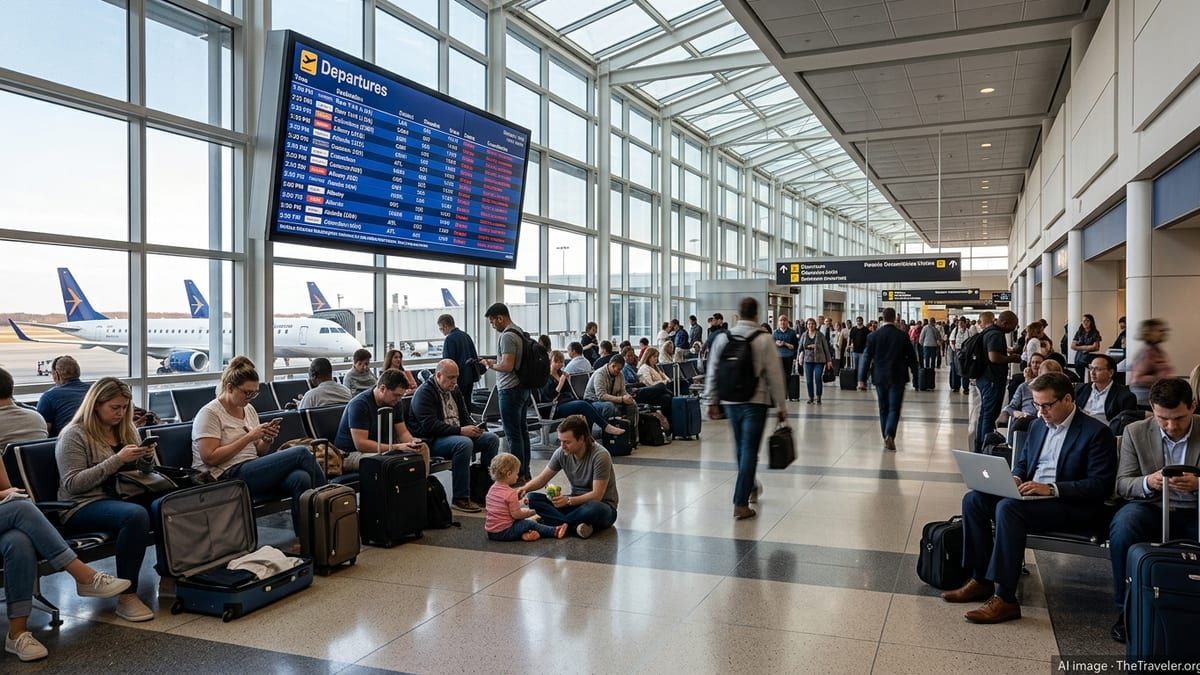
The cascading issues at Reagan National translated into a challenging day for passengers passing through the terminal. Airport departure boards showed multiple Republic-operated flights toggling between estimated and delayed times, while travelers faced longer waits at rebooking counters as they sought alternative routings.
For those traveling to or from cities with fewer daily frequencies, the options were often constrained. Publicly available airline tools and third-party booking platforms showed some affected travelers being rerouted through other hubs in the Northeast and Midwest, adding hours to journeys that are typically short nonstop hops. In some cases, same-day arrivals became difficult to guarantee, especially on evening departures.
Reports from consumer-facing flight-tracking services indicated that average delay durations on the most affected Republic-operated flights at Reagan National were significantly higher than the airport’s typical baseline for regional services. While some early-morning flights departed close to schedule, afternoon and evening departures saw delay times lengthen as aircraft and crews fell further out of position.
What Travelers Can Do on Days of Heavy Disruption
The latest round of disruption at Reagan National highlights how quickly conditions can change at a busy slot-controlled airport and how those changes reverberate across a regional network. For travelers booked on Republic-operated flights, whether branded by American, Delta, United or another partner, monitoring flight status well before leaving for the airport remains critical.
Travel advisors often recommend using both the operating carrier’s mobile app and independent flight-tracking platforms on days when delays are mounting. Same-day change functions, where available, can sometimes allow flexible passengers to move to earlier departures before the schedule deteriorates further. For those connecting through Washington on tight layovers, proactively requesting a rebooking with a longer connection window can reduce the risk of misconnection.
Travel patterns in and out of Reagan National over the past several seasons show that even short disruptions can ripple widely when they coincide with peak morning or late-afternoon departure banks. The latest round of Republic flight suspensions and delays underscores that vulnerability, offering a reminder that flyers using the airport’s dense regional network should build extra time and contingency plans into their itineraries on busy travel days.