

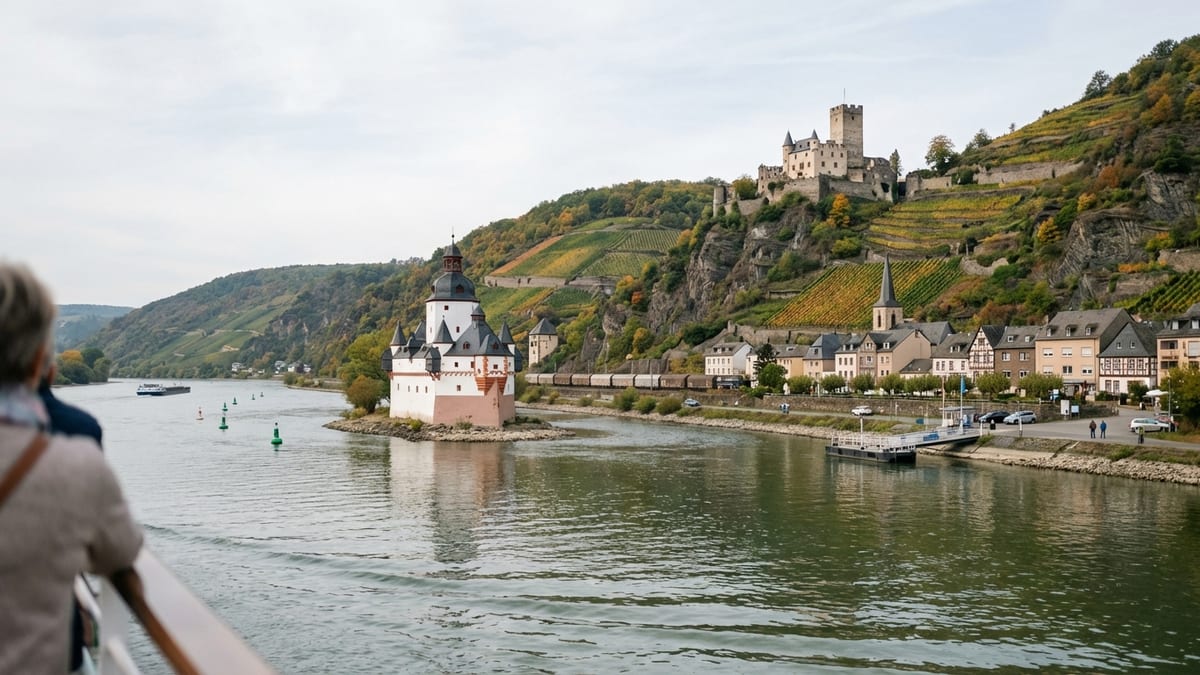
The Rhine Gorge is one of those rare places where the marketing photos do not exaggerate. On the 65 kilometer stretch between Koblenz and Rüdesheim, a river cruise really does pass a near-continuous chain of castles, terraced vineyards and steep slate cliffs.
From the water the scenery feels both intimate and theatrical. Medieval toll towers loom at tight bends, trains flash past at the base of cliffs, and church spires rise from compact riverside towns that look almost unchanged in centuries. This is what you actually see from the deck: not just “pretty views” but a living corridor of European history unfolding bend by bend.
Understanding the Rhine Gorge From the Water
The stretch most cruise lines call the “Rhine Gorge” is officially the Upper Middle Rhine Valley, a UNESCO World Heritage site that runs roughly from Koblenz in the north to Rüdesheim and Bingen in the south. From the river, that classification immediately makes sense. Hills rise steeply on both sides, often straight from the waterline, forcing towns into narrow strips along the banks and vineyards onto gravity-defying terraces high above. When you are on the water, you see how geography dictated everything from settlement patterns to warfare and trade.
On a typical downstream transit between Rüdesheim and Koblenz you will be on this most dramatic section for about four to five hours on a standard day cruise, slightly less on a large river ship moving with the current. That limited time is densely packed with sights. More than 40 castles and fortified sites line the gorge, meaning that from the deck of your ship you rarely go more than a couple of minutes without some tower, ruin or walled town entering view. It feels continuous because it is: an almost unbroken chain of defenses, toll stations and noble residences presiding over one of Europe’s great trade arteries.
From the water you also appreciate how narrow and sinuous the channel still is at key choke points like Kaub and the Lorelei. Modern navigation markers, signal towers and powerful tugs share the same difficult curves that once made this stretch dangerous for wooden barges. Many river cruise lines schedule this section in daylight specifically so passengers can hear commentary that points out castles, explains the shipping signals and highlights the rock formations that do not always stand out from photographs alone.
Castles on Every Bend: What You Actually Recognize
When brochures say “a castle at every turn,” it is easy to assume that is hyperbole, but on the Rhine Gorge it is almost a literal description. From the water, several castles stand out as clear anchor points in the landscape. Near Koblenz, Marksburg sits high above the right bank, one of the few hilltop castles here never destroyed or heavily rebuilt. Its intact white walls and compact towers form a textbook example of a medieval fortress. Your ship usually passes below at some distance, but the commanding position is impossible to miss.
Further south, near Boppard and St. Goar, the ruins grow more imposing. Rheinfels, above St. Goar, is one of the most expansive castle complexes on the Middle Rhine. From deck level you do not see all its tunnels and bastions, but the sheer spread of crumbling walls across the hillside gives a sense of its scale when it controlled this section of river. Across from it, the slopes are dotted with smaller ruins and terraced vines, illustrating the density of fortification where rival lords once competed for toll revenue.
As you progress through the central gorge around Bacharach and Kaub, the castles feel closer and more three-dimensional. Stahleck, set above Bacharach, appears balanced on a rocky knuckle above the town’s half-timbered roofs. At Kaub, Gutenfels rises above the right bank directly opposite the river island of Pfalzgrafenstein, forming one of the most photographed ensembles on the Rhine. From the ship this duo is striking because you see the strategic relationship in one glance: the hilltop castle controlling the heights and the small island fortress sitting in midstream, perfectly placed to stop passing ships.
Approaching the southern outlet of the gorge, near Bingen and Rüdesheim, castle silhouettes begin to overlap with modern features such as the Niederwald monument and cable car lines over the vineyards. Rheinstein, Reichenstein, Sooneck and Ehrenfels appear one after another above the river’s left and right banks. Many were heavily restored in the 19th century, which is obvious from the fanciful towers and romantic embellishments. From the water you can distinguish these “reborn” castles from the untouched ruins upstream, and you see how 19th century Romanticism reimagined the medieval Rhine for tourism long before today’s river cruises existed.
River Towns, Vineyards and Everyday Life Along the Banks
Castles might be the marketing hook, but what you actually spend a lot of time watching from the deck are the everyday towns, vineyards and transport lines that still rely on the river. Nearly every few kilometers the ship passes a compact settlement pressed between tracks and water, its church spire often the tallest structure. Towns like Boppard, Oberwesel and Bacharach are particularly striking because their old walls and gate towers remain visible from the water. From a passing cruise ship you see whole ensembles at once: colored facades along the promenade, defensive towers on the inland side, and sometimes a castle perched directly above.
The vineyards are almost as memorable as the buildings. The gorge’s steep slate slopes catch the sun and retain heat, creating prized conditions for Riesling grapes. From the water, you can study the geometry of terracing and the narrow access tracks snaking up impossibly steep gradients. In some sections, such as above Rüdesheim and Assmannshausen, the vineyards run in near-continuous ribbons from the waterline to the crest. If your cruise includes commentary, you will hear about individual vineyard names painted on the slopes, but even without that detail the visual impression is of a cultivated landscape pushed to its limits.
Modern life is impossible to ignore. Freight trains and regional passenger services race along both riverbanks, their lines hugging the feet of cliffs and frequently diving into tunnels. Long freight barges carry containers, coal, aggregates and chemicals, moving at deliberate speed against or with the current. From your ship, you may find yourself almost eye level with truck drivers on the road or commuters waiting at small riverside stations. This juxtaposition is one of the Rhine Gorge’s defining experiences from the water: medieval ruins above, working river and rail corridor below, all constantly in motion.
In summer, pontoons and small marinas appear in front of certain towns, where local ferries shuttle across the current and private boats are moored. On sunny weekends, you may see paddlers or small motorboats weaving carefully between commercial traffic. In the evenings, as many cruise itineraries schedule, promenades fill with walkers, and the lit facades of towns like St. Goar, Bacharach or Rüdesheim create a string of reflections in the water. The river, viewed from the deck, feels less like staged scenery and more like a heavily used main street that multiple generations share.
Signature Sights: Lorelei Rock, Pfalzgrafenstein and the Mouse Tower
Even among dozens of castles and towns, certain landmarks define the Rhine Gorge experience from a ship’s rail. The Lorelei is the most famous. As your vessel approaches the tight S-curve near St. Goarshausen, the cliffs on the right bank suddenly rise to about 130 meters at a prominent rocky headland. The Lorelei itself is not a freestanding pinnacle but a massive outcrop forming the outer wall of the bend. From the water you see its sheer slate face and understand immediately why navigation here has always been hazardous: currents accelerate, and the channel narrows against submerged rocks.
Many cruise lines slow down here, and commentary often shifts to the legend of the siren whose singing supposedly lured sailors to their deaths on the rocks. Looking up from the deck, you may spot the modern statue and viewpoint far above, but the real drama remains at water level, where passing barges visibly adjust their line to thread the safest path. When river levels are low, this section looks even more constrained, and the rock ledges that once wrecked wooden boats are easier to imagine just below the surface.
Pfalzgrafenstein Castle, near Kaub, is the other sight that many passengers remember most vividly. Unlike the hilltop fortresses, it sits on a small island in midstream, its white walls and dark roofline floating seemingly untethered in the current. From a passing cruise ship you can see the full outline: a low, irregular outer wall shaped to deflect ice and debris, and a taller central tower capped with a baroque-style roof. Its scale is modest compared with the big hill castles, but the location feels almost theatrical, particularly when your vessel passes close to the downstream side and the island fills your field of vision.
Near the southern exit of the gorge, approaching Bingen, the Mouse Tower appears on a small island just offshore. The slender structure looks almost like a stone lighthouse, but from commentary you learn it was once a customs and watch tower linked to the formidable river defenses of nearby Ehrenfels Castle on the opposite bank. From the water the relationship between tower, castle and the narrowing river channel is easy to see: together they formed a tight gate that no cargo boat could bypass without paying dues. Today the tower is usually closed to visitors, but from a ship’s deck it is one of the simplest structures to photograph, framed against the town and vineyards in the background.
Seasonal and Water-Level Realities You Notice From the Deck
From the water, the Rhine Gorge looks different in every season, and those seasonal changes affect both what you see and how you experience the cruise. In spring, slopes glow in fresh greens, and vineyard workers and tractors are visible on the terraces. River traffic begins to build, and the air can be crisp, with long periods of clear light that favor photography. Summer brings dense cruise schedules, more small craft, and the vine canopy at its fullest. On hot days, heat haze can soften distant views, but long evenings allow sunset passes through some sections of the gorge, when castles are lit with warm light and sometimes with artificial illumination.
Autumn is visually the richest. Vineyards turn shades of gold and rust, and wooded sections of slope add deep reds and browns. Passing trains and the occasional plume of smoke from a wine estate or town festival blend with the scent of wet leaves and river air. Many cruise lines time “Rhine in Flames” events in late summer and early autumn, when sections of the gorge are lit with coordinated fireworks displays. From a ship this can be spectacular, but even on ordinary evenings in October, individual towns often illuminate their castles and churches, so the whole valley glows softly after dark.
Low water levels have become a more frequent reality in recent years, and you may notice their effects directly from the deck. Exposed riverbed, especially near islands and along the inner sides of bends, makes the channel look narrower. Navigation buoys stand higher above the surface, and some smaller local ferries reduce frequency or suspend service when levels drop below safe thresholds. Large cargo barges often travel partially loaded in such conditions, riding higher in the water. For leisure travelers, this can mean slower speeds in shallow sections and occasional timetable adjustments, but major river cruise lines typically alter schedules rather than cancel entire passages.
Winter, though less popular for mainstream cruises, reveals the gorge in its starkest form. Trees are bare, making castle outlines sharper against the sky. Snow, when it falls, highlights terraces and cliff textures. From the water, you can see deep into side valleys and pick out paths and old quarries usually hidden by foliage. Some small excursion boats do not operate in the coldest months and a number of attractions close, but freight trains and commercial barges continue almost regardless of weather, reinforcing the sense that the Rhine remains a working river in all seasons.
What It Feels Like Onboard While Watching the Gorge
The visual drama of the Rhine Gorge is enhanced by the rhythm of life onboard a river vessel. On most modern river cruise ships, the open sun deck is the prime viewing platform, with low railings and unobstructed sightlines in all directions. As your ship enters the UNESCO section near Boppard or Rüdesheim, there is often an almost choreographed migration of passengers upward, cameras in hand. The atmosphere becomes hushed but excited. People stake out chairs, then quickly abandon them as the first castle appears, realizing that the action is practically continuous and best appreciated on your feet.
Audio commentary usually accompanies this passage, either live from a cruise director or via the ship’s internal speakers. From the deck, you hear the names of castles and towns timed to your position, along with brief anecdotes about sieges, noble families, or modern wine festivals. It is not a deep historical seminar, but it adds crucial context to what you are seeing. When your guide points to defensive arrow slits high on a ruin, or to a hillside chapel barely visible among vines, the static scenery becomes a story unfolding in real time beside you.
On local day boats that operate “hop on, hop off” services between Koblenz and Rüdesheim, the feeling is more relaxed and mixed-use. Commuters, hikers linking sections of the Rhine Castle Trail, backpackers and day trippers spread out across indoor lounges and open decks. You still get commentary in several languages, but you also hear snippets of everyday conversation, clatter of coffee cups, and announcements for upcoming stops. The gorge becomes not just a highlight reel, but the backdrop to some very ordinary journeys, giving you a more low-key but equally authentic sense of the river as a lived-in landscape.
Onboard routines temporarily bend around the scenery. Breakfast or lunch service may be staggered so that nobody feels they must choose between a sit-down meal and standing at the rail watching castles slip by. Crew members often step out between duties to point out favorite villages or explain how water levels influence the route. Even passengers who arrived on board mainly for comfort and convenience usually end up spending these hours outside, tracking each new headland and comparing photos as the river bends again and reveals yet another tower on a distant ridge.
Planning Your Cruise Day: Direction, Timing and Weather
From a purely visual standpoint, your direction of travel and the time of day you pass through the gorge influence what you see and how well you can photograph it. Northbound cruises heading toward Koblenz tend to have the right bank castles better lit in the morning, while southbound ships toward Rüdesheim favor left bank landmarks earlier in the day. Many multi-day itineraries deliberately schedule this passage during mid-morning to early afternoon, when the sun is high enough to clear ridge lines without casting everything into backlit silhouette.
If you are booking an independent day cruise between Koblenz and Rüdesheim, you can choose departure times that prioritize either crisp morning light or softer late afternoon tones. Early sailings often have cooler air and fewer crowds on deck, which can be an advantage if you want unobstructed views. Later transits may bring warmer temperatures and warmer color, especially in spring and autumn, though you risk more haze on very hot days. Either way, be prepared to spend most of those hours outside if conditions allow, as indoor views, while comfortable, flatten the experience.
Weather is the other major variable. Even on cloudy or lightly rainy days, the gorge retains a brooding appeal. Low cloud can sit on the ridges, making castles emerge suddenly from mist as you round bends. Colors are more muted, but reflection from the water often brings enough light up under the clouds for photography. Heavy rain or strong wind, by contrast, can make extended time on the open deck less pleasant. In such cases, look for sheltered spots near open doors or windows where you can step out quickly as key landmarks approach, then retreat to warmth between them.
In recent years, fluctuating water levels have occasionally required cruise operators to adjust boarding points or use buses to bridge exceptionally shallow sections farther upstream or downstream from the gorge. Within the central UNESCO stretch itself, however, vessels are usually able to operate with reduced capacity rather than stop entirely. For travelers, the key practical point is to build a small margin into schedules and to pay attention to pre-departure updates from operators. Once you are actually on the river, these logistical complexities tend to fade in the face of the landscape sliding past your rail.
The Takeaway
Experiencing the Rhine Gorge from the water is not just about ticking off a list of castles or capturing a few postcard shots of the Lorelei. It is about feeling how geography, history and modern commerce converge in one narrow corridor. From a ship’s deck, you watch fortified hilltops give way to terraced vines, industrial barges glide past medieval towers, and small towns continue their routines much as they have for generations, all within a landscape that has been consciously preserved and interpreted for visitors.
What you actually see is a layered story: the raw rock of the gorge that forced the river into its tight curves, the human response of walls and watchtowers that taxed and protected trade, the later romantic reinvention of the Rhine as a destination in its own right, and the present-day reality of a working waterway that still carries a significant part of Europe’s inland freight. From the water these layers are visible at a glance, often in a single frame that includes a ruined keep, a vineyard slope and a passing freight train.
For many travelers on broader Europe itineraries, the Rhine Gorge is a half-day highlight. Yet its impact often outlasts longer stops in major cities. Standing at the rail as the next castle appears ahead and the previous one recedes behind, you gain an intuitive sense of how interconnected European landscapes are along their rivers. That is the lasting memory for most passengers: not just that the Rhine is beautiful, but that from the water it reveals how beauty, history and everyday life can share the same narrow banks.
FAQ
Q1. Which section of the Rhine should I cruise to see the famous gorge?
The most scenic and castle-rich section is the Upper Middle Rhine Valley between Koblenz and Rüdesheim (or nearby Bingen). This roughly 65 kilometer stretch is the UNESCO-listed “Rhine Gorge” that most river cruise lines highlight.
Q2. How long does the scenic Rhine Gorge part of a river cruise usually last?
On a standard day cruise between Koblenz and Rüdesheim, the core gorge segment with the highest density of castles usually takes about four to five hours. Large multi-day river cruise ships may transit the same stretch a bit faster when traveling with the current.
Q3. Which side of the ship has the best views?
Both banks are packed with castles and towns, so you will want to move around. If you have to choose, the right bank is particularly strong around Marksburg, Katz Castle and the Lorelei, while the left bank offers superb views of Rheinfels, Stahleck, Schönburg and several others. The top deck is ideal because you can simply switch sides as sights appear.
Q4. What are the must-see landmarks from the water?
From a passenger’s perspective, the most distinctive sights include Marksburg Castle near Koblenz, Rheinfels above St. Goar, the paired ensemble of Gutenfels and Pfalzgrafenstein at Kaub, the Lorelei rock near St. Goarshausen, and the Mouse Tower with Ehrenfels Castle near Bingen and Rüdesheim.
Q5. Will I learn about what I am seeing, or is it just scenery?
Most river cruise ships and many day boats provide live or recorded commentary in multiple languages while passing through the gorge. Guides typically identify each castle and town, explain their history and point out modern features such as vineyards and railway lines, so you can connect the scenery with its stories.
Q6. What is the best time of year for a Rhine Gorge river cruise?
Late spring through early autumn offers the most comfortable temperatures and the widest choice of sailings. April and May bring fresh greenery, July and August have the longest days, and September and October combine mild weather with colorful vineyards and often very atmospheric light.
Q7. How do low water levels affect what I experience as a tourist?
When the river runs unusually low, cargo barges may sail with lighter loads and some cruise itineraries may adjust timetables or embarkation points. From a passenger’s perspective, you might notice exposed riverbanks and slightly slower speeds in shallow sections, but operators generally work to maintain the core gorge experience rather than cancel it.
Q8. Can I combine a river cruise with visiting castles on land?
Yes. Many itineraries pair the scenic transit with shore excursions to specific castles such as Marksburg, Rheinfels or Stolzenfels. If you are traveling independently, you can use local boats or trains along the valley to reach towns with accessible hilltop castles or castle hotels.
Q9. Are short day cruises worth it, or do I need a full river cruise?
Short day cruises specifically between Koblenz and Rüdesheim (or Bingen) can deliver the core visual experience of the Rhine Gorge, including its headline castles and the Lorelei. Multi-day river cruises add comfort, guided excursions and a broader sweep of the Rhine basin, but for pure scenery a single dedicated gorge day is often enough.
Q10. What should I bring onboard to enjoy the views?
Pack layers for changing wind and temperature on deck, sunglasses, sunscreen, a hat, and a camera or phone with sufficient battery and storage. A small pair of binoculars can greatly enhance your ability to pick out details on hilltop castles and vineyard terraces as you sail through the gorge.