

Rhodes is one of those rare islands that seems to offer everything at once: a perfectly preserved medieval city, long ribbons of sandy beach, mountain villages, pine forests and a nightlife scene that can go from languid to lively in a single evening.
As one of Greece’s most visited destinations, it rewards a little advance planning, especially in light of the wildfires that affected parts of the island in 2023 and the subsequent efforts to rebuild and improve visitor services.
Understanding Rhodes: Island Layout and Best Time to Visit
Rhodes is the largest of Greece’s Dodecanese islands, sitting in the southeast Aegean close to the Turkish coast. The island has a distinctly two sided character. The east coast is drier and more sheltered, with most of the resort development and the most popular sandy beaches.
The west coast is windier and greener, dotted with smaller settlements, ancient ruins and windsurfing spots. Most visitors base themselves either in Rhodes Town in the north, in one of the mid east coast resorts such as Faliraki or Kolymbia, or near Lindos farther south, then explore from there.
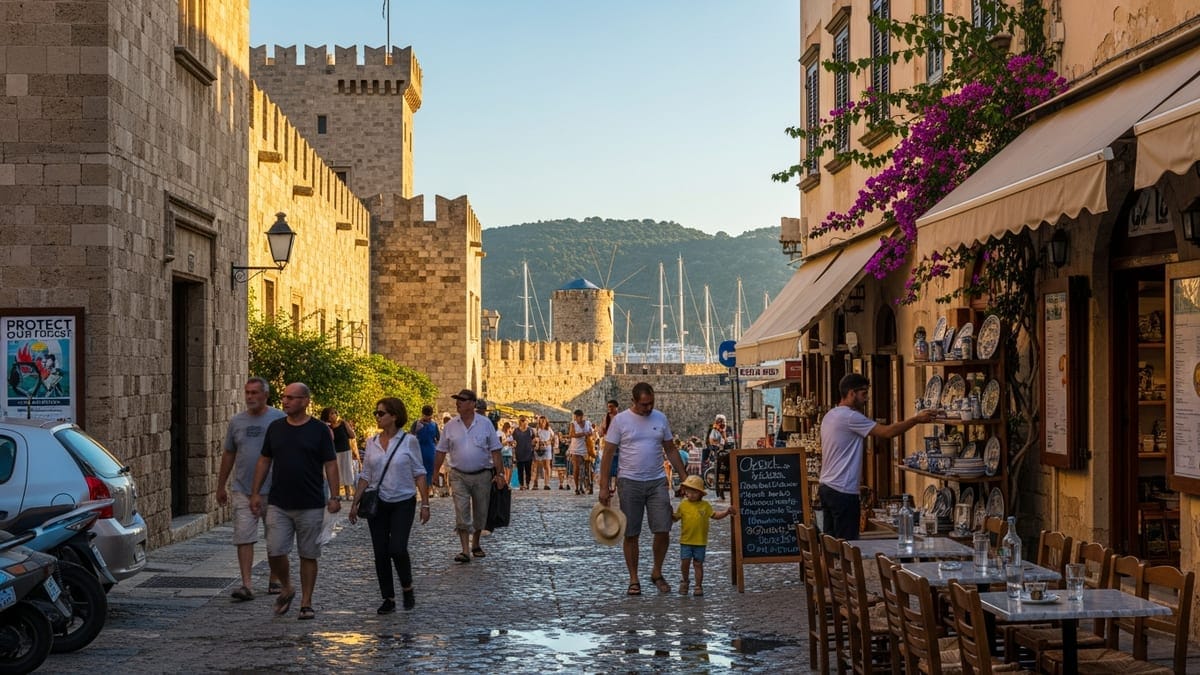
The island’s capital, often just called Rhodes Town, is really three places in one: the UNESCO listed Medieval City encircled by massive walls, the so called New Town with its early 20th century buildings, shops and waterfront promenades, and the modern commercial zones where most locals live and work.
Further down the east coast you will find a sequence of resort communities that each have a slightly different feel, from the club heavy beachfront of Faliraki to the more laid back family focus of Afandou and the upscale hotels of Kiotari. The west coast in contrast retains a quieter, more local rhythm, with villages like Soroni and Siana making good bases for travelers who want to drive and hike rather than sit on a sunbed.
Choosing when to visit Rhodes is crucial to your experience. Peak season from late June through August brings the highest temperatures, the fullest hotels and the most crowded beaches, as well as the best selection of direct flights from across Europe. Sea temperatures are at their warmest and days are long, but you should be prepared for intense sun and the possibility of heatwaves.
Shoulder season in May, early June, September and October is ideal for many visitors, with warm weather, swimmable seas, fewer crowds and lower prices, along with more space on roads and walking paths.
Winter on Rhodes, from November through March, is cooler, rainier and much quieter. Some hotels and many beach oriented businesses close, but the main sites and the Medieval City remain open, and Rhodes Town continues its life as a working city.
This can be a rewarding time to explore if you are more interested in architecture, history and hiking than in long days on the beach. It is also the time when the island has been focusing on rebuilding forested areas affected by the 2023 fires and strengthening its fire prevention measures, part of a broader conversation about climate resilience in Greek tourism.
Arrival Logistics and Getting Around the Island
Most international visitors arrive at Rhodes Diagoras Airport, about 15 kilometers southwest of Rhodes Town. The airport has seen upgrades in recent years, with expanded terminals and better passenger facilities. Once you land, you have three main options to reach the city or your accommodation: public bus, taxi and pre booked transfer or rental car.
A public bus connects the airport to Rhodes Town multiple times daily, with a journey time of around 40 minutes and a one way ticket cost of roughly 2.50 euros. The bus stop is a short walk from the arrivals area and you typically purchase tickets from the driver, so it helps to have small bills or coins ready.
Taxis line up outside arrivals and are the most straightforward way to get directly to your hotel, especially if you have luggage or are arriving late. Fares are regulated with published price ranges by zone. A ride to Rhodes Town usually falls in the mid 20 euro range, with higher fares to resorts further down the east coast or to the southern tip near Prasonisi.
At peak times in July and August there can be short waits, but queues generally move quickly. Pre booked private transfers have grown more common since the pandemic and can offer fixed pricing and a driver waiting with a sign, which some travelers prefer for peace of mind or when traveling with young children.
Once you are settled in, getting around Rhodes is relatively easy if you understand how the roads and bus lines work. Two main bus companies operate the island routes, one serving the west side and one serving the east side. From Rhodes Town you can reach popular resorts like Faliraki, Afandou, Kolymbia, Archangelos and Lindos by scheduled buses that run more frequently in summer.
Newer routes have made it easier to link directly to some mid east coast resorts, although buses typically stop at main road junctions rather than individual hotels, so you may have a short walk at the end of your journey.
Hiring a car gives you the greatest freedom to explore beaches, mountain villages and inland archeological sites at your own pace. Road conditions are generally good along the main coastal arteries, though narrower village roads require slower, more careful driving.
Fuel prices are comparable to the Greek mainland, and parking is usually straightforward outside Rhodes Town and Lindos. If you prefer not to drive, you can combine buses with taxis for the last leg, or join organized day tours that bundle transport with sightseeing at top destinations such as Lindos, the Valley of the Butterflies or nearby islands.
Exploring Rhodes Town and the Medieval City
The highlight of any visit to Rhodes is the Medieval City, one of the best preserved fortified towns in Europe and listed as a UNESCO World Heritage Site. Encircled by roughly four kilometers of thick stone walls strengthened by bastions and towers, the old town was largely shaped between the 14th and early 16th centuries when the Knights of St John ruled the island.
You can enter through a number of gates, each with its own character, from the imposing marine gateway near Mandraki harbor to smaller arches that lead directly into residential quarters.
Inside the walls, the Street of the Knights forms the ceremonial spine of the upper town. This slightly sloping, cobbled thoroughfare is lined with the inns of the different “tongues” or national groups that made up the Order, each with carved coats of arms above doorways.
At the top stands the Palace of the Grand Master, reconstructed in the 20th century on medieval foundations and now housing exhibitions on the island’s history. Elsewhere in the Medieval City you will find Ottoman era mosques, fountains and bathhouses, a reminder that Rhodes remained an important urban center long after the knights departed.
Beyond the monumental core, the old town’s life plays out in a maze of narrow lanes, small squares and residential neighborhoods. Parts of this historic fabric are highly commercialized, with souvenir shops, bars and restaurants catering to cruise passengers and day trippers, particularly around the main arteries near Ippokratous Square.
Venture a few turns away, however, and you will encounter quieter streets with traditional houses, small workshops and cafés where locals still outnumber visitors. Early morning and late evening are the best times to experience the atmosphere with fewer crowds and softer light.
Outside the walls, modern Rhodes Town arcs along the northern tip of the island. Mandraki harbor, watched over by two stone windmills and a breakwater fortress, is the departure point for many boat excursions. The New Town’s streets radiate inland from here, with a mix of Italian era public buildings, hotels, shops and restaurants that give the city a cosmopolitan feel.
The long Elli Beach on the northeastern side is a convenient place for a swim if you are staying in town, though it is mostly pebbly and can be busy in high season. As night falls, the waterfront and adjacent streets fill with locals on evening strolls and visitors out for drinks or dinner, providing a lively but generally relaxed urban scene.
Beaches, Nature and Outdoor Experiences
Rhodes owes much of its popularity to its coastline, which ranges from broad sandy bays to rocky coves framed by cliffs and pines. On the east coast, where the sea is calmer and the winds are lighter, you will find many of the island’s classic beach destinations. Faliraki, one of the oldest resort areas, offers a long sandy strand backed by hotels, beach bars and water sports centers.
It still has a reputation for nightlife, though the mood has softened from its heaviest party years and now mixes families, couples and groups of friends. Further south, beaches like Tsambika and Agathi draw visitors with their fine sand and clear shallow water, ideal for swimming and families with children.
For a more varied coastline, head to the west side where the Meltemi wind often blows. Here beaches tend to be pebbly or mixed, with deeper water and waves that attract windsurfers and kitesurfers. Ixia and Ialyssos are particularly popular with water sports enthusiasts thanks to reliable winds and specialized centers offering gear rental and lessons.
The west coast also feels less built up, with swathes of shoreline backed by fields, orchards and forested slopes. Even in high season you can find quieter spots by walking a little farther from main parking areas or exploring smaller coves.
Nature on Rhodes is not limited to the shore. Inland, low mountains and wooded valleys offer welcome shade and a different perspective on island life. One of the best known inland attractions is the Valley of the Butterflies, where a particular species of moth gathers in large numbers during the summer months.
In peak season the paths can get crowded, so visiting early or later in the day will give you a calmer experience and is easier on the delicate environment. Elsewhere, walking trails lead through pine forests and past chapels, springs and viewpoints that look across to neighboring islands and the Turkish coast.
For more active travelers, Rhodes offers opportunities for hiking, cycling and even rock climbing in certain areas, particularly around the island’s higher points such as Profitis Ilias and Akramitis. Summer heat means that outdoor activity is best timed for early morning or late afternoon, while shoulder season months allow for more comfortable daytime excursions.
Always carry water, sun protection and sturdy footwear, as trails can be rocky and signage is sometimes limited. Respect fire warnings, particularly in areas recovering from the 2023 blazes, and avoid lighting any kind of open flame during the dry season.
Lindos, Ancient Sites and Cultural Highlights
If Rhodes Town presents the island’s medieval and modern side, Lindos is the postcard image of whitewashed houses clustering beneath an ancient acropolis above a deep blue bay. Located on the east coast about 50 kilometers from the capital, Lindos is one of the most visited places on the island and justifiably so.
From the main square, narrow lanes wind between cubic houses with ornate pebble mosaics in their courtyards, many of which now host small hotels, bars and boutiques. The village rises toward the acropolis, which crowns the hill with layers of fortifications built atop a much older sanctuary of Athena.
Reaching the acropolis requires a fairly steep climb on steps and slopes, so comfortable shoes and water are essential, especially in summer. At the top, ruins of Hellenistic structures, a restored temple and medieval walls provide both a sense of deep history and sweeping views over the coastline and the twin bays of Lindos.
The site can be extremely busy when tour coaches arrive, particularly in the middle of the day. To enjoy it more peacefully, try to visit early in the morning or later in the afternoon, or consider staying overnight in Lindos so you can explore outside core day trip hours.
Apart from Lindos, Rhodes hosts a number of other archeological and historical sites that are worth seeking out. On a hill above the modern village of Ialyssos, the site of ancient Ialysos combines temple ruins, a monastery and panoramic vistas.
Near the village of Kameiros on the northwest coast, the remains of ancient Kamiros cascade down a hillside, revealing a grid of streets, cisterns and public buildings that speak to the sophistication of classical era city planning. Compared with the crowds in Rhodes Town and Lindos, these sites are often quieter and lend themselves to slow wandering and contemplation.
Culture on Rhodes is also embedded in its living traditions and everyday spaces. Many villages host summer festivals in honor of local saints, blending religious observance with music, dancing and communal food. Traditional tavernas serve regional specialties such as melekouni, a sesame and honey confection, and dishes based on local fish, wild greens and pulses.
As tourism has grown, the island has seen new museums and cultural venues open, including spaces that showcase contemporary Greek art and design alongside historical collections. Checking local event listings during your stay can reveal concerts, theater performances and exhibitions that connect you to the island beyond its beaches.
Practicalities, Safety and Post Wildfire Realities
Rhodes is generally a straightforward and safe destination, but being aware of local conditions and recent developments will help you travel more responsibly and comfortably. The 2023 wildfires, which led to the evacuation of tens of thousands of people from parts of the south and southeast of the island, prompted a wide ranging response from local authorities and the national government.
Reforestation efforts, improved fire breaks and early warning systems have been prioritized, particularly in forested and rural zones. At the same time, tourism infrastructure in affected areas has been repaired and, in most cases, fully reopened, underlining the island’s dependence on and commitment to its visitor economy.
Visitors who were forced to cut short their stays during the 2023 fires have been offered compensation in the form of e vouchers that cover accommodation for a future trip during set periods, part of a program that has drawn international attention as a pioneering response to climate related disruption in tourism.
While this initiative directly concerns only those previously affected travelers, it highlights an important point for all visitors: as summers grow hotter and drier, wildfire risk increases, and travelers should remain alert to local advice, respect access restrictions and avoid any behavior that could inadvertently ignite fires, such as discarding cigarettes or using barbecues in wooded areas.
In day to day terms, standard travel common sense applies. Tap water is generally considered safe to drink in Rhodes Town and many larger settlements, though some hotels and locals still prefer bottled water. Heat management is critical in summer: keep hydrated, seek shade during the hottest hours of the day and use high factor sun protection.
The Meltemi wind can make temperatures feel more comfortable but can also mask the intensity of the sun, particularly on the west coast and at sea. If you are planning a boat trip or extended time on the water, consider hats, light long sleeves and reef safe sunscreen to protect both your skin and the marine environment.
Healthcare facilities on Rhodes include a public hospital in Rhodes Town and several private clinics, with pharmacies widely available in urban and resort areas. Travel insurance that covers medical care and evacuation is strongly recommended. In terms of personal safety, violent crime is rare and the main issues are petty theft and the occasional late night scuffle in bar districts.
Keeping valuables secure, avoiding excessive intoxication and using licensed taxis rather than unregulated rides will minimize most risks. Respect local customs in villages and religious sites by dressing modestly and observing posted rules, particularly in monasteries and churches.
Money, Language, Etiquette and Sustainable Choices
Greece uses the euro and Rhodes is no exception. Cash is still useful, especially in small villages, at family run tavernas or for purchasing bus tickets and beach amenities, but card payments are widely accepted in hotels, supermarkets, larger restaurants and many shops. ATMs are easy to find in Rhodes Town and in major resort areas, though they can charge varying fees, so it is worth using machines attached to major banks when possible.
Prices on Rhodes reflect its popularity but remain competitive compared with some other Mediterranean islands. You can still eat affordably at local tavernas or bakeries, while upscale dining and beach clubs cater to those willing to spend more.
Greek is the official language, but English is widely spoken in tourist facing businesses and by younger locals. Learning a few basic Greek phrases, however, can go a long way in establishing goodwill, especially in less touristy areas. A simple greeting, thank you or please in Greek will often be met with a smile and more attentive service.
When it comes to tipping, service charges are sometimes included in restaurant bills, but a small additional tip is appreciated if you are happy with the experience. Rounding up taxi fares and leaving coins or a few euros in cafés and bars is a common practice.
Etiquette on Rhodes is relaxed but grounded in respect. Beachwear belongs on the beach, and going shirtless in town or in shops is generally frowned upon. In churches and monasteries, shoulders and knees should be covered, and voices kept low. Smoking is officially restricted in indoor public spaces, though enforcement can be uneven, particularly on outdoor terraces.
Noise regulations are more strictly applied in residential neighborhoods than in dedicated nightlife zones, so be mindful when returning late at night through local streets.
With climate and environmental pressures in mind, traveling sustainably on Rhodes means making choices that reduce strain on resources and support the local community. Visiting outside the absolute peak period spreads tourism benefits more evenly and eases crowding.
Choosing accommodations that invest in energy saving measures, waste reduction and local employment strengthens positive impacts. Simple actions like refilling a reusable water bottle, avoiding single use plastics on the beach and staying on marked trails in nature reserves help protect the island’s ecosystems. Buying from local producers, whether that means olive oil, honey, ceramics or textiles, directs more of your spending into the Rhodian economy rather than international supply chains.
The Takeaway
Rhodes is an island of layers, where ancient temples, medieval walls and modern beach resorts coexist on a relatively compact stretch of land. Understanding its geography, seasons and transport options allows you to match your trip to your priorities, whether that is losing yourself in cobbled lanes, swimming in sheltered coves or hiking through pine forests.
The legacy of recent wildfires and the measures now in place to adapt to a changing climate are reminders that even the most seemingly timeless destinations are evolving and need thoughtful visitors.
By approaching Rhodes with curiosity and respect, you can experience both its headline sights and its quieter corners. Spend a morning tracing the footsteps of knights in the Medieval City, an afternoon floating in clear water on the east coast, an evening tasting local recipes in a village taverna, and you will begin to see why so many travelers return.
With careful planning and a willingness to slow down, Rhodes offers not just a sunny escape, but a chance to engage with history, nature and contemporary island life in a way that feels both restorative and enriching.
FAQ
Q1. When is the best time to visit Rhodes for good weather and fewer crowds?
The best balance of pleasant weather and manageable crowds is usually from May to early June and from mid September through October. Temperatures are warm, the sea is swimmable, most businesses are open and accommodation prices and beaches are less pressured than in the peak months of July and August.
Q2. Is Rhodes safe to visit after the 2023 wildfires?
Yes. The areas affected by the 2023 wildfires have undergone restoration and most tourism facilities have reopened. Authorities have strengthened fire prevention and response systems, especially in forested regions. As a visitor, you should still follow local guidance during high risk periods and avoid any activities that could start fires, but Rhodes is broadly considered safe for travel.
Q3. Do I need a car to get around Rhodes?
You do not strictly need a car, but having one offers greater flexibility. Public buses connect Rhodes Town with major resorts and some inland villages, and taxis are widely available. If you want to explore more remote beaches, mountain drives and smaller archeological sites on your own schedule, renting a car for at least a few days can be very worthwhile.
Q4. Where should I stay: Rhodes Town, Lindos or a beach resort?
Rhodes Town suits travelers who like a mix of history, urban energy and easy day trip options. Lindos works well if you want a picturesque village and acropolis on your doorstep, with nearby beaches. Beach resorts along the east coast are ideal if your priority is relaxation by the sea, with nightlife or family facilities depending on the specific area you choose.
Q5. What should I wear when visiting religious sites on Rhodes?
In churches and monasteries, both men and women should cover shoulders and knees. Lightweight long trousers or skirts and a scarf or shawl for the shoulders are usually sufficient. Hats should be removed inside, and photography may be restricted in some areas, so always check and follow posted signs.
Q6. Can I drink the tap water on Rhodes?
In Rhodes Town and many larger settlements, tap water is generally considered safe to drink, and many locals use it daily. Some hotels and residents still prefer bottled water due to taste or local variations. If in doubt, ask your accommodation for specific advice for their area and consider using a refillable bottle to reduce plastic waste.
Q7. Are there quiet places to escape the crowds in high season?
Yes. Even in peak summer you can find quieter spots by heading to the west coast, exploring smaller coves away from major resort centers or venturing inland to villages and mountain trails. Visiting popular sites like the Medieval City, Lindos and the Valley of the Butterflies early in the morning or later in the afternoon also helps you avoid the busiest times.
Q8. How expensive is Rhodes compared with other Greek islands?
Rhodes offers a wide range of price points. You can find budget friendly rooms, simple tavernas and free public beaches, as well as luxury resorts, fine dining and high end beach clubs. Overall, costs are often lower than on ultra popular islands such as Santorini or Mykonos, especially if you eat where locals eat and consider traveling outside the absolute peak weeks of summer.
Q9. What local foods should I try while on Rhodes?
Look for melekouni, a traditional sesame and honey sweet often served at celebrations, as well as fresh fish, octopus and dishes based on lentils, chickpeas and wild greens. Many tavernas serve slow cooked meats, local cheeses and seasonal vegetables, paired with regional wines or ouzo. Ask for daily specials, which often reflect what is freshest and most typical.
Q10. Do I need to book tours and accommodation far in advance?
For travel in July and August, it is wise to book accommodation and any must do excursions well ahead, particularly in hotspots like Lindos and popular beach resorts. In shoulder seasons you will have more flexibility, though booking a first few nights is still sensible. Last minute options exist year round in Rhodes Town and larger resorts, but advance planning generally secures better choice and value.