

More news on this day
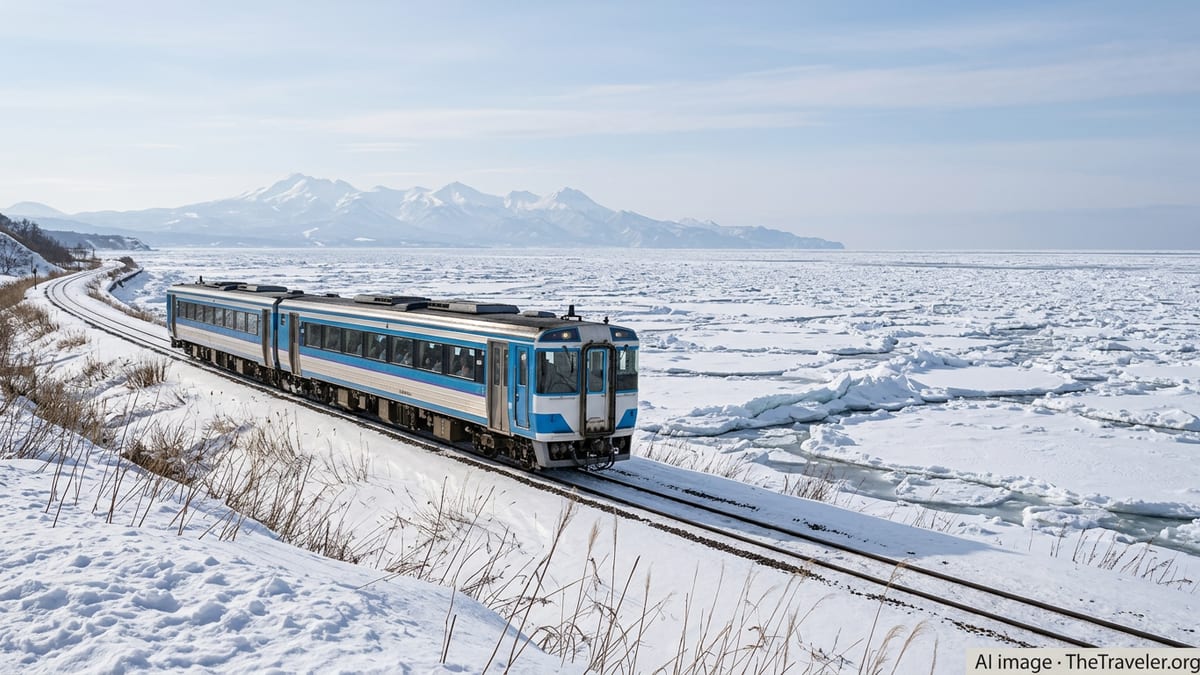
As midwinter grips Japan’s northernmost island, one of Hokkaido’s most unusual rail journeys returns: the Ryuhyo Monogatari Train, a limited-season service that traces the Sea of Okhotsk just as the coastline transforms into a moving white tapestry of drift ice.
A Seasonal Train Timed to the Drift Ice
Operated by JR Hokkaido, the Ryuhyo Monogatari Train is a winter-only sightseeing service that runs along the Senmo Main Line between Abashiri and Shiretoko-Shari, a stretch of track famed for its proximity to the Sea of Okhotsk. The route is active only during peak drift ice season, when floes that originate near the mouth of the Amur River descend on Hokkaido’s eastern shore and lock the coastline in a frozen mosaic.
For the 2026 season, the train is scheduled to operate from January 31 to March 1, with an additional weekend of services on March 7 and 8. Timetables typically feature two round trips a day, synchronized with the limited daylight hours so passengers can maximize time spent watching the drifting ice fields off the starboard side of the train. Services are marketed as event trains, but they run on regular JR tracks and connect seamlessly with Hokkaido’s broader rail network.
The train’s compact formation, usually two diesel cars, is a deliberate choice for this remote line where heavy snow, high winds, and freezing coastal temperatures are routine. Windows are oversized for better viewing, and the train operates at reduced speed along key sections, giving passengers more time to photograph or simply absorb the stark winter scenery.
Demand is bolstered by the Ryuhyo Monogatari’s status as one of the few rail journeys in Japan that is explicitly built around a natural phenomenon. Unlike cherry blossom or autumn foliage trains, which can shift timetables based on annual conditions, this service is programmed to coincide with the most statistically reliable window for drift ice off the Okhotsk coast.
From Abashiri to Shiretoko-Shari: A Coastal Story in Motion
The journey begins in Abashiri, a small port city on Hokkaido’s northeastern edge that has grown into a hub for winter tourism. From here, the Ryuhyo Monogatari Train heads east, hugging the shoreline where the sea often appears more white than blue in February. On clear days, the snow-covered Shiretoko mountain range looms beyond the ice floes, framing the horizon with jagged peaks.
One of the most anticipated moments comes when the train slows near sections where the tracks seem to run almost directly above the frozen shoreline. Passengers commonly crowd the seaward windows to photograph the thick slabs of ice, often stacked and ridged where currents and wind have compressed the floes into sculptural formations. Depending on conditions, the landscape can shift from loose patches of floating shards to an almost continuous white plain stretching toward Russia.
At Kitahama Station, trains running from Abashiri toward Shiretoko-Shari make a roughly 10-minute stop, allowing passengers to step onto the platform and climb a small observation deck. From there, the view opens to an uninterrupted sweep of the drift-ice-covered Sea of Okhotsk, with the wooden station building and its rustic waiting room providing a snapshot of classic rural Hokkaido rail culture.
On the return leg toward Abashiri, the train typically pauses at Hama-Koshimizu Station, where a roadside station complex offers local snacks and souvenirs. Here, passengers can briefly warm up indoors, shop for regional specialties, or simply stand outside to feel the sharp Okhotsk wind that shapes the surrounding dunes and coastal wetlands.
Onboard Experience: Local Flavors and Limited-Edition Livery
Although the Ryuhyo Monogatari covers just 37.3 kilometers end-to-end, operators have leaned into the journey’s storytelling potential. Seasonal announcements explain the science behind drift ice and introduce local history, while onboard sales counters stock regional products, from snacks made with Hokkaido dairy to souvenirs themed around the train’s signature ice-blue and white color scheme.
The train’s paintwork itself has become part of its appeal. Special livery in blue and white is designed to echo both the color of the Okhotsk Sea and the crystalline hues of compressed ice, standing out vividly against the region’s deep winter snowpack. For photographers waiting at rural crossings or small stations, the bright two-car set cutting through a monochrome landscape has become an iconic seasonal sight.
Inside, seating is largely non-reserved, with some trains designating specific sea-facing rows as reserved seats during busier periods. Wide windows and relatively open interiors reflect the service’s primary mission as a rolling observatory. Families, solo travelers, and rail enthusiasts often share benches, swapping tips about the best spots to photograph the ice or comparing notes on other winter trains such as the SL Fuyu-no-Shitsugen, which runs farther south through the Kushiro Wetlands.
Collaborations add another layer of interest. Recent seasons have seen tie-ins with pop culture set in eastern Hokkaido, including themed announcements, limited-edition merchandise, and signage that highlights real-life locations featured in games and dramas. These crossovers are aimed at younger travelers and repeat visitors already familiar with the region’s classic winter attractions.
Planning a Winter Journey in Eastern Hokkaido
For international visitors, the Ryuhyo Monogatari Train slots neatly into broader itineraries across eastern Hokkaido. Abashiri is reachable from Sapporo via the Limited Express Okhotsk service, and many travelers pair the rail journey with a cruise on the Aurora icebreaker ship, which departs from a terminal near Abashiri’s waterfront and cuts directly through the drift ice fields.
Rail passes, including regionally focused products that cover JR Hokkaido lines, can help reduce costs on longer stays, though passengers still need to purchase limited express surcharges or reserved seat tickets where applicable. For the Ryuhyo Monogatari itself, seat availability can be tight on weekends and holidays, so travelers are advised to secure reservations through JR Hokkaido’s official channels or authorized international agents as soon as seasonal schedules are released.
Accommodation choices in Abashiri range from business hotels near the station to ryokan-style properties closer to the sea, while Shiretoko-Shari serves as a gateway to the Shiretoko Peninsula. Buses link Shiretoko-Shari Station with the resort area of Utoro, opening up activities such as guided walks on the drift ice, night-time light festivals, and wildlife tours that search for sea eagles along the coast.
Given the severity of winter in this part of Hokkaido, preparation is crucial. Daytime temperatures often remain below freezing, and strong winds off the Sea of Okhotsk can make platforms and observation decks feel significantly colder. Travelers are encouraged to pack insulated boots, windproof outerwear, and hand warmers, especially if they plan to spend extended periods outside at viewpoints or on icebreaker decks.
A Changing Landscape for Hokkaido’s Scenic Trains
The Ryuhyo Monogatari Train operates at a time when Hokkaido’s railways are rethinking how to sustain rural lines with declining populations and harsh operating conditions. JR Hokkaido has increasingly turned to seasonal and themed services to draw visitors to remote corridors, transforming what were once purely functional routes into tourist attractions in their own right.
Looking ahead, new sightseeing trains are set to join the network later in the decade, including services timed to the same drift ice season that defines the Ryuhyo Monogatari’s appeal. These projects, featuring upgraded rolling stock and enhanced onboard experiences, underline how critical winter tourism has become to the viability of eastern Hokkaido’s transport infrastructure.
For now, the Ryuhyo Monogatari remains a compact but powerful showcase for the region’s winter landscapes. It connects coastal communities to a global audience of rail fans and nature travelers who might otherwise never witness drift ice at such close range. With each short run along the Senmo Line, the train tells a story of a coastline defined as much by the sea’s frozen surface as by the land itself.
As the 2026 operation period approaches, local tourism boards and national rail enthusiasts alike are highlighting the train as a must-ride experience for the coming season. For visitors willing to embrace subzero temperatures and shifting ice fields, the Ryuhyo Monogatari offers one of Japan’s most distinct seasonal journeys, revealing a side of Hokkaido that only truly comes alive in the depths of winter.