

More news on this day
One of Europe’s most dramatic rail journeys is drawing fresh global attention as the Bernina Express, the panoramic train linking Switzerland and northern Italy, rolls into 2026 with record demand, new premium offerings and a spotlight on its UNESCO-listed Alpine landscape.
Get the latest news straight to your inbox!
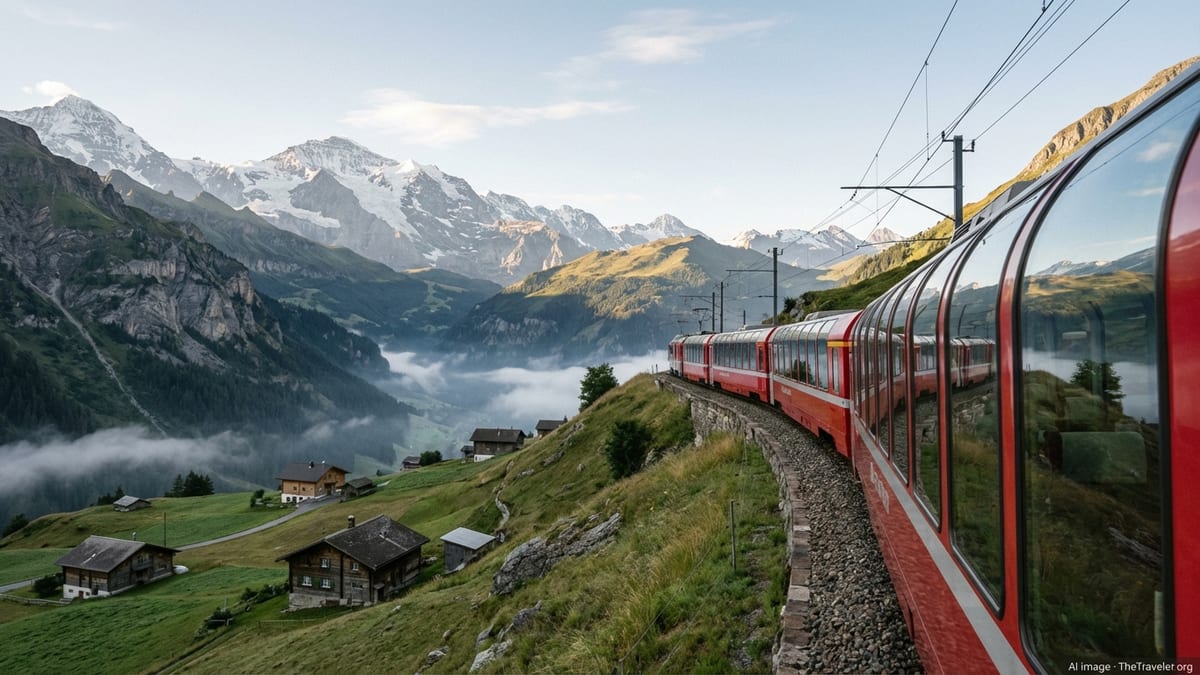
A High-Alpine Line Connecting Switzerland and Italy
The Bernina Express is operated by Switzerland’s Rhaetian Railway and connects the historic city of Chur and the resort of St Moritz with Tirano in Italy’s Valtellina region. Publicly available information shows that the train crosses the Engadin Alps on what is promoted as the highest rail route over the Alps without rack assistance, climbing to around 2,253 meters at the Bernina Pass before descending toward the Italian border.
The line forms part of the Rhaetian Railway in the Albula and Bernina Landscapes, which are recognized as a UNESCO World Heritage site. Marketing materials highlight a route that threads through 55 tunnels and over 196 bridges, including the celebrated Landwasser Viaduct and the spiral Brusio Circular Viaduct. Panoramic carriages with floor-to-ceiling windows are designed to frame these landmarks along with glaciers, turquoise lakes and high Alpine pastures.
Travelers can ride the full route between Chur and Tirano or opt for the shorter St Moritz to Tirano section, which focuses on the most mountainous stretch. Several rail-planning platforms describe the journey as an all-season experience, with snowbound winter scenes giving way to wildflower meadows in late spring and autumn foliage on the Italian side of the border.
Passenger Demand Surges on the Bernina Line
Recent rail-industry reporting indicates that demand on the Bernina line has risen sharply as travelers seek low-carbon alternatives to short-haul flights and road trips through the Alps. Figures cited in sector coverage show the Bernina Express carrying more than 400,000 passengers between January and October 2025, a double-digit percentage increase on the previous year.
The surge reflects a wider trend in Alpine tourism toward scenic rail journeys, with the Bernina Express often paired with Switzerland’s Glacier Express and regional lines as part of multi-day itineraries. Travel media and tour operators describe the train as a flagship of the “Grand Train Tour of Switzerland,” a marketing concept that links the country’s most scenic rail routes into a single network.
Rhaetian Railway has publicly outlined plans to respond to this demand by integrating Bernina Express services more tightly into its regular timetable and by expanding the fleet of panoramic coaches. Rail news outlets report that the operator is working to increase capacity while balancing the heritage character of the route and the limited infrastructure of a century-old mountain railway.
New Premium Products and Seasonal Timetables for 2026
For 2026, the Bernina Express is being positioned with a more layered product range. A recently published fact sheet by the railway outlines the introduction of a Pullman Class from summer 2026, adding a higher-end option above the existing first and second classes. The new class is expected to offer upgraded interiors and a more exclusive ambience on selected departures.
Public documentation also confirms that a supplement remains mandatory for travel in the panoramic Bernina Express cars, regardless of class, and is charged in addition to a standard ticket or rail pass. Seasonal supplements are listed for peak and off-peak periods, with long-distance services between Chur and Tirano attracting higher fees during the core summer months from early May to late October.
Timetable information for the coming winter and summer seasons shows at least one daily direct train between Chur and Tirano in each direction during low season, alongside short-run services between St Moritz and Tirano. From December 2025 through early May 2026 and again from late October to mid-December 2026, the railway applies a winter timetable that reduces frequencies slightly but maintains year-round connectivity across the pass, subject to weather and maintenance work.
Travel-planning sites note that regional trains on the same route remain available without the panoramic supplement, providing flexibility for budget travelers and for visitors who wish to break the journey in intermediate villages such as Pontresina or Poschiavo.
A Window on UNESCO Landscapes and Climate-Conscious Travel
Coverage from tourism organizations and travel media consistently emphasizes the Bernina Express as a showcase for sustainable Alpine tourism. Powered by electricity and integrated into Switzerland’s broader rail network, the service is promoted as a lower-emission alternative to road-based sightseeing or domestic flights between Swiss and northern Italian hubs.
The UNESCO listing for the Albula and Bernina sections of the Rhaetian Railway highlights the technical achievement of building a standard-gauge mountain line that harmonizes with the landscape through curves, tunnels and viaducts that follow natural contours. Scenic highlights marketed to visitors include the Landwasser Viaduct’s stone arches, the gleaming Lago Bianco near the pass summit and the terraced vineyards that appear as the train descends toward Tirano’s milder microclimate.
Tourism boards in both Switzerland and Italy frame the route as a cultural bridge as much as a scenic one, pointing to the contrast between German-speaking Graubünden and Italian-speaking Valtellina. In practice, this means that travelers can step off a train that has crossed glaciers and high passes and be sampling Italian coffee or local specialties within minutes of arrival in Tirano.
Practical Considerations for Travelers in 2026
As the Bernina Express heads into its busiest years yet, practical information is becoming increasingly important for would-be passengers. Publicly available booking data and forum discussions suggest that peak summer departures, particularly on the Chur to Tirano route, can sell out weeks in advance, prompting calls from rail commentators to secure reservations early.
Information published by the Rhaetian Railway and travel-advice sites stresses that two components are needed for the panoramic train: a valid ticket or rail pass for the underlying journey and a separate seat reservation or supplement for the Bernina Express coaches. Holders of products such as the Swiss Travel Pass or Eurail can typically cover the base fare but still require paid reservations for the panoramic service.
Travel features and user reports underline that travelers should monitor scheduled engineering works, as maintenance on sections of the Bernina line can lead to temporary bus replacement services, which lack the panoramic windows of the train. Recent notices have highlighted short periods when tracks between key intermediate stations were closed for upgrades, with buses following a similar but not identical route along the valley roads.
Despite these occasional disruptions, the Bernina Express remains one of the most reliable and accessible Alpine experiences for international visitors. With new premium offerings scheduled from summer 2026, sustained high demand and a growing reputation as a pillar of climate-conscious travel, the route between Chur, St Moritz and Tirano is set to remain a headline journey for travelers crossing the Alps by rail.