

More news on this day
Switzerland’s Glacier Express is gearing up for its 2025–2026 operating seasons with updated timetables, enhanced premium services and fresh demand for one of Europe’s most sought-after scenic rail journeys through the Alps.
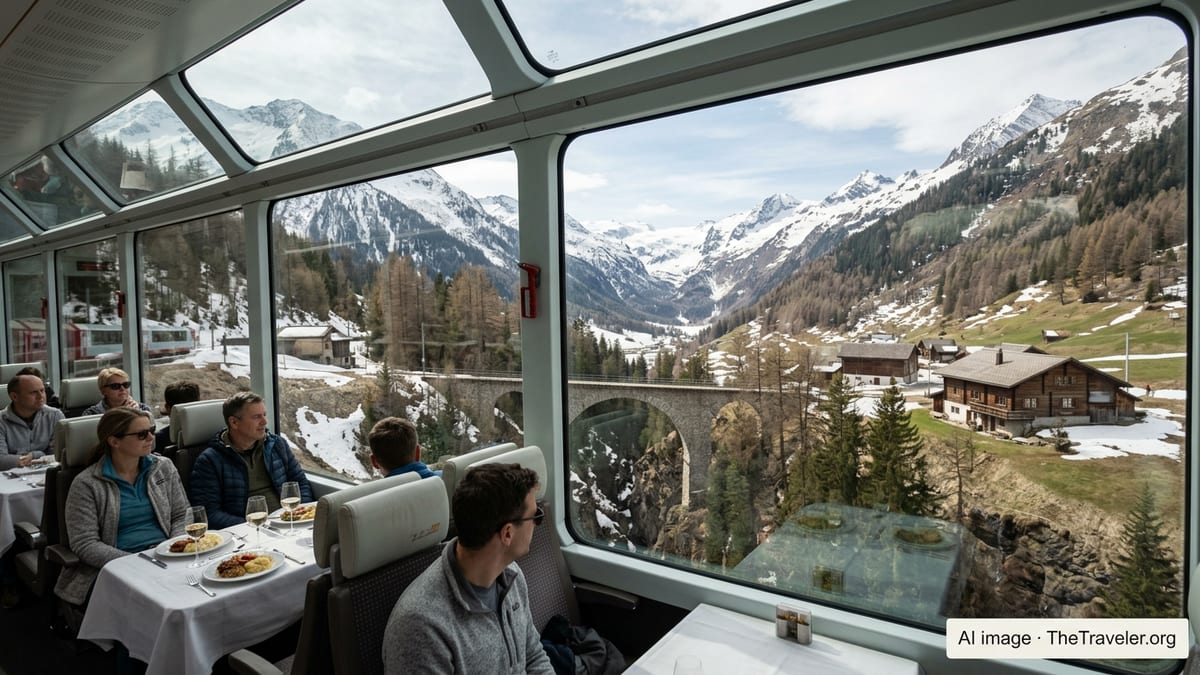
An Eight-Hour Panorama Across the High Alps
Marketed as the slowest express train in the world, the Glacier Express links Zermatt at the foot of the Matterhorn with the resort town of St. Moritz in about eight hours, tracing a single continuous arc through some of Switzerland’s most dramatic Alpine landscapes. Panoramic carriages with floor to ceiling windows are designed to maximise views of deep gorges, high passes and river valleys that unfold in quick succession along the route.
According to the latest information from the operator, the train crosses 291 bridges and passes through 91 tunnels between Valais and the Engadine, climbing to more than 2,000 metres above sea level on the Oberalp Pass. The broad glass panels extend into the roofline, giving passengers unobstructed sightlines of snow fields, larch forests, stone villages and distant glaciers that would be difficult to experience from winding mountain roads.
The route is fully panoramic from end to end, but several sections remain particular highlights for photographers and first time visitors. These include the ascent from Andermatt toward the Oberalp Pass, winter views along the young Rhine near Disentis and the approach to the Landwasser Viaduct, where the train curves out of a cliff tunnel onto a stone bridge anchored high above the valley floor.
Updated Timetable and Seasonal Operations for 2026
The current timetable shows the Glacier Express operating in two main seasons for 2025–2026. The winter schedule runs from 6 December 2025 to 1 May 2026, with at least one daily service in each direction between Zermatt and St. Moritz and additional departures on peak winter dates. The summer season follows from 2 May to 10 October 2026, when a second daily train on the full route increases capacity during the warmest months.
In winter, a morning departure from Zermatt typically leaves just before 9 a.m., reaching St. Moritz late in the afternoon, while a corresponding train sets off from St. Moritz slightly earlier to arrive in Valais by early evening. Summer sees two departures in each direction at roughly hourly intervals in the morning, allowing travellers to combine the ride with same day onward connections across the Swiss rail network.
There are, however, key gaps that prospective passengers must watch. The Glacier Express will not operate at all between 11 October and 4 December 2026 because of the annual maintenance break on the route. In addition, rail authorities have scheduled short term works on some line segments in March 2026, with replacement buses covering the Chur to Domat Ems stretch over one weekend. Travellers are being advised to check dates carefully, particularly for shoulder season journeys that fall near the edges of the operating windows.
Rising Demand, Higher Reservation Fees and Capacity Pressure
Interest in the Glacier Express has remained strong in the post pandemic recovery, with rail forums reporting heavily booked summer departures and limited last minute availability in higher classes for peak weeks. On some dates, first class and the top tier Excellence Class have sold out months in advance, a trend that industry observers attribute to the train’s global profile and the wider boom in rail based tourism.
In response, operators have kept the mandatory seat reservation system in place and confirmed that fees will rise from December 2025. From 6 December 2025 onward, the reservation supplement in both first and second class will increase to 54 Swiss francs per person for any segment, while the Excellence Class reservation will be set at 540 Swiss francs on top of a valid first class ticket. The higher supplements are intended to manage demand on busier days and support on board service upgrades.
For travellers considering the journey in 2026, the combination of higher reservation costs and strong global interest is pushing many to book well ahead of time, especially for holiday periods and school vacation weeks. Swiss rail passes and saver tickets remain valid for the basic transport component, but do not remove the obligation to reserve a seat and pay the supplement on the Glacier Express itself.
Excellence Class Elevates the Luxury Rail Experience
At the very top of the product range, the Glacier Express has continued to refine its Excellence Class, a dedicated premium coach that offers an upmarket alternative to conventional first class. The carriage is configured with lounge style seating and a guaranteed window seat for every guest, with a concierge on board to coordinate services from welcome drinks to luggage assistance at the platform.
The official specifications for Excellence Class highlight a multi course seasonal tasting menu prepared in the train’s kitchen, paired with regional wines and served at the seat over the course of the journey. Passengers receive an aperitif on boarding, access to an exclusive Glacier Bar at one end of the carriage and use of individual tablets that provide route information, a moving map, historical notes and an entertainment system during quieter stretches of the trip.
Excellence Class is only sold for the full distance between Zermatt and St. Moritz or the reverse direction and is available throughout the published operating period, with one significant exception in 2026. The operator has confirmed that Excellence Class will not run between 9 March and 27 March 2026 because of scheduled works and service adjustments, even though standard panoramic carriages will continue to operate during that window.
Choosing the Best Season for Panoramic Views
Debate continues among travellers over whether winter or summer is the better time to ride the Glacier Express, and the 2026 timetable offers opportunities for both. Winter departures typically reveal snow covered pastures, frozen lakes and ice edged rivers, with low sun and long shadows accentuating the texture of rock faces and forests. Clear January and February days can deliver striking contrast between bright snowfields and deep blue skies, though storms may occasionally limit distant views.
Summer journeys, by contrast, showcase green valleys, open alpine meadows and lakes that turn shades of turquoise and deep blue as the snowmelt progresses. Windows can be opened slightly in some vestibule areas at intermediate stops, giving photographers a chance to avoid reflections while capturing viaducts and stone villages. Higher summer frequencies also make it easier to combine the Glacier Express with secondary scenic lines such as the Bernina route or the Gotthard corridor on adjacent days.
For those seeking quieter carriages and lower crowds, late spring and early autumn remain attractive options. Services in early May and late September often offer a balance of relatively mild temperatures and more available seats, while still preserving much of the panoramic drama that has made the Glacier Express one of Europe’s flagship scenic trains.