

More news on this day
Bhutan’s tourism revival is colliding with a new wave of global instability, as soaring fuel prices and geopolitical tensions threaten to push up air fares, squeeze airline margins and test the country’s carefully calibrated high-value, low-volume tourism model.
Tourism Recovery Meets a New Cost Shock
After a slow, cautious reopening from the pandemic, Bhutan’s visitor numbers have surged over the past two years, with more than 200,000 tourists estimated to have entered the kingdom in 2025, according to recent government and industry data. Authorities credit the rebound to targeted marketing, streamlined entry procedures and a recalibrated Sustainable Development Fee designed to attract longer-stay, higher-spending visitors while preserving cultural and environmental integrity.
The rapid recovery has raised hopes that tourism can again anchor foreign exchange earnings and job creation, alongside hydropower exports. Tour operators report renewed interest from key markets such as India, Europe and North America, while hotel construction and trekking services have scaled up to meet anticipated demand.
Yet this upswing is unfolding against a dramatically altered global backdrop. The sudden spike in oil and gas prices linked to conflict around the Persian Gulf and disruptions in the Strait of Hormuz has driven up jet fuel costs worldwide, reversing the relative price stability that supported aviation’s post-pandemic rebound. Airlines across Asia, including those serving small, landlocked markets like Bhutan, now face higher operating costs just as they seek to consolidate fragile route networks.
For Bhutan, where nearly all international leisure visitors arrive by air and tourism depends on a limited number of carriers and routes, the timing is particularly sensitive. Industry stakeholders warn that without careful policy coordination, rising costs risk eroding the competitiveness of a destination that already positions itself at the premium end of the global market.
Bhutan’s Airlines Navigate Fuel Prices and Fragile Routes
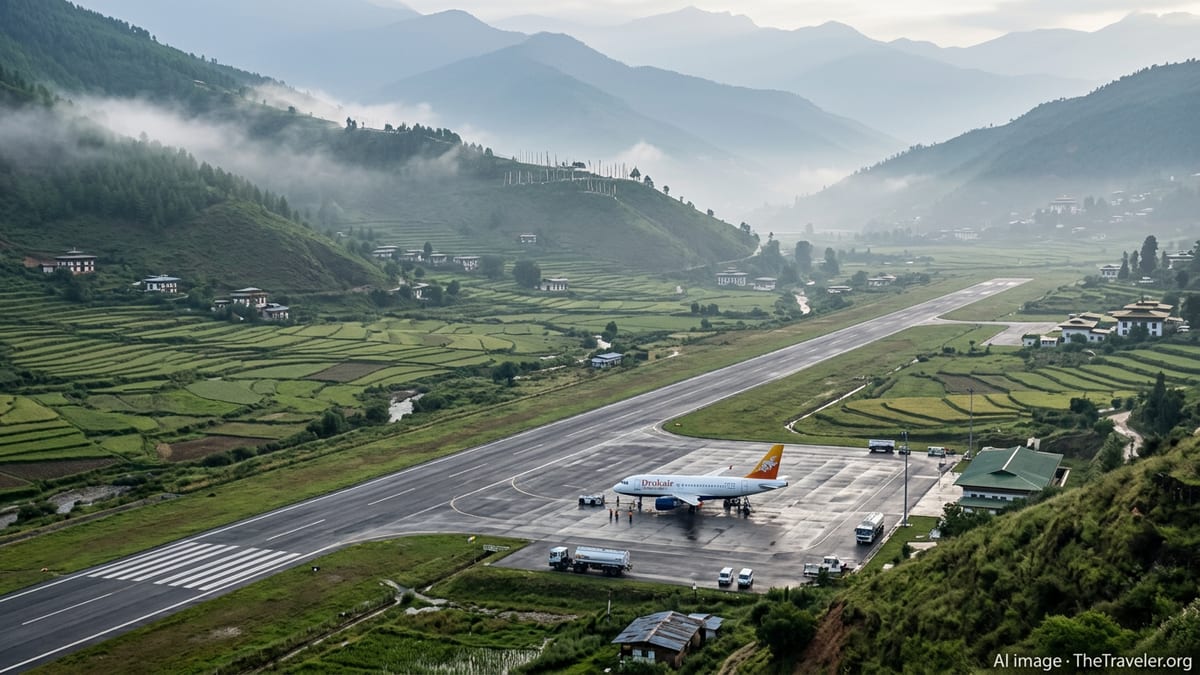
Bhutan’s aviation sector is dominated by national carrier Drukair and private airline Bhutan Airlines, which operate a modest fleet of narrow-body jets and turboprops linking Paro to a handful of regional hubs including Delhi, Bangkok and Kathmandu. These airlines already contend with unique structural challenges, from short, weather-sensitive runways hemmed in by Himalayan terrain to strict safety margins that limit payload and seating capacity.
In this context, jet fuel expenses account for a disproportionately high share of operating costs. As global oil benchmarks have climbed in response to supply fears and shipping disruptions in the Middle East, fuel bills for regional carriers have risen sharply. Aviation analysts in South Asia say smaller airlines with limited hedging capacity and thin balance sheets are among the most exposed to extended price spikes.
Bhutan’s carriers have historically deployed a mix of modest fare adjustments and seasonal promotions to manage volatility, but industry officials suggest the current environment may require more explicit fuel surcharges, particularly on longer regional legs. Any such move risks pushing ticket prices further beyond those of competing Himalayan and South Asian destinations, particularly for travelers originating in price-sensitive markets.
Route planning is also under pressure from wider geopolitical turbulence. Prolonged airspace restrictions in parts of South and Central Asia, combined with longer routings adopted by many international airlines to avoid conflict zones, are shortening connection windows and narrowing options for Bhutan-bound passengers. Aviation planners warn that if regional hubs cut frequencies or up-gauge aircraft in response to their own cost pressures, Bhutan could see reduced connectivity or inconvenient schedules that undercut its appeal for short-stay, high-spend visitors.
High-Value, Low-Volume Tourism Under Strain
The cornerstone of Bhutan’s tourism policy remains its high-value, low-volume approach, anchored by the Sustainable Development Fee levied on most international visitors. The government argues that this model allows it to cap environmental impact, fund public services and ensure that tourism revenues support Gross National Happiness priorities rather than unchecked mass tourism.
Recent policy tweaks, including time-bound SDF discounts and waivers for meetings and incentive groups, have sought to stimulate demand and encourage longer stays without abandoning core principles. Official data shows tourism revenue climbing alongside arrivals, even if the sector has yet to regain its pre-pandemic peak.
However, rising aviation costs are now complicating this delicate equation. As air tickets absorb more of a traveler’s budget, the space for premium land packages, higher-end accommodations and guided cultural experiences may narrow. Tour operators report that some potential visitors, particularly families and mid-market travelers from the region, are recalibrating trip lengths or downgrading hotel categories to offset higher flight prices.
Within Bhutan, industry voices are increasingly vocal about what they describe as “rising arrivals but shrinking returns.” Hoteliers in secondary towns say occupancy rates and average daily rates remain soft even as headline visitor numbers improve, suggesting that spending is unevenly distributed and that leakages through foreign intermediaries remain significant. If geopolitical pressures keep fuel prices elevated, these concerns are likely to intensify, forcing policymakers to reassess how far the SDF and tax regime can buffer domestic operators from global shocks.
Government Weighs Policy Tools to Protect Connectivity
Bhutanese officials have framed tourism as a strategic pillar in the country’s long-term economic roadmap, alongside initiatives such as the Gelephu Mindfulness City and efforts to diversify beyond hydropower. Protecting reliable, affordable air links is therefore emerging as a policy priority, even if direct control over global energy markets and regional geopolitics is limited.
Economic planners are examining a range of options, from temporary fiscal relief on aviation fuel and ground handling charges to risk-sharing arrangements that make marginal routes more viable for domestic carriers. While any subsidy carries budgetary trade-offs, proponents argue that maintaining regular services to key hubs is essential for safeguarding tourism, business travel and medical and educational journeys abroad.
Regulators are also under pressure to improve coordination between aviation and tourism policy. Industry groups want more predictable timelines for SDF adjustments, visa rule changes and marketing campaigns, arguing that frequent shifts make it harder to plan capacity, set fares and negotiate code-share or interline agreements with regional partners. Greater transparency over long-term traffic and revenue targets, they say, would give airlines clearer signals about where to invest scarce aircraft and crew resources.
At the same time, consumer advocates warn that any support for airlines must be matched with protections for passengers, including better disclosure of surcharges and commitments to maintain minimum service levels on critical routes. Striking this balance will be key as Bhutan navigates an environment in which neither fuel prices nor geopolitical tensions show signs of stabilising quickly.
Pivoting Toward Resilience and New Tourism Niches
Within the tourism sector, rising transport costs are accelerating a shift toward higher-yield niches that can better absorb premium pricing. Travel planners report growing interest in wellness retreats, long-stay cultural residencies and immersive trekking itineraries that align with Bhutan’s spiritual identity and landscapes. These products tend to attract visitors who are less price-sensitive to air fares and more focused on authenticity and impact.
The government’s broader economic diversification agenda also intersects with these trends. Gelephu Mindfulness City, envisioned as a hub for wellness, education and green innovation, is being marketed as a gateway for investors and visitors seeking deeper engagement with Bhutan’s values. If realised, such projects could create new aviation demand profiles, with more business and conference travel supplementing traditional leisure flows and smoothing seasonality for airlines.
Meanwhile, there is renewed emphasis on spreading tourism benefits beyond the well-trodden western circuit of Paro, Thimphu and Punakha. Developing regional airports and improving overland connections could give Bhutan some resilience against disruptions in a single gateway, though terrain and cost constraints remain formidable. Community-based tourism initiatives in central and eastern districts aim to ensure that any growth driven by high-value visitors translates into local livelihoods rather than concentrating gains in a few urban centres.
For now, Bhutan’s aviation and tourism sectors are bracing for a period of heightened uncertainty, where energy markets and distant conflicts play an outsized role in shaping flight schedules, ticket prices and visitor behaviour. How effectively the kingdom can adapt its policies, support its small airlines and refine its high-value tourism offer may determine whether the current turbulence becomes a temporary headwind or a structural test of its development model.