

More news on this day
Rising jet fuel prices tied to renewed conflict in the Middle East are starting to reshape airline economics worldwide, with carriers adjusting ticket prices, revising schedules and rethinking flight paths ahead of the peak summer travel season.
Get the latest news straight to your inbox!
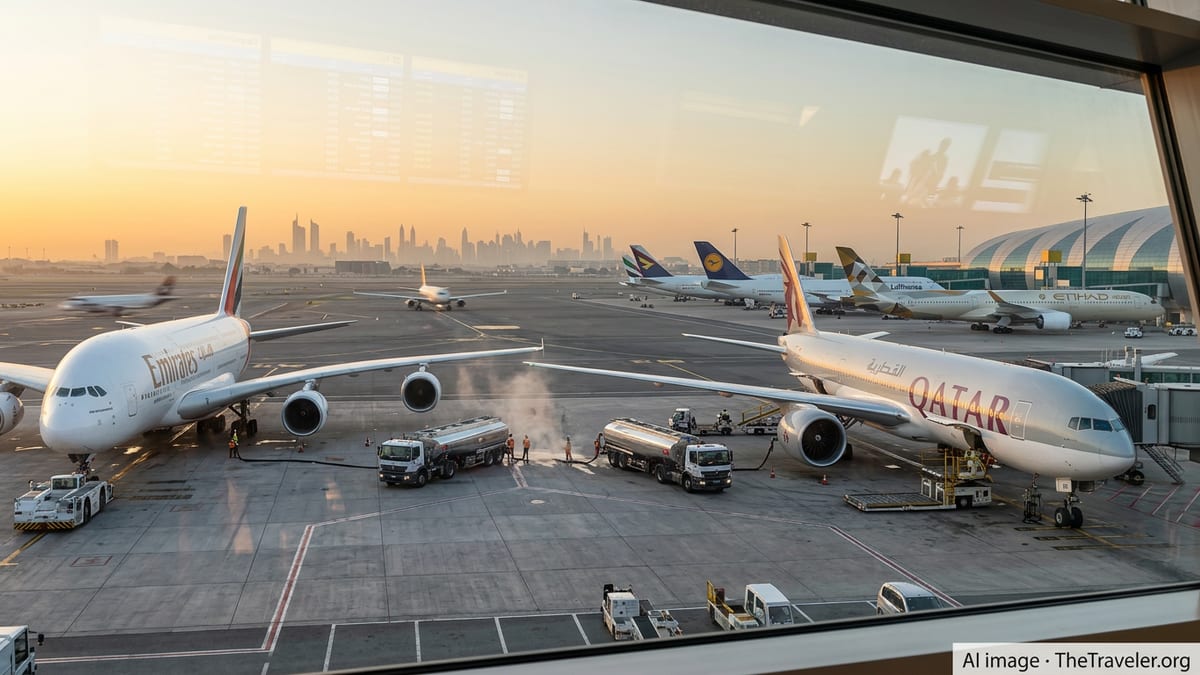
Middle East Conflict Sends Oil and Jet Fuel Costs Higher
Oil markets have swung sharply in recent days as fighting in the Middle East disrupts key export routes and raises fresh concerns about supply security. International benchmark Brent crude briefly surged above 119 dollars a barrel in early March 2026, the highest level since the months following Russia’s invasion of Ukraine, according to recent economic coverage. That spike is feeding directly into the cost of refined products such as gasoline, diesel and jet fuel.
Industry data compiled by the International Air Transport Association’s Jet Fuel Price Monitor and regional traffic reports indicate that average jet fuel prices have climbed to their highest levels since mid-2024. A recent European aviation overview put the global average at around 2.45 dollars per gallon at the end of February, up about 7 percent in just two weeks and noticeably above the 2025 yearly average.
The conflict is affecting supply on several fronts. Reports describe interruptions and delays affecting crude shipments out of the Gulf, as well as heightened risks to pipelines, export terminals and tanker traffic in the region. Some oil producers have signaled cutbacks or slower exports while transport risks are reassessed, tightening the balance in an already sensitive market.
For airlines, the result is a rapid and unplanned increase in one of their largest expenses. Industry analyses regularly cite fuel as accounting for roughly one quarter to one third of an airline’s operating costs, and in some business models even more. When prices move suddenly, carriers have limited short-term options beyond adjusting capacity and fares.
Airlines Move to Raise Fares and Add Fuel Surcharges
With jet fuel now significantly more expensive than at the start of the year, airlines in several regions have begun passing part of the burden to travelers. Coverage in Asia and the Middle East describes a wave of new or higher fuel surcharges on long-haul and regional routes, often applied as separate line items on tickets to reflect the volatility of fuel costs.
Recent reporting from Gulf-based outlets notes that carriers in the region, along with airlines in markets such as Australia and Hong Kong, have announced or implemented fare increases in the mid-single to high-single digit range on select international routes. One major Asia-Pacific airline cited a sharp jump in jet fuel prices as it raised average international fares by around 5 percent, while another increased fuel surcharges on leisure routes to the Maldives, Nepal and parts of South Asia by more than 30 percent.
In Europe, economic coverage referencing IATA briefings suggests that overall ticket prices could climb by roughly 8 to 9 percent if current fuel costs persist, particularly on longer flights that burn more fuel per passenger than short domestic hops. Some large European airline groups say their short-term hedging strategies are providing a temporary buffer, but many low-cost or smaller carriers have less protection and may need to react more quickly.
In North America, airlines have so far been more cautious about across-the-board price increases, but executives quoted in recent U.S. business reports have warned that higher fares are likely if jet fuel remains elevated into the main summer travel period. Analysts note that, without substantial hedging, airlines that delay adjustments risk seeing profit margins eroded just as demand for international travel is strengthening.
Rerouted Flight Paths Add Distance, Time and Fuel Burn
Beyond higher fuel prices themselves, the conflict is also disrupting traditional flight corridors through and around the Middle East, adding further cost pressure. Publicly available flight-tracking data and aviation analyses show airlines rerouting some services to avoid airspace perceived as higher risk, particularly for long-haul flights linking Europe with Asia and Oceania.
Some flights that previously crossed portions of Iranian or nearby airspace are now operating along more southerly or northerly tracks, which can lengthen flight times and require additional fuel reserves. Reports detailing recent traffic into major Gulf hubs have highlighted temporary holding patterns and reroutes linked to security alerts, illustrating how quickly operational conditions can change.
For ultra-long-haul services, even modest deviations can have outsized impacts. An extra 30 to 60 minutes of flying time can significantly increase fuel burn, sometimes pushing aircraft closer to range limits or forcing weight restrictions. Airlines may need to cap passenger numbers or cargo loads on certain days to meet performance and fuel requirements, reducing revenue potential even as costs increase.
Network planners must balance safety assessments, airspace restrictions, crew duty time rules and airport scheduling constraints when redesigning routes. Each change can trigger a cascade of operational adjustments, from revised connection banks at hubs to altered maintenance windows. All of this feeds into higher unit costs at a time when fuel itself is already sharply more expensive.
Travelers Face Rising Costs and Regional Differences
For passengers, the combined impact of higher fuel prices and rerouted flights is beginning to show up in search results and booking engines, particularly for long-haul itineraries that cross or skirt the Middle East. Industry commentary suggests that leisure travelers headed to Europe, Asia or the Indian Ocean this summer may see fewer deep-discount deals and more instances of peak-season surcharges.
The effect is uneven across regions. Europe and parts of Asia, which rely more heavily on Middle Eastern oil supplies and are closer to affected airspace, appear more exposed to cost increases than some North American domestic markets. In several European countries, consumer groups have already noted that advertised fares for key holiday routes are trending higher than at the same point last year, even before traditional last-minute price surges.
Experts cited in recent coverage recommend that travelers book earlier than usual to lock in lower fares before additional adjustments work through airline pricing systems. Flexible dates and the willingness to consider one-stop routes instead of nonstops may also help limit the impact, although some connecting itineraries are themselves affected by rerouting and schedule changes.
Corporate travel buyers are watching the situation closely, as higher long-haul fares can quickly inflate budgets. Some are weighing whether to adjust travel policies, encourage more virtual meetings or shift demand to less affected regions if price differences become more pronounced over the coming months.
Airlines Lean on Fuel Management and Sustainability Strategies
The latest fuel shock is reinforcing a longer-term industry focus on fuel efficiency and alternative energy sources. IATA’s recent analysis on fuel efficiency in 2026 underscores that jet fuel typically makes up 25 to 30 percent of airline operating costs, and that efficiency gains have become harder to achieve as older fleets remain in service longer than planned due to supply chain constraints.
Airlines are accelerating efforts to trim fuel burn where possible, including optimizing flight planning, reducing weight on board and updating procedures for taxiing, climb and descent. While each change may save only a small amount of fuel, aggregated across thousands of flights these measures can partially offset the hit from higher prices and also contribute to emissions reduction goals.
Sustainable aviation fuel remains a central pillar of many airlines’ long-term climate strategies, but its role in the current crisis is constrained by cost and availability. Recent assessments from industry bodies and market analysts indicate that SAF production is still less than 1 percent of global jet fuel consumption and that prices remain several times higher than conventional jet fuel in many markets. As a result, airlines face an additional cost burden in jurisdictions where SAF use is mandated, at the same time as conventional fuel costs are spiking.
Looking ahead, recent economic outlooks for global air transport anticipate ongoing fuel price volatility in 2026, driven by geopolitical risks, refinery constraints and uneven demand growth. For travelers and airlines alike, the latest Middle East conflict is a reminder that route maps and ticket prices remain tightly linked to events far beyond airports, and that both planning and pricing may need to stay flexible as the situation evolves.