

More news on this day
Saudi Arabia’s newest carrier, Riyadh Air, is set to reshape regional skies as it prepares to launch daily Boeing 787 service between Cairo and Riyadh, intensifying competition on one of the Arab world’s busiest corridors and injecting fresh momentum into the tourism surge driven by Vision 2030.
A New Heavyweight on the Cairo–Riyadh Corridor
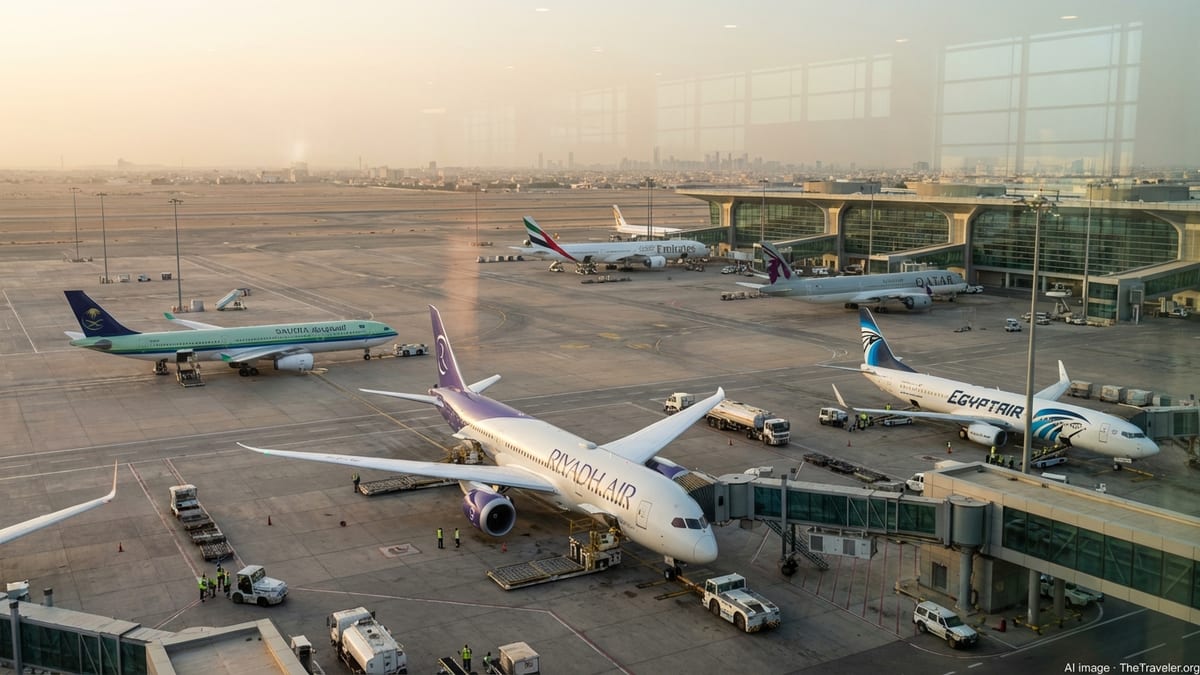
The planned Cairo–Riyadh operation will be Riyadh Air’s first high-frequency route into North Africa, positioning the fledgling Saudi carrier as a direct challenger to long-established operators Saudia, EgyptAir, Emirates, Qatar Airways, flynas and flyadeal on flows between the two regional giants. Industry documents outline plans for daily widebody service, using Boeing 787 aircraft from Riyadh’s King Khalid International Airport into Cairo International Airport, connecting two capitals that already rank among the Middle East’s busiest city pairs.
Unlike its early invitation-only flights to London and Dubai, Riyadh Air’s Cairo route is designed as a workhorse: high-capacity, daily and aimed squarely at the mass market of workers, pilgrims, medical tourists, business travelers and leisure visitors who move between Egypt and Saudi Arabia year-round. With codeshare and strategic cooperation agreements already signed with EgyptAir and other global partners, the route is expected to offer through-ticketing deep into both networks, multiplying the impact well beyond point-to-point traffic.
For Saudi policymakers, the move is not just another route announcement. It is a visible sign of how the kingdom’s Public Investment Fund is using Riyadh Air as a catalyst to expand air connectivity, support new airport infrastructure and accelerate tourism’s rise as a core pillar of the non-oil economy. The Cairo link, connecting the Arab world’s largest population to its fastest-growing tourism market, is central to that strategy.
Vision 2030, Tourism Targets and the Saudi–Egypt Axis
Saudi Arabia’s tourism sector has been expanding at record pace as the government pursues Vision 2030 goals to diversify away from hydrocarbons and position the kingdom as a global leisure, business and religious destination. Official data show that Saudi Arabia welcomed well over 100 million tourists in 2024, with tens of millions arriving from overseas and tourism revenues hitting historic highs. Authorities have set a target of 150 million annual visitors by 2030, with roughly 70 percent expected to be international, backed by an estimated 800 billion dollars in tourism-related investment.
Egypt, for its part, has been racing to rebuild and expand its own tourism industry, leveraging Cairo’s status as a historic gateway to the region and Europe, and its role as a major labor and education hub for the Arab world. Air links to Saudi Arabia underpin everything from Hajj and Umrah pilgrimages to seasonal work migration, medical trips and short-break leisure travel to new Saudi destinations such as AlUla and the Red Sea coast.
Against this backdrop, the daily Riyadh Air service between Cairo and Riyadh is expected to deepen a bilateral travel market that was already among the Middle East’s most resilient. By pairing Saudi Arabia’s ambitious visitor targets with Egypt’s vast pool of outbound travelers and expatriate workers, the route gives concrete form to the vision of a tightly connected tourism ecosystem stretching across the Red Sea.
How One Daily Route Changes Capacity, Choice and Competition
The Cairo–Riyadh corridor is already crowded with big names. Saudia and EgyptAir operate multiple daily rotations, while Emirates and Qatar Airways channel Egyptian and Saudi passengers through their Dubai and Doha mega-hubs. Low-cost players flynas and flyadeal have built dense schedules linking secondary Saudi cities to Egypt, capturing price-sensitive travelers and adding resilience during peak pilgrimage and holiday seasons.
Riyadh Air’s entry with a daily widebody aircraft alters the equation. A Boeing 787 typically offers several hundred seats per flight, meaning that even a single daily rotation can inject thousands of extra weekly seats into the market. That additional capacity gives airlines more room to segment: full-service carriers can pitch premium cabins and seamless connections to Europe, Asia and North America, while low-cost operators focus on volume and price. For consumers, the result is more choice, more time options and, potentially, sharper competition on fares.
The new service also strengthens Riyadh’s push to become a transfer hub in its own right, rather than ceding long-haul connecting traffic to Dubai and Doha. Travelers from Cairo heading to emerging Saudi leisure zones or further afield to Asia and Africa will be able to connect in Riyadh under a single booking. Through its cooperation agreements with EgyptAir and other international airlines, Riyadh Air can offer joint schedules, shared frequent flyer benefits and coordinated timings designed to minimize connection times on both sides of the Red Sea.
For Egypt-based passengers, the daily Riyadh service provides a new premium option on a familiar route. For Saudi Arabia, it is a statement that the capital’s new carrier intends to compete head-to-head with Gulf rivals not only on glamour routes to London and major Asian gateways but also on the bread-and-butter corridors that sustain regional tourism and trade.
Building a Multi-Carrier Bridge Across the Red Sea
The daily Riyadh Air flight will not operate in isolation. It will join a web of services that already link Egypt and Saudi Arabia through a mix of full-service and low-cost models. Saudia is in the midst of a fleet and network expansion as it targets tens of millions more passengers by the end of the decade, while maintaining a significant share of the religious and visiting-friends-and-relatives market. EgyptAir, meanwhile, is leveraging its own hub in Cairo for connections into Africa and Europe and has upgraded its cooperation with Saudi carriers and now with Riyadh Air itself.
Gulf heavyweights Emirates and Qatar Airways continue to play an outsized role on connecting traffic. For Egyptians and Saudis traveling to long-haul destinations in Europe, the Americas or East Asia, itineraries via Dubai and Doha remain attractive, and the arrival of Riyadh Air is likely to intensify competition for that high-yield segment. The Saudi marketplace is also being reshaped from below by flynas and flyadeal, which are expanding fleets and opening new point-to-point routes that bypass traditional hubs and pull secondary Egyptian cities more tightly into the Saudi orbit.
Riyadh Air’s leadership argues that, rather than cannibalizing existing players, the new airline will expand the overall market by stimulating demand, improving connectivity and providing new transfer options that keep more traffic within the Saudi ecosystem. In practical terms, the daily Cairo–Riyadh service will act as a spine onto which additional frequencies, seasonal charters and feeder flights from both countries can be attached, allowing all carriers on the corridor to capture new flows of tourists, business travelers and pilgrims.
As air connectivity grows, so too does the scope for joint tourism campaigns, bundled packages and multi-destination itineraries that combine Saudi Arabia’s new attractions with Egypt’s established draws. Travel companies in both markets are already positioning to market Red Sea twin-center holidays, where visitors split their time between cultural sites in Cairo or Luxor and emerging resorts and heritage sites on the Saudi side.
Riyadh’s Hub Ambition and the Next Phase of Growth
The Cairo route is also a building block in a much broader transformation of Riyadh’s role in global aviation. King Khalid International Airport is slated for a major overhaul and expansion as part of a multi-runway mega-hub project that aims to handle more than 100 million passengers annually by 2030. Riyadh Air is central to that vision, with plans to serve around 100 destinations across six continents by the end of the decade and to contribute billions of dollars to Saudi Arabia’s non-oil gross domestic product.
Saudi officials have made clear that aviation and tourism are the backbone of their diversification efforts. Air connectivity indices show the kingdom climbing rapidly in global rankings as new routes are launched, frequencies added and partnerships signed. The daily Cairo–Riyadh service, though only one link in a much larger network, is emblematic of this shift: a high-density corridor transformed from a functional bridge for workers and pilgrims into a strategic artery for two economies that increasingly see tourism as a core industry.
For travelers, the changes will be felt most directly in the form of more direct flights, shorter journeys and simpler visa processes. For Saudi Arabia and Egypt, the real impact will be measured in hotel occupancies, conference bookings, investment flows and jobs created on both sides of the Red Sea. As Riyadh Air joins Saudia, EgyptAir, Emirates, Qatar Airways, flynas and flyadeal in contesting the Cairo–Riyadh skies, the route is fast becoming a test case for how Vision 2030’s aviation push can translate into a sustained travel boom linking two of the Arab world’s most pivotal capitals.