

More news on this day
Riyadh’s King Khalid International Airport has completed its largest terminal reshuffle since opening, a tightly choreographed overhaul that is set to lift annual capacity to 56 million passengers and rewire how travelers move through the Saudi capital in 2026.
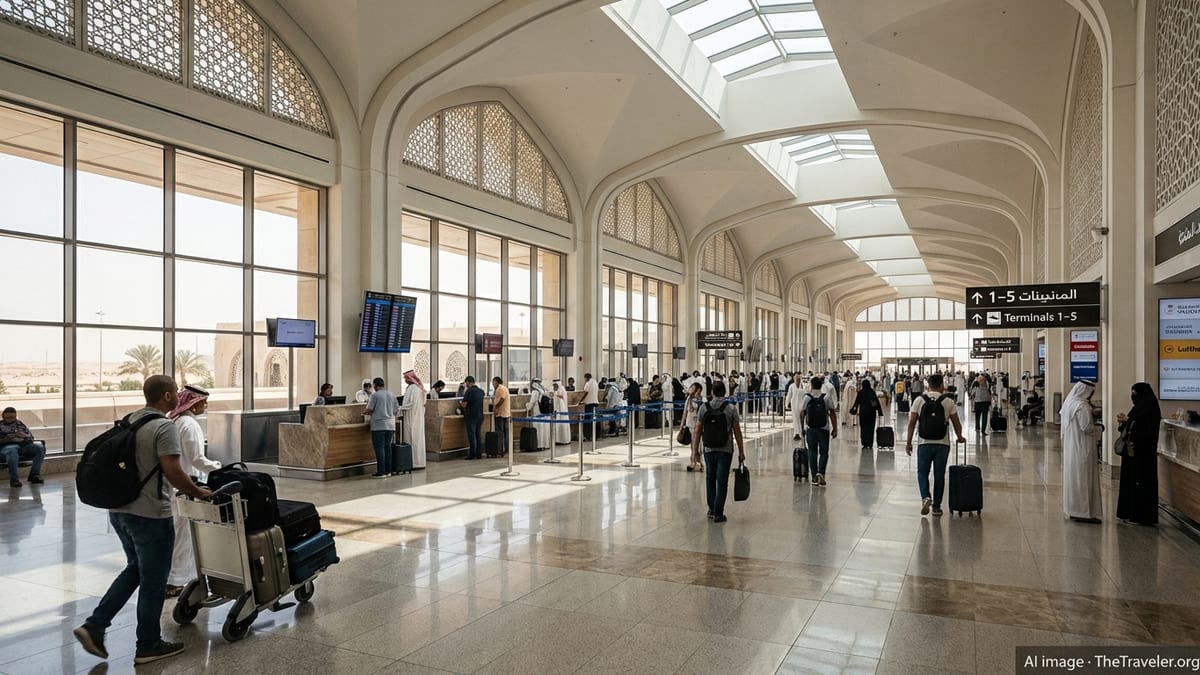
Largest Terminal Transition Since the Airport Opened
The operator, Riyadh Airports Company, confirmed that the terminal transition ran from February 16 to 25, marking the biggest operational change at King Khalid International Airport since it was inaugurated in 1983. The complex, multi-day project was executed while flights continued to operate, with no major disruption reported.
During the transition window, the airport handled more than 1.04 million arriving and departing passengers across over 7,650 flights, underscoring both the logistical complexity and the stakes of the move. Officials framed the exercise as a live stress test of the hub’s readiness for a new growth phase.
The reallocation forms the operational core of a broader transformation plan launched in late 2025, which aims to upgrade capacity, streamline passenger flows and align the capital’s main airport with the Saudi aviation strategy and Vision 2030 targets.
New Terminal Layout Redefines Passenger Flows
Under the new layout, Terminals 1 and 2 are now dedicated to international flights operated by Saudi Arabia’s national carriers, while Terminals 3 and 4 handle their domestic services. Terminal 5 has been assigned exclusively to international flights of foreign airlines, concentrating overseas carriers into a single, purpose-configured facility.
By clustering domestic and international operations for national airlines, planners expect to shorten connection times, cut transfer distances and reduce congestion at security and immigration checkpoints. The redesign also clarifies wayfinding for passengers, who previously faced a more fragmented terminal map.
For foreign carriers, the move to Terminal 5 promises more consistent gate access, streamlined ground handling and easier integration with the airport’s growing retail and hospitality offerings. Several airlines, including major regional and Asian operators, have already confirmed the shift of all Riyadh operations into the revamped terminal during 2026.
Capacity Jumps as Riyadh Chases Hub Status
The terminal overhaul is forecast to raise total annual capacity at King Khalid International Airport from about 42 million passengers in 2025 to 56 million by the end of 2026, a jump of more than one third. Terminals 3 and 4 alone are expected to see capacity climb from 16 million to 25 million passengers a year after the reconfiguration and associated upgrades.
Transit capacity is projected to rise to 7.5 million passengers annually, a key metric as Riyadh pitches itself as a regional connecting hub between Europe, Asia and Africa. Officials say the redesigned terminal mix, together with tighter coordination with airlines on schedules and connection banks, will make the airport more competitive for one-stop itineraries.
The capacity lift comes as Saudi Arabia accelerates investment across its aviation sector, with plans for a new King Salman International Airport on land adjacent to the existing facility. While the future mega-hub targets up to 120 million passengers by 2030, the latest changes at King Khalid International Airport are designed to bridge the capacity gap and support the capital’s rapid traffic growth in the interim.
Operational Playbook: Guides, Shuttles and Free Parking
Behind the scenes, the transition relied on a detailed operational plan drawn up with the Ministry of Transport and Logistics Services, the General Authority of Civil Aviation, Matarat Holding Company and security agencies. More than 650 guides and field support staff were deployed across check-in halls, security points and curbside areas to direct travelers to new departure gates and arrival channels.
To smooth the experience for passengers caught in the middle of the terminal shift, the airport offered one hour of free parking in designated zones and complimentary transport between terminals. Shuttle buses ran every four minutes, while the Riyadh Metro and licensed taxis were integrated into the temporary transfer plan.
Officials say the combination of extra staffing, real-time coordination rooms and expanded digital messaging helped maintain operational stability through the switchover. The playbook, they add, will be used for future phases of the airport’s transformation and for seasonal peaks such as Ramadan and major events.
What the Overhaul Means for Travelers in 2026
For travelers passing through Riyadh this year, the most visible change will be a clearer split between national and foreign airlines and between domestic and international journeys. Passengers connecting on Saudia or other national carriers should benefit from shorter walks between gates, more predictable security queues and improved minimum connection times.
International visitors flying on foreign airlines will find a more consolidated experience in Terminal 5, which is being positioned as a primary gateway for tour groups, business travelers and pilgrims arriving from a widening network of destinations. Airport managers say retail, food and beverage and lounge offerings will expand in line with the terminal’s rising throughput.
Looking ahead, Riyadh Airports Company is expected to use the new 56 million passenger ceiling as a platform for route expansion, additional frequencies and closer coordination with emerging home-based carriers. For now, the completed terminal reshuffle signals that the Saudi capital’s main airport is entering a more ambitious era, with its operations, capacity and passenger experience all recalibrated for the next wave of growth in 2026.