

More news on this day
More than 40 flights were canceled at King Khalid International Airport in Riyadh amid ongoing regional airspace upheaval, leaving hundreds of travelers stranded and scrambling to rebook or reroute their journeys across the Gulf.
Get the latest news straight to your inbox!
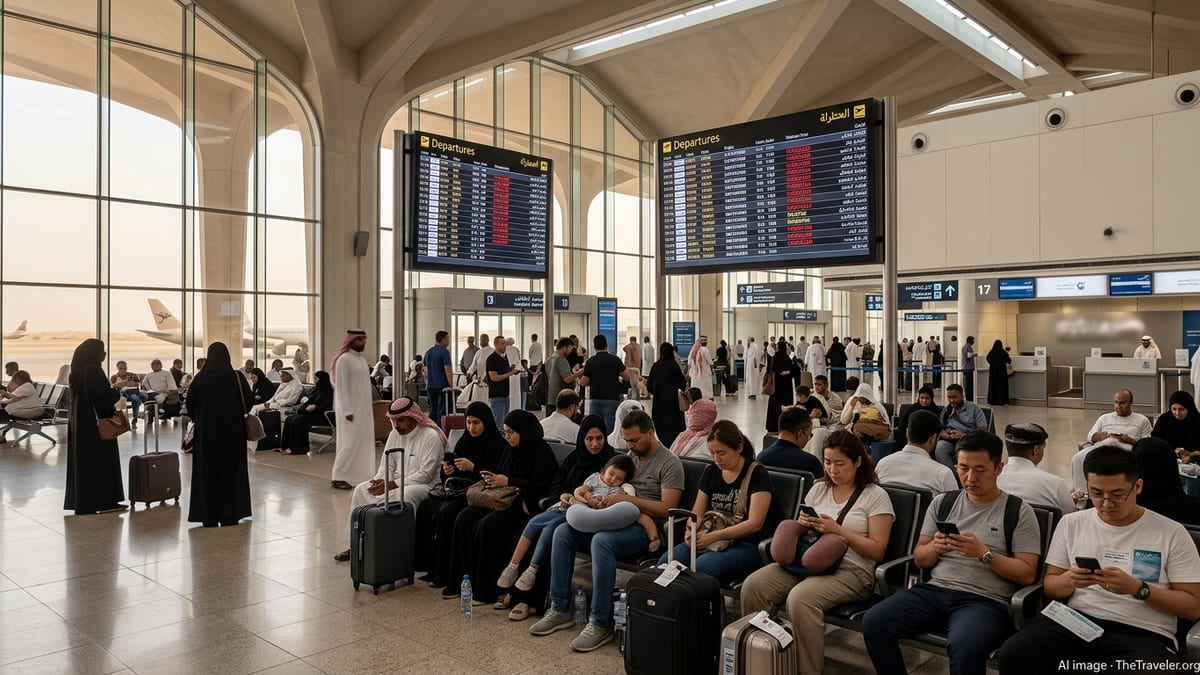
What Happened at Riyadh’s King Khalid International Airport
Publicly available flight tracking data and regional aviation reports indicate that over 40 departures and arrivals at King Khalid International Airport were canceled within a short window, as airlines adjusted schedules in response to wider airspace restrictions and security concerns across the Gulf. The disruption has primarily affected international services, though some domestic routes have also experienced knock-on delays.
The cancellations at Riyadh are part of a broader pattern that has swept through key Middle East hubs since late February, with thousands of flights scrubbed or rescheduled across the region. While Riyadh’s airspace has largely remained open, airlines have been forced to recalibrate routings, aircraft rotations, and crew schedules as nearby hubs coped with damage, operational suspensions, and congestion.
Airport operations in Riyadh have continued, but with a reduced and frequently changing schedule. Passengers have reported abrupt cancellations within hours of departure, aircraft returning to gates after boarding, and last minute diversions to secondary airports elsewhere in Saudi Arabia when routings became untenable.
On the ground, this has translated into long queues at airline desks, crowded waiting areas, and extended overnight stays for travelers who suddenly found themselves without confirmed seats out of the Saudi capital.
How the Regional Crisis Is Driving Cancellations
The Riyadh disruptions are closely linked to a wider aviation shock triggered by the recent conflict involving Iran, Israel, and the United States, which has led to intermittent airspace closures, missile and drone activity, and damage to airport infrastructure in parts of the Gulf. Industry trackers and international media coverage describe tens of thousands of flights canceled across the Middle East since the end of February, with Dubai, Abu Dhabi, Doha, and Kuwait City among the hardest-hit hubs.
These knock-on effects are now rippling into airports that remain physically intact, including Riyadh. When major transit hubs operate far below capacity or suspend arrivals, airlines must cancel or retime associated feeder flights, often at short notice. Aircraft and crew that would normally rotate through Dubai or Doha to serve Riyadh may be stranded elsewhere, making it difficult for carriers to maintain published schedules.
Saudi Arabia’s own airspace has stayed comparatively less restricted, and travel advisories point to Riyadh as one of the key alternatives for people trying to exit the region. This shift has increased demand for seats through King Khalid International Airport at precisely the time when airlines are coping with hardware and staffing constraints.
Some carriers have announced temporary suspensions or significant reductions on select Gulf routes, preferring to consolidate limited capacity on long haul repatriation or essential services. As those plans evolve day by day, Riyadh’s flight boards have reflected the volatility with waves of cancellations interspersed with sudden additions of extra sectors.
Impact on Stranded Passengers in Riyadh
The immediate impact for passengers at King Khalid International Airport has been uncertainty and extended waits. Travelers transiting through Riyadh, in particular, have faced challenges if their onward connections took them to airports subject to heavy restrictions or temporary shutdowns. In such cases, itineraries have sometimes collapsed entirely, leaving people to seek alternative routes at their own expense or wait for airlines to organize new options.
Reports shared by passengers on social platforms describe hotel shortages near the airport, difficulty reaching airline customer service channels, and confusion about which flights are actually operating versus those still listed in reservation systems. Some travelers who accepted rebooking options days in advance later discovered that those new flights, too, had been canceled as conditions changed.
Families, elderly travelers, and those with medical or work obligations have been particularly affected. In other Gulf hubs, airlines are increasingly prioritizing these groups for scarce outbound seats, and travelers in Riyadh are watching closely to see whether similar informal priority patterns emerge there as carriers manage waitlists.
At the same time, the situation for passengers can differ widely depending on their airline and ticket type. Those booked on large full service carriers with broader networks and interline agreements may find more options to reroute via alternative cities, while passengers on point to point or low cost operators may have fewer choices beyond refunds or open-dated credits.
What Travelers Should Do If Their Flight Is Affected
Travel experts and consumer advocates emphasize that the first step for any traveler caught in the Riyadh disruption is to confirm their flight’s real time status directly with the airline, preferably through the carrier’s app or official channels. Published timetables and some third party booking platforms may lag behind fast moving operational decisions, so relying only on earlier confirmations can be misleading.
Passengers whose flights are canceled should check the specific disruption policies for their airline. In recent days, several Gulf and international carriers serving the region have issued special waivers for tickets originally scheduled around the onset of the crisis, allowing free date changes, rerouting under certain conditions, or full refunds. These rules can be complex, and some require that the original flight be officially canceled before more flexible options become available.
Travelers already in Riyadh may wish to explore alternative routings via still functioning hubs in Saudi Arabia or neighboring countries, bearing in mind that road and regional air links can themselves be under strain. Some governments are organizing repatriation flights or advising their citizens on preferred exit routes; affected passengers should monitor official advisories from their home country as well as updates from airlines.
Those facing long waits at the airport are advised to keep all receipts for meals, local transport, and accommodation, since reimbursement rules vary but may cover some out of pocket expenses, especially when cancellations are directly tied to airline operational decisions rather than border closures or explicit government orders.
Outlook for Operations at King Khalid International Airport
The outlook for flight operations in Riyadh remains fluid and largely dependent on the broader security and airspace picture across the Gulf. Aviation analysts note that once major hubs such as Dubai, Abu Dhabi, and Doha stabilize their schedules and repair any infrastructure damage, knock-on disruptions at secondary airports like Riyadh should begin to ease, though there may still be lasting timetable changes.
Published information from regional aviation authorities suggests that airspace corridors are being adjusted step by step to allow controlled flows of commercial traffic while limiting exposure to conflict zones. As those corridors expand and airlines gain confidence in their ability to operate safely and reliably, more regular scheduling to and from Riyadh is expected to resume.
In the short term, travelers should expect intermittent clusters of cancellations, last minute schedule changes, and continued high demand for any available seats out of King Khalid International Airport. Carriers may continue to operate additional ad hoc or repatriation style flights without selling regular tickets on all sectors, focusing first on clearing backlogs of stranded passengers.
Given how quickly conditions have been changing since late February, the most reliable strategy for anyone planning to travel through Riyadh is to treat published schedules as provisional, maintain flexible plans, and monitor official airline and government channels closely in the hours leading up to any planned departure.