

More news on this day
Numerous flight cancellations at King Khalid International Airport in Riyadh have left hundreds of passengers stranded in recent days, as wider Gulf airspace disruptions ripple through Saudi Arabia’s busiest hub.
Get the latest news straight to your inbox!
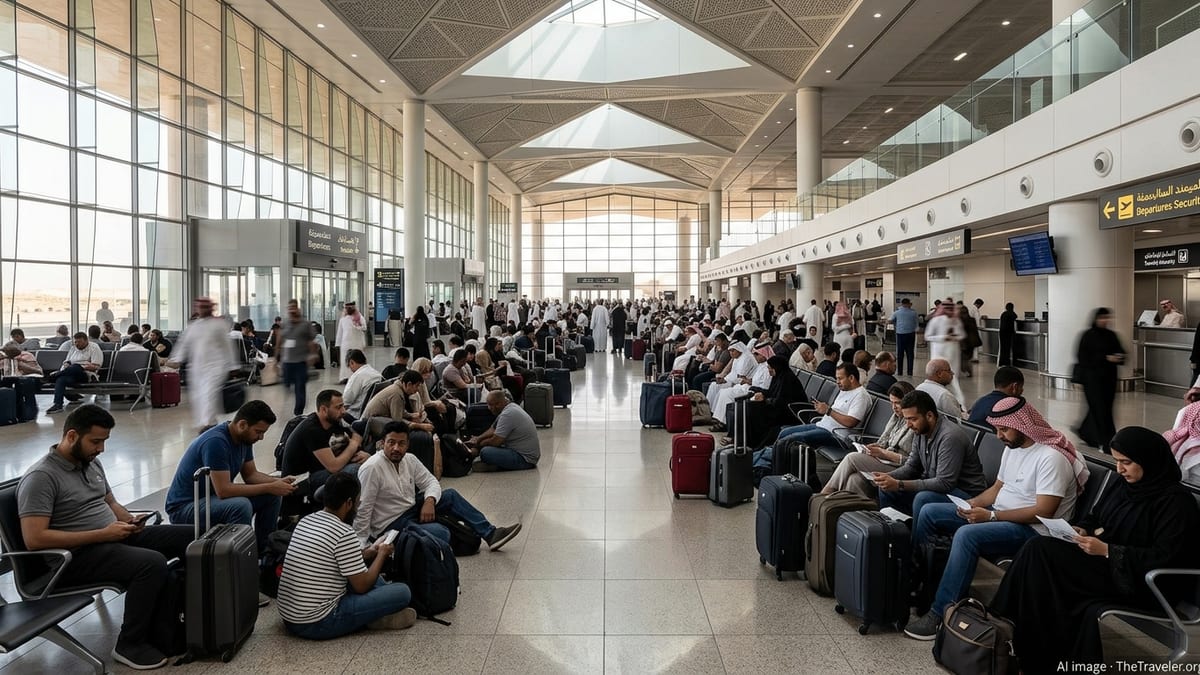
What Is Happening at King Khalid International Airport
Publicly available travel advisories and aviation tracking data in March 2026 point to continued disruption at King Khalid International Airport, with a reduced schedule and a pattern of late-notice cancellations and extended delays. While the airport remains operational, the number of regular commercial flights has been significantly curtailed compared with typical levels for this time of year.
Regional security tensions and airspace restrictions across the Gulf have forced airlines to trim frequencies, reroute aircraft, or temporarily suspend some services. Travel risk bulletins issued in early March describe King Khalid as operating with limited flights, noting ongoing cancellations and irregular operations that have made planning departures and connections more difficult for travelers.
Passengers transiting through Riyadh report congested terminals at peak times, long queues at rebooking counters, and uncertainty over when alternative flights will depart. Some carriers have been able to move disrupted travelers onto later services or indirect routings, but capacity constraints mean many people are still facing unexpected overnight stays in the city.
The situation in Riyadh is unfolding alongside extensive disruption at other Gulf hubs, including Dubai, Abu Dhabi, Doha, and Kuwait City. That broader regional picture is an important factor in understanding why flights into and out of King Khalid have become so difficult to operate reliably.
Why Flights Are Being Cancelled and Delayed
The current wave of cancellations at King Khalid is closely linked to the wider conflict-driven disruption affecting air corridors over and around Iran and parts of the Gulf. As airspace has been closed or restricted in several countries, airlines have had to abandon preferred routes, accept longer flight times, and reduce schedules to manage crew duty limits and aircraft rotations.
Published coverage of the 2026 Iran-related conflict describes rolling airspace closures and heightened security measures across the region, with thousands of flights cancelled or diverted over a short period. For carriers serving Riyadh, this has meant that aircraft arriving from disrupted hubs can be significantly delayed or grounded, cascading into cancellations on onward sectors from King Khalid.
Operational risk assessments used by corporate travel managers characterize the current environment as unstable, with elevated likelihood of last-minute schedule changes. Even when Riyadh’s airspace itself remains open, the complex web of connections and aircraft routings that feed Saudi Arabia’s capital mean that problems elsewhere can quickly translate into cancellations on what appear, on paper, to be unaffected routes.
Airlines have also been prioritizing certain strategic routes and repatriation-style services in response to stranded travelers throughout the Gulf. As limited aircraft and crew are reassigned to these flights, some regular commercial services to and from Riyadh have been temporarily dropped from schedules or placed on extended delay.
How Passengers at Riyadh Are Being Affected
For travelers on the ground at King Khalid, the most immediate impact has been extended waiting times, uncertainty over rebooking, and difficulties securing accommodation at short notice. Social media posts and traveler forums from early to mid-March describe passengers being held in departure lounges for hours while flights move from delayed to cancelled status, often with limited advance warning.
Once a cancellation is confirmed, rebooking can be challenging. With multiple airlines trimming flights across the region, spare seats on remaining services from Riyadh are in high demand, particularly to major European and Asian hubs. Some travelers report being offered itineraries with long or risky connections at other Gulf airports that are themselves experiencing disruption.
Accommodation has become another pressure point. When large numbers of passengers are stranded at once, hotel availability in and around the airport area tightens quickly, and prices can spike. Travelers without flexible budgets or comprehensive travel insurance may need to rely on basic terminal facilities, especially if they are holding non-refundable or low-cost tickets.
Despite these difficulties, some passengers have managed to depart Riyadh after accepting indirect routings or substantial schedule changes. Others have shifted to overland travel within Saudi Arabia, heading to alternative airports that retain more stable operations, although these options often require additional time and planning.
Practical Guidance for Travelers With Upcoming Flights
Anyone scheduled to fly from or through King Khalid in the coming days should prepare for a higher-than-normal risk of disruption and treat their plans as flexible. Travel advisories recommend checking flight status repeatedly in the 24 hours before departure, as some cancellations are appearing only a few hours before boarding.
Airline mobile apps and direct notifications are currently the most reliable way to receive real-time updates. Travelers are encouraged to confirm not just departure times, but also whether routings and connection points have changed, as airlines continue to adjust schedules around shifting airspace restrictions.
Experts in corporate travel risk management advise carrying essential medications, chargers, and a change of clothes in cabin baggage in case of enforced overnight stays. Travelers with tight onward commitments, such as cruises or major events, may want to consider bringing departure forward or exploring alternative routings that avoid the most impacted hubs, even if that means longer journeys.
Those who have not yet booked should factor potential disruption into their planning, including building extra buffer days into itineraries and choosing flexible or refundable fares where possible. Travel insurance policies should be reviewed carefully to understand what is covered in cases of conflict-related disruption and airspace closures.
What to Watch in the Coming Days
The outlook for flights at King Khalid International Airport will depend heavily on how the broader regional security situation and associated airspace restrictions evolve. If closures are eased and traffic is able to use more direct routings again, airlines could gradually restore more of their regular schedules and reduce the volume of cancellations.
Conversely, any renewed escalation or additional airspace limitations would likely extend or worsen the disruption, particularly for long-haul services that pass close to affected areas. Industry analysts note that airlines typically move cautiously when reintroducing flights after a period of instability, prioritizing safety margins and operational resilience over a rapid return to pre-crisis capacity.
Travelers should expect that schedules published several weeks in advance may be subject to significant revision at shorter notice. Even as some Gulf hubs begin to recover, knock-on effects can persist for days or weeks, as aircraft and crews are repositioned and maintenance backlogs cleared.
For now, anyone planning to pass through Riyadh’s King Khalid International Airport is advised to remain closely informed, keep options open for itinerary changes, and budget extra time and resources to navigate a fluid and occasionally unpredictable travel landscape.