

More news on this day
Riyadh’s fast-growing metro network has passed the 200 million passenger mark, reinforcing its emergence as a central pillar of Saudi Arabia’s efforts to reshape mobility in the capital.
Get the latest news straight to your inbox!
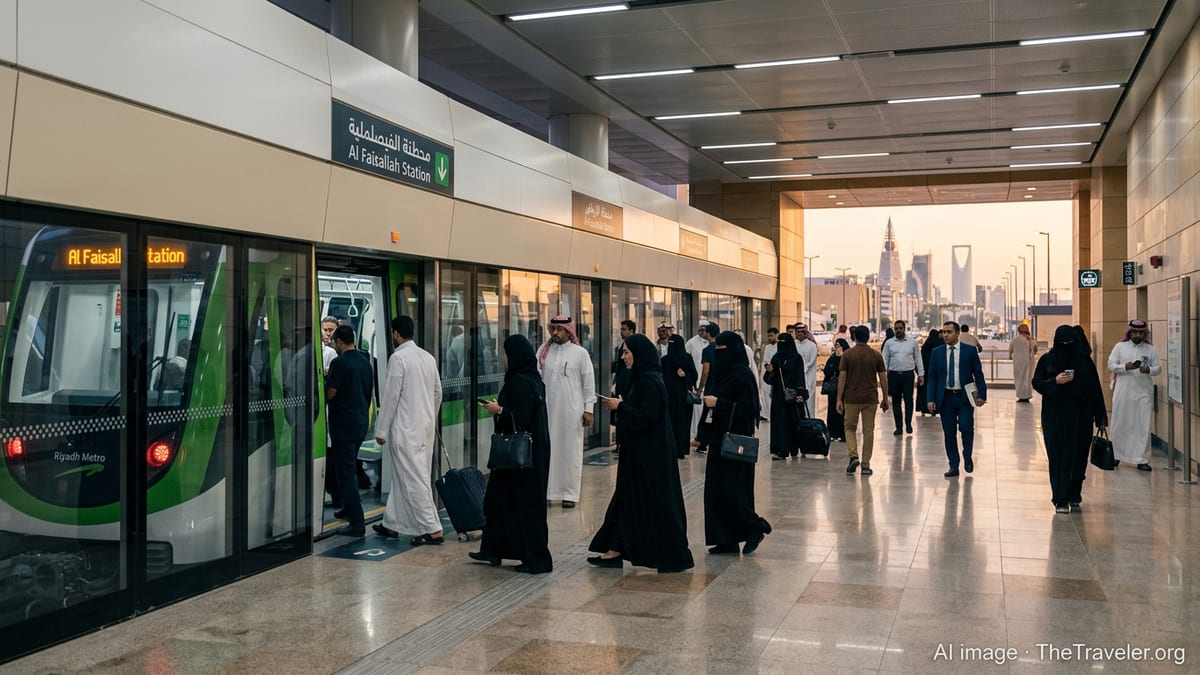
A Rapid Ascent in Global Metro Rankings
Publicly available data on the Riyadh Metro’s rollout shows how quickly ridership has climbed since services began in December 2024. The network recorded more than 18 million passengers in just over two months of operation, then reached 100 million riders in less than nine months, according to published coverage of the early launch period. With those benchmarks passed in 2025, transport-focused analyses now indicate that cumulative trips have moved beyond 200 million as daily usage continues to build.
The pace places Riyadh among the fastest-growing new metro systems worldwide. Reports on the system’s design note that it was built with a daily capacity of around 3.6 million passengers, suggesting that current ridership remains well below the theoretical ceiling and leaving room for substantial growth as more residents and visitors shift from private cars to rail.
Industry and government briefings on Saudi Arabia’s rail sector describe strong momentum across the country, with urban rail leading the expansion. Within that context, the Riyadh Metro’s 200 million passenger milestone is seen as a signal that large-scale public transport is gaining traction in a city historically dominated by road traffic.
Six Lines Reshaping How Travelers Cross the Capital
The Riyadh Metro comprises six color-coded lines and 85 stations, forming a lattice across the capital that connects residential districts, financial hubs, cultural venues, and major road corridors. Early ridership figures highlighted the Blue Line along the Olaya Road axis as the busiest, followed by the Red Line on King Abdullah Road and the Orange Line serving the Madinah Road corridor.
Key transfer hubs such as Qasr Al Hokm, the King Abdullah Financial District, the stc station, and the National Museum have consistently ranked among the most heavily used stops. Coverage of the network’s rollout notes that these stations collectively attract close to a third of passengers, reflecting their role as interchange points where travelers can switch lines to reach different parts of the city.
As the network matures, journey patterns are becoming more varied. Commuters use the system to access business districts and universities, while visitors rely on metro connections to reach cultural sites, parks, major events, and entertainment zones. This mix of everyday commuting and leisure travel is helping to distribute ridership throughout the day and across multiple lines.
Integrating Buses, Park and Ride, and New Urban Districts
Riyadh’s metro is designed as the backbone of a wider public transport ecosystem that includes buses, on-demand services, and extensive park and ride facilities. Public information released by the Royal Commission for Riyadh City and the Transport General Authority emphasizes that these modes are intended to work together, offering riders continuous connections from neighborhoods on the city’s outskirts to central destinations.
At many stations, structured parking encourages drivers to leave their cars and complete trips by rail, reducing pressure on arterial roads. Reports indicate that this integration has been critical in attracting first-time users who may be unfamiliar with using public transport in Riyadh. Over time, the combination of metro and bus networks is expected to reduce peak congestion and support more predictable travel times.
Urban development plans linked to Vision 2030 are also reshaping the districts around metro stations. New business clusters, residential projects, and mixed-use complexes are being oriented toward transit access, a pattern that transport analysts say can reinforce ridership growth by placing more jobs, homes, and leisure activities within walking distance of stations.
Environmental and Tourism Impacts for a Growing City
Saudi Arabia’s Vision 2030 roadmap highlights public transport as a tool for cutting emissions, improving air quality, and making cities more livable. The Riyadh Metro’s 200 million passenger milestone is being framed within that environmental narrative, with technical documents on the project underlining the potential for large-scale modal shift away from single-occupancy vehicles.
As a fully automated, driverless network, the system has become a showcase for advanced rail technology in the Gulf region. Travel and infrastructure publications describe the metro’s stations as modern, climate-controlled environments, which is particularly significant in Riyadh’s desert climate where high summer temperatures can discourage walking and outdoor activity.
The metro is also influencing the city’s tourism offer. Seasonal events such as Riyadh Season, large trade fairs, and new entertainment destinations around the capital all benefit from direct rail access, giving international visitors a practical alternative to taxis and private cars. For many travelers arriving from abroad, the system’s extensive coverage and contemporary design are becoming part of the city’s first impression.
What the Milestone Signals for Riyadh’s Mobility Future
Passing 200 million passenger trips is a symbolic moment for a system that did not exist a few years ago. Transport specialists note that the metro’s rapid adoption suggests a broader shift in public attitudes toward shared mobility in a city long associated with private car use and wide expressways.
Looking ahead, planning documents and expert commentary point to continued expansion of services, more transit-oriented development around key hubs, and increasingly sophisticated integration between ticketing, real-time information, and last-mile options. As these elements take shape, the metro’s role is expected to evolve from a high-profile megaproject into an essential, everyday utility for residents.
For travelers, the 200 million rider mark underlines that the Riyadh Metro is no longer an experimental addition but a proven way to move quickly across one of the Middle East’s fastest-growing capitals. As ridership climbs, the system is likely to become even more central to how both locals and visitors experience the city.