

More news on this day
Riyadh has joined Jeddah, Dhahran, Dammam, Khobar, Jubail and other Saudi hubs under heightened interception alert after a fresh wave of Iranian missile and drone attacks swept across the Gulf, shaking confidence in the region’s skies and disrupting air travel just as peak business and pilgrimage seasons approach.
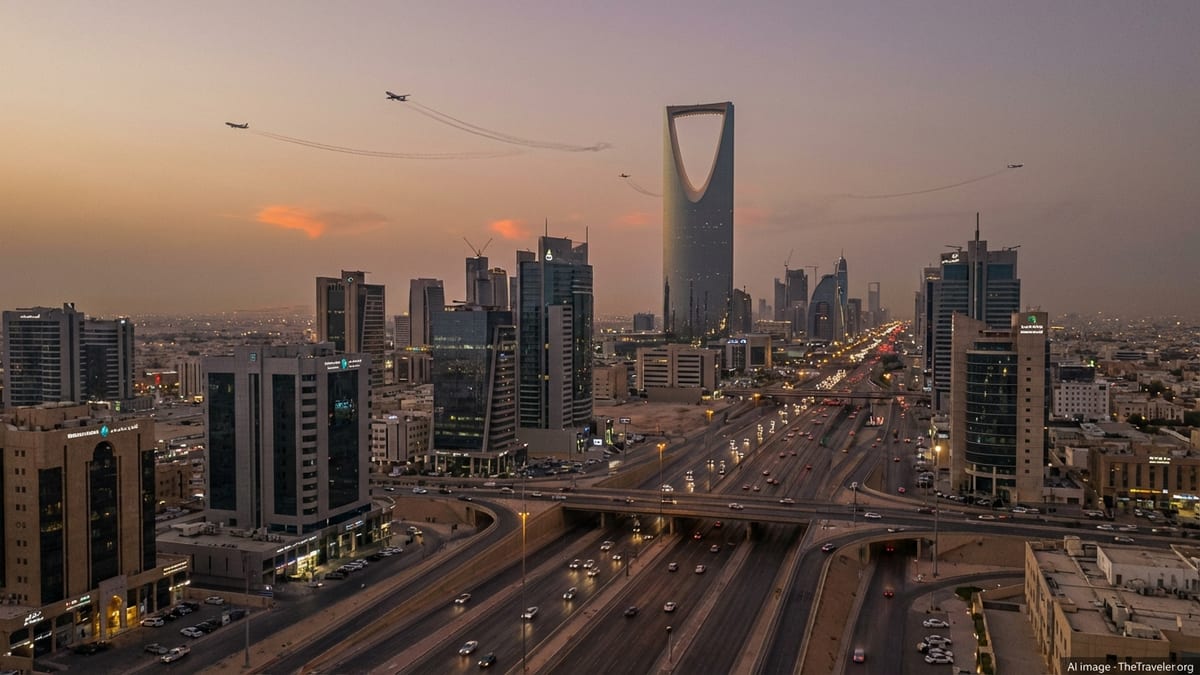
Escalating Strikes Pull Saudi Cities Into the Line of Fire
The latest escalation began after coordinated United States and Israeli strikes on targets in Iran in late February 2026, prompting Tehran to launch retaliatory salvos of ballistic missiles and drones at US bases and Gulf cities. Explosions were reported around several regional capitals, with Iranian projectiles tracked toward sites in Abu Dhabi, Dubai, Doha, Manama and Riyadh as air defense systems lit up the night sky.
Saudi officials confirmed that missiles linked to Iran’s campaign targeted US military infrastructure in the Kingdom, notably the Prince Sultan Air Base south of Riyadh, as part of a broader regional barrage. While early reports indicate limited physical damage, the episode has underscored the vulnerability of air corridors and energy infrastructure across eastern Saudi Arabia, home to critical hubs such as Dhahran, Dammam, Khobar and Jubail.
In January, Riyadh had already been added to the list of Saudi locations classified by regional aviation and security analysts as high-risk interception zones, joining Jeddah and the industrial cluster on the Gulf coast. The February and March strikes have hardened that assessment, with intelligence agencies warning that any renewed round of US or Israeli operations against Iran could rapidly trigger follow-on projectiles over, or near, Saudi territory.
For travelers, the shift is most visible in the way skies over the Kingdom are increasingly governed by air defense radar and real-time threat assessments, rather than purely commercial scheduling. Airport managers in Riyadh and Jeddah are now working in close coordination with military commands to stagger departures and adjust routings when interception operations are under way.
Airspace Closures and Rerouted Flights Reshape Regional Travel
The ripple effects of the Iranian barrages have been felt first in the air. Gulf authorities have temporarily closed or restricted segments of their airspace, forcing airlines to reroute services that typically transit the skies of Qatar, Bahrain, Kuwait, the United Arab Emirates and Saudi Arabia. At times, carriers have held aircraft on the ground while air defense batteries engage incoming missiles, delaying connections through Riyadh, Jeddah and Dammam.
In neighboring states, missile interceptions have already had lethal consequences. Debris from destroyed projectiles has killed and injured civilians in the UAE and damaged buildings in central business and diplomatic districts. Aviation regulators in these countries are issuing recurrent advisories, urging airlines to maintain flexible flight plans and warning that sudden closures or altitude restrictions may be imposed with little notice.
Saudi Arabia has so far avoided major casualties on its soil, but its General Authority of Civil Aviation has moved to tighten coordination across control centers serving King Khalid International Airport in Riyadh, King Abdulaziz International Airport in Jeddah and King Fahd International Airport in Dammam. Airlines operating long-haul services between Europe, Asia and Africa are revisiting routings that traditionally rely on Saudi and adjoining Gulf airspace, adding flight time and operational costs.
For international visitors, the practical impact ranges from extended journeys and missed connections to last-minute airport changes within the Gulf. Travel agents report a surge in inquiries about routing options that avoid the immediate conflict zone, although for many long-haul itineraries the alternatives remain limited without significant detours over Central Asia or the Indian Ocean.
Saudi Response: Condemnation, Defense Readiness and Diplomatic Outreach
Riyadh has publicly condemned Iran’s missile and drone waves as a blatant violation of regional sovereignty and international law, while insisting that Saudi airspace is not being used as a platform for offensive operations against Iran. At the same time, the Kingdom has pledged to place all its military and security capabilities at the disposal of Gulf partners that come under fire, signaling a firm defensive stance without overtly entering the offensive campaign.
Saudi air and missile defense units around Riyadh, Jeddah and the Eastern Province have been quietly reinforced, with additional Patriot and other interception systems deployed to shield key airports, oil facilities and urban centers. While officials have been cautious about disclosing exact numbers, regional security analysts note that the density of air defense coverage around Dhahran, Dammam, Khobar and Jubail now rivals that of any theater on the globe.
In parallel, Saudi diplomats have been working the phones with counterparts across the Muslim world and beyond, seeking to frame Iran’s actions as an unacceptable escalation that threatens civilians and international energy security. Statements from organizations headquartered in Jeddah and Mecca have echoed that view, warning that repeated missile salvos risk normalizing cross-border attacks in one of the world’s most strategically vital corridors.
Yet Riyadh also remains wary of being dragged into a wider direct confrontation. Officials continue to stress that Saudi Arabia did not authorize its soil to be used for the initial US and Israeli strikes, even as the Kingdom now plays a central role in regional air defense. That balancing act is shaping both its security posture and the messages it is sending to residents, visitors and the travel industry.
Traveler Impact in Riyadh, Jeddah and Eastern Saudi Hubs
For travelers currently in, or planning trips through, Saudi Arabia, the most immediate concern is operational rather than existential. Airports across Riyadh, Jeddah, Dhahran, Dammam, Khobar and Jubail remain open, but they are operating against a backdrop of intermittent air raid sirens, controlled lighting protocols and discrete security checks when regional tensions spike.
Airlines are advising passengers to build in longer connection windows at Riyadh and Jeddah and to stay in close touch with carriers’ mobile apps and customer service channels for last-minute gate or timing changes. Some flights are departing at unusual hours to take advantage of windows when military authorities judge the threat level to be lower, subtly reshaping the daily rhythm of major Saudi hubs.
Hotel operators in airport districts and central business areas report a rise in unscheduled stopovers as travelers wait out delays or rebook disrupted itineraries. Many properties have updated emergency briefings, pointing out shelter locations and advising guests how to respond to sirens or announcements. For now, these measures remain precautionary, but they underline how deeply the interception threat has become woven into the region’s hospitality and travel experience.
Travel insurers are also recalibrating. Policies that once treated much of the Gulf as a standard-risk destination are being revised to factor in the possibility of missile-related airspace closures, with some underwriters attaching conflict-related exclusions or requiring supplemental coverage for corporate travelers routing repeatedly through hubs like Riyadh and Dammam.
Outlook: Volatile Skies Over a Critical Travel and Energy Corridor
Analysts caution that the current cycle of strike and counterstrike could persist, particularly if diplomatic efforts fail to create credible off-ramps for Washington, Tehran and Jerusalem. In that scenario, interception alerts over Saudi Arabia’s main cities may become a recurring feature rather than a short, sharp crisis, forcing airlines, airports and travelers to adapt to a new normal in Gulf aviation.
For Saudi Arabia, the stakes are unusually high. The Kingdom sits at the nexus of global energy flows and is investing heavily in tourism, with new visitor corridors planned through Riyadh, the Red Sea coast and the Eastern Province. Each wave of missiles and drone intercepts in nearby skies complicates that strategy, even if the country’s defenses succeed in preventing large-scale damage.
Industry experts say the travel sector’s resilience will hinge on clear, timely communication. The more accurately authorities in Riyadh, Jeddah, Dhahran, Dammam, Khobar and Jubail can signal changing risk levels and operational constraints, the easier it will be for airlines and travelers to manage disruption. In the meantime, those flying through the region face an uncomfortable reality: the Gulf’s busiest air hubs are now operating on the front line of one of the world’s most volatile geopolitical flashpoints.