

More news on this day
Romania has moved into line with a growing group of European Union countries that are reimposing visa requirements on Georgian diplomats and officials, tightening official travel just as Brussels formally suspends visa-free access for Georgia’s political elite amid deepening concern over democratic backsliding and street unrest in Tbilisi.
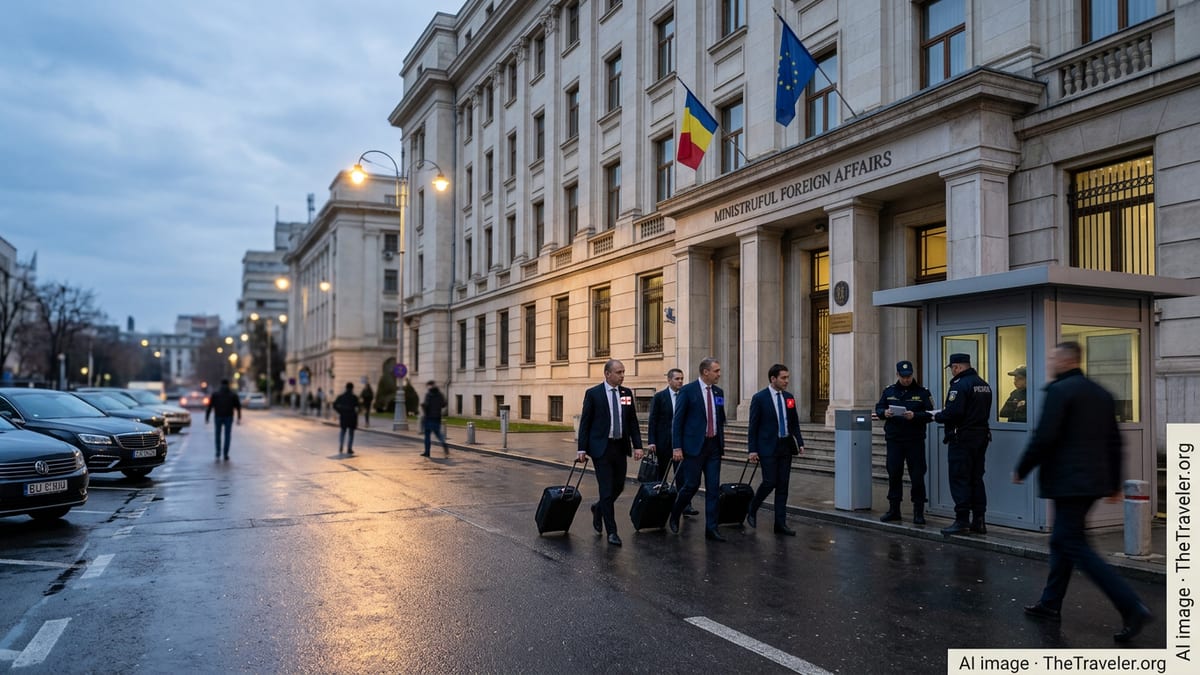
Coordinated EU Shift Targets Georgia’s Political Elite
The European Commission on 6 March 2026 adopted a regulation temporarily suspending visa-free travel for Georgian holders of diplomatic, service and other official passports, citing a pattern of democratic erosion and failure to align with EU visa policy. The move does not affect ordinary Georgian tourists, who may still enter the Schengen area visa-free for short stays, but it sharply curtails the mobility of those representing the Georgian state.
Long before the bloc-wide decision, a group of member states had already started to act on their own. By mid‑2025, Romania, Spain, Belgium, Luxembourg, the Netherlands, Slovakia and Estonia, along with countries such as France, Italy, Bulgaria, Latvia, Lithuania and the Czech Republic, had introduced or announced national visa requirements for Georgian diplomatic and service passport holders. Those steps are now being folded into a common EU framework, transforming what began as a patchwork of bilateral restrictions into a coordinated signal from Brussels.
For Georgian officials accustomed to seamless entry into Schengen states for meetings, conferences and private travel, the change is significant. Embassies and consulates across the bloc, including Romania’s mission in Tbilisi, are preparing for an uptick in applications from government delegations and parliamentarians who previously crossed borders on short notice without prior paperwork.
EU officials stress that the message is political rather than personal. By targeting privileged travel rather than the broader population, they say they are attempting to hold the Georgian leadership accountable while preserving ties with ordinary citizens, many of whom continue to support closer integration with Europe and have taken to the streets to oppose the country’s current trajectory.
Romania’s Alignment and Regional Travel Implications
Romania’s alignment with partners such as Spain, Belgium and the Netherlands places it firmly among the EU states pressing Tbilisi to reverse course. The country, which joined the passport‑free Schengen area for air and sea borders in 2025, now sits on an important travel route for both EU and non‑EU visitors transiting between the Black Sea region and the rest of the continent. Its decision to require visas from Georgian diplomats therefore carries both symbolic and practical weight.
Romanian officials frame the measure as a response to Georgia’s actions rather than a change in their attitude toward the Georgian public. Bucharest continues to back Georgia’s long‑stated objective of closer EU integration, but insists that respect for democratic norms, independent media and peaceful assembly are non‑negotiable conditions. Visa‑free privileges for state representatives, they argue, cannot be sustained at a time when those same authorities are accused of repressing pro‑European protesters at home.
For travelers, the new regime will be most visible in official delegations rather than in tourism flows. Georgian ministers, lawmakers and senior civil servants will now need to plan trips that include Romania or its like‑minded partners further in advance, submitting documentation, itineraries and proof of official purpose. While these applications are typically processed relatively quickly, they introduce an administrative friction that did not exist for nearly a decade after Georgia first gained visa‑free entry to much of the EU in 2017.
Regional analysts note that the change may alter preferred routes for official travel from Tbilisi. Instead of transiting via hubs in Bucharest, Madrid, Brussels or Amsterdam, some delegations may pivot to itineraries through capitals viewed as more sympathetic or slower to enforce the new rules. Yet with the Commission’s implementing regulation now in force across the bloc, the room for such workarounds is narrowing.
Democratic Backsliding and Protests in Georgia
The tightening of diplomatic travel comes against a backdrop of escalating political turmoil in Georgia. Since late 2024, the ruling Georgian Dream party has been accused by domestic protesters and international observers of stalling, and in some cases reversing, key reforms linked to the country’s EU aspirations. Controversial legislation on foreign influence and media regulation, together with disputed elections and the use of force against demonstrators, has triggered repeated warnings from Brussels.
Human rights groups and opposition leaders in Tbilisi describe a climate of intimidation marked by mass arrests, pressure on independent journalists and a shrinking space for civil society. Large, often youthful crowds have filled central squares demanding adherence to pro‑European commitments embedded in Georgia’s constitution. Riot police have responded with tear gas, water cannon and detentions, images that have circulated widely in European capitals and hardened attitudes among policymakers.
The EU’s decision to focus on visa‑free travel for diplomats reflects a broader shift toward targeted measures that stop short of economic sanctions but clearly signal displeasure. European officials say that while they want to avoid isolating the Georgian people, they cannot ignore what they describe as “systemic and targeted” attacks on democratic institutions and fundamental rights.
For now, the suspension is time‑limited, initially set for one year, but Brussels has left the door open to extensions if the Georgian authorities fail to address concerns. Conversely, the regulation can be lifted sooner should Tbilisi demonstrate tangible progress on rule of law, electoral standards and respect for peaceful dissent.
What the Changes Mean for Travel and Diplomacy
The immediate impact of the new rules will be felt within diplomatic circles rather than by holidaymakers or business travelers. Holders of ordinary Georgian passports remain eligible for short‑stay visa‑free travel to Schengen states, including Romania, Spain, Belgium, Luxembourg, the Netherlands, Slovakia and Estonia. Consular authorities are taking care to emphasize this distinction to avoid confusion among tourists and the Georgian diaspora.
For the EU, restricting official travel is also a way to limit what some member states view as security risks associated with abuse of diplomatic passports. The Commission has highlighted cases where official documents issued by third countries were allegedly used to facilitate entry for individuals who would otherwise require visas, arguing that tighter scrutiny of diplomatic and service passports can help safeguard the integrity of the Schengen system.
At a practical level, embassies across the bloc are adjusting staffing and procedures to cope with the expanded workload. Consular sections in capitals like Bucharest, Madrid and Brussels report preparing new appointment systems, checklists and guidance notes tailored to Georgian official travelers. These include clearer requirements on proof of official status, letters of invitation and assurances about return, mirroring the paperwork already familiar to many other nationalities.
Diplomats caution that the shift could complicate day‑to‑day contacts between EU institutions and their Georgian counterparts, particularly for last‑minute technical meetings, training sessions or cultural exchanges. However, they insist that the cost of inconvenience is outweighed by the need to defend the credibility of the EU’s values‑based foreign policy, especially in its own eastern neighborhood.
Signals to Other Visa-Free Partners
Beyond Georgia, the decision has resonated with other countries that enjoy visa‑free access to the Schengen area. In recent years, the EU has strengthened its mechanism for suspending such regimes when partners diverge from shared visa policies, see spikes in irregular migration or exhibit serious democratic backsliding. The Georgian case is now seen in Brussels as an early, high‑profile test of these updated rules.
Romania and fellow member states that have already tightened entry for Georgian diplomats view the coordinated move as a necessary precedent. By demonstrating that visa‑free access is conditional and reversible, they hope to deter other governments from taking advantage of the privileges that come with closer alignment to the EU while undermining the values that underpin the relationship.
For travelers, that message may seem far removed from holiday planning or business trips. Yet the health of visa‑free regimes ultimately shapes how easily people can move across borders for tourism, study and work. Developments in Georgia will therefore be watched closely by other visa‑exempt countries whose domestic politics are under scrutiny from Brussels.
In the meantime, Romania’s decision to stand with partners such as Spain, Belgium, Luxembourg, the Netherlands, Slovakia and Estonia against Georgia’s democratic backsliding reinforces its role as an increasingly assertive player in EU foreign and visa policy. As the situation in Tbilisi evolves, both officials and travelers will be looking to see whether these new restrictions become a temporary warning or the start of a more profound recalibration in Georgia’s relationship with Europe.