

More news on this day
Romania is preparing to turn its most famous legend into a high-tech tourism engine, as the €1 billion Dracula Land mega-project near Bucharest moves from concept to concrete plans and stakes a claim to compete with the world’s largest theme resorts.
Get the latest news straight to your inbox!
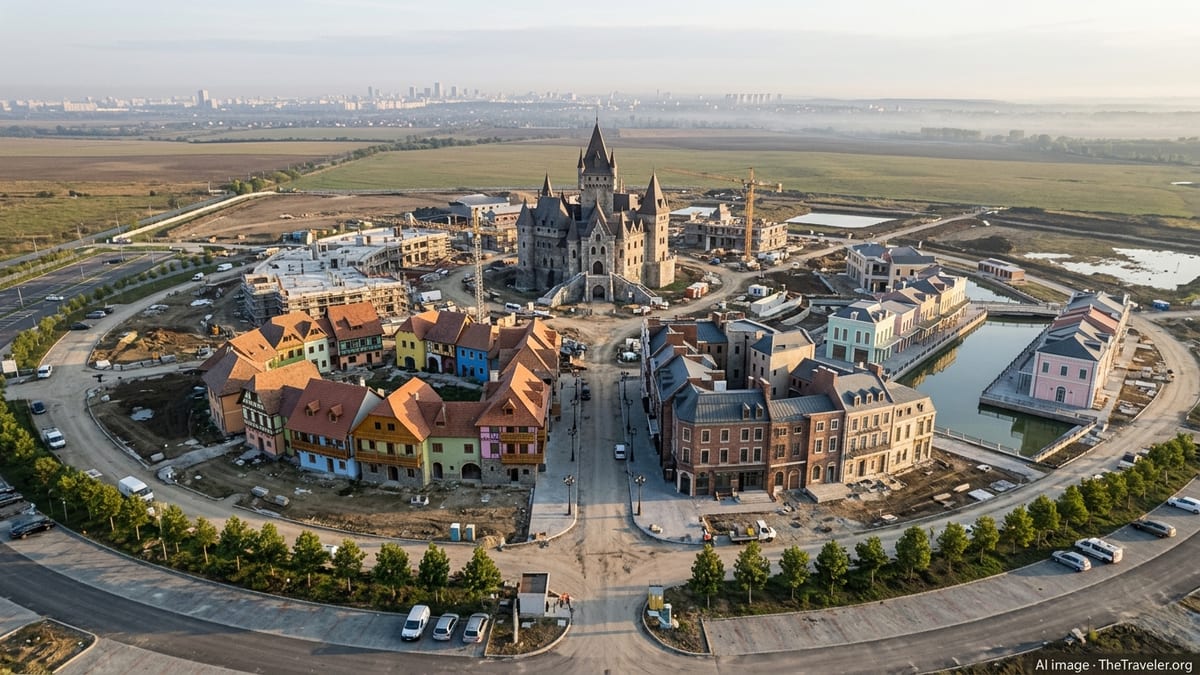
A Mega-Resort Built on a Global Myth
Recent project launches and press materials describe Dracula Land as a privately funded development of more than €1 billion, positioned as Europe’s largest integrated entertainment, retail, and technology destination. Planned on a site of around 164 hectares within easy reach of Bucharest and the capital’s main international airport, the complex is designed to function as a full-scale resort rather than a standalone park, echoing the multi-day experience of destinations such as Disney’s Florida properties or Universal’s emerging European projects.
At the heart of Dracula Land will be a vast theme park of roughly 780,000 square meters, built around Romania’s Dracula mythology and wider folklore, but presented through contemporary storytelling, media, and immersive technology. Publicly available descriptions speak of a “modern mythological platform,” with classic vampire imagery woven together with references to the Carpathian Mountains, medieval fortresses, and the historical figure of Vlad III that inspired Bram Stoker’s fictional Count.
Far from a niche horror attraction, the concept positions Dracula as a gateway to Romanian culture, history, and landscapes. Reports indicate that the thematic design aims to move beyond clichés, using the familiarity of the Dracula brand to introduce visitors to local architecture, crafts, gastronomy, and regional traditions from Transylvania and Wallachia.
Developers and published coverage frame the project as a national symbol that could demonstrate Romania’s ability to deliver world-class leisure infrastructure at a scale previously associated with Western Europe, the United States, and East Asia.
Six Immersive Worlds and Next-Generation Attractions
Concept documentation and media reports outline an ambitious line-up of themed zones inside Dracula Land’s core park, promising more than 40 major attractions across six distinct areas. A “Transylvania” zone is expected to recreate traditional villages framed by stylised Carpathian peaks, while a central castle icon will reinterpret the Gothic fortress imagery long associated with Bram Stoker’s novel and Bran Castle’s global marketing.
Other planned areas, such as “London Town” and “Port of New Orleans,” highlight the story’s international reach, nodding to Victorian England and the atmospheric ports that helped embed Dracula in global popular culture. These zones are slated to host dark rides, roller coasters, live entertainment, water attractions, and interactive experiences designed to appeal to families, thrill-seekers, and dedicated fans of the Dracula legend.
Beyond classic rides, the mega-project is being promoted as a testing ground for advanced digital layers, with references in Romanian and international coverage to extended reality experiences, esports events, and a dedicated metaverse component. A 22,500-seat multifunctional arena is planned to host concerts, gaming tournaments, and large-scale cultural shows, while an integrated technology hub is expected to support both entertainment programming and commercial partnerships.
The technical and creative design is being compared to the latest generation of destination resorts, in which storytelling flows from physical environments into digital platforms. Dracula Land’s backers are positioning this seamless integration as a key differentiator that could attract visitors who might otherwise choose established giants in Paris, Orlando, or Tokyo.
Hotels, Outlet Malls and a New Tourism Economy
Dracula Land is conceived as a complete tourism ecosystem, with hospitality and retail given as much prominence as rides and shows. Plans described in public materials include three core hotel concepts with around 1,200 rooms: a four-star Dracula Grand Hotel for upscale guests and conference traffic, a family-focused midscale hotel, and a more budget-conscious inn format integrated into the resort village.
Conference and events facilities are expected to target business tourism, international conventions, and hybrid entertainment-industry gatherings, aiming to extend visitor stays beyond a single weekend. This strategy mirrors the evolution of major theme resorts worldwide, where meetings and incentives business often complements leisure traffic and helps stabilise occupancy across seasons.
A major outlet mall, branded within the Dracula concept, is another central pillar of the development. According to project presentations, this retail district is intended to function as a social and commercial hub, mixing international brands with Romanian designers and food concepts. The goal is to keep the site active throughout the day and into the evening, encouraging both tourists and local residents to treat the complex as a regular meeting place, not just an occasional attraction.
Economic impact estimates cited in Romanian business media point to a potential multi-billion-euro contribution over the first decade of operation, driven by direct employment, supplier networks, hospitality spending, and increased international arrivals. If timelines are met, the project could become one of the most significant private tourism investments in Eastern Europe.
Timelines, Location and Competition With Disney
Dracula Land’s backers have outlined a phased development schedule, with concept unveiling and master planning already underway and initial construction activities expected to intensify in the coming years. The chosen location, approximately 15 minutes from Bucharest’s main airport and connected to major road links, is regarded in industry commentary as critical to attracting both short-break European visitors and long-haul travellers combining the resort with wider tours of Romania.
While no firm public opening date has been confirmed, coverage in regional tourism outlets frequently references the late 2020s as a target window for major components of the park and its associated facilities. The long lead time reflects both the complexity of large-scale leisure projects and Romania’s intention to align new transport and urban infrastructure with the resort’s eventual debut.
Comparisons with Disney and Universal are emerging naturally as analysts weigh the potential scale of Dracula Land’s attractions, hotel capacity, and surrounding commercial district. At more than €1 billion in private funding, the investment rivals recent European theme-resort announcements and could shift traditional tourism flows, particularly if it succeeds in drawing visitors who might otherwise opt for Paris, London, or Mediterranean beach destinations.
Observers also note that Dracula Land arrives as global theme-park operators expand aggressively into Europe and the Middle East. Romania’s strategy appears to be to claim a distinct cultural niche rather than replicate existing Western models, leveraging the singular global recognition of the Dracula name to secure a position alongside much older brands on the international tourism map.
Opportunities and Questions for Romania’s Tourism Future
For Romania, Dracula Land represents both a bold branding play and a test of long-term strategic planning. Tourism specialists point out that the country has spent decades debating how heavily to lean on the Dracula image, balancing concerns about stereotypes with the clear marketing power of a story known on every continent. The new project embraces that identity outright, but pairs it with promises of cultural authenticity and regional representation within the park’s design.
Public commentary in Romanian media and online forums reflects a mix of enthusiasm and scepticism, shaped by earlier, unrealised Dracula-themed proposals dating back to the early 2000s. Some voices welcome the prospect of new jobs, infrastructure, and international visibility, while others raise questions about environmental impact, land use, and the feasibility of such an ambitious private venture in a challenging construction and regulatory landscape.
Industry analysts note that the project’s success will depend on sustained investor commitment, robust governance, and the ability to coordinate with local and national authorities on transport, utilities, and workforce planning. The absence of direct state or European funding, highlighted in recent coverage, may insulate public budgets but also places execution risk squarely on private stakeholders.
If Dracula Land reaches completion as envisioned, it could mark a turning point for Romania’s tourism profile, shifting the country from a primarily cultural and nature-based destination to a global theme-resort contender. For now, the world’s travel and attractions sectors are watching closely as the land of Dracula prepares to test whether a legendary vampire can indeed dethrone some of the biggest names in modern leisure.