

More news on this day
A Rossiya Airlines Sukhoi Superjet 100 operating flight SU6343 from St. Petersburg to Murmansk was forced to abandon its climb and circle above Pulkovo Airport after a cockpit indication suggested a problem with the landing gear, according to early Russian-language media reports and flight-tracking data.
Get the latest news straight to your inbox!
Incident Over St. Petersburg on Domestic Route to Murmansk
Publicly available flight data for March 16 shows SU6343 departing St. Petersburg’s Pulkovo Airport on a scheduled domestic service to Murmansk before halting its northbound climb and returning to the vicinity of the airport. Tracking traces indicate the aircraft entered a holding pattern at relatively low altitude, consistent with crews carrying out checklists and coordinating a precautionary return following an abnormal indication.
Reports in Russian aviation-focused outlets describe the aircraft as a Sukhoi Superjet 100 operated by Rossiya Airlines, one of Russia’s largest domestic carriers. The jet had been scheduled for the short morning sector to Murmansk, a route commonly served by regional aircraft connecting the northwest hub of St. Petersburg with the Arctic port city.
Preliminary information indicates that, shortly after takeoff, the crew received a cockpit alert related to the status of the landing gear. In such situations, standard operating procedures call for crews to halt the climb, remain in the vicinity of the departure airport and evaluate whether the landing gear is safely retracted or locked in position for landing.
Available coverage suggests the crew elected to keep the aircraft in a racetrack pattern over the city’s outskirts while completing technical checks and coordinating with ground services. The flight’s ground track shows multiple orbits before the jet lined up again with the runway at Pulkovo for a precautionary landing.
Return and Precautionary Landing at Pulkovo
Based on flight-tracking timelines and media descriptions, the Superjet remained in a holding pattern for an extended period to burn fuel and reduce landing weight, a typical precaution when there is potential for a landing gear malfunction. Reducing weight can lessen stress on the gear assemblies and braking system during touchdown.
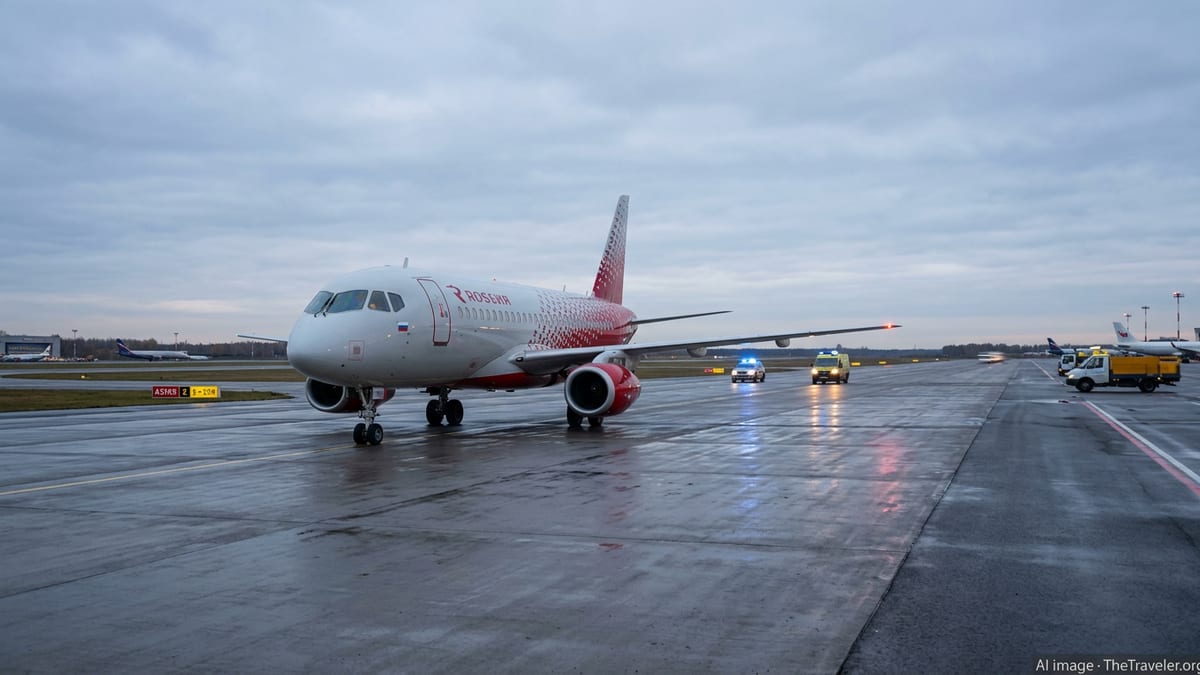
When the aircraft eventually returned to Pulkovo, publicly available information indicates it completed a low and controlled approach, with emergency services positioned along the runway in line with standard airport procedures for an abnormal landing gear indication. Such deployments are precautionary and do not necessarily mean that serious damage or fire is expected.
Initial reports do not indicate injuries among passengers or crew, and there is no public evidence of a runway excursion or fire following the landing. Descriptions from Russian news coverage focus on the extended circling and the technical nature of the landing gear alert, rather than on visible structural damage to the aircraft.
After the aircraft vacated the runway, operations at Pulkovo appeared to continue without prolonged disruption, based on subsequent scheduled movements. Official documentation on any temporary closure or reduced-capacity period at the airport has not yet been published.
Landing Gear Alerts and Superjet 100 Safety Context
Landing gear indication problems are a known category of incident across commercial aviation and can arise from issues ranging from faulty sensors and wiring to mechanical anomalies within the gear doors or locking mechanisms. In many cases, the problem is ultimately traced to a sensor or control fault rather than a complete structural failure of the gear itself.
The Sukhoi Superjet 100, the aircraft type involved in SU6343, has been the subject of heightened attention in Russia due to its role as a domestically produced regional jet and its mixed operational record over the past decade. Previous accidents and serious incidents, including events involving hard landings and gear damage within Russian territory, have prompted technical advisories and equipment bulletins focused on landing systems and related components.
Russian and international safety documents accessible to the public describe a history of modifications and inspections on Superjet landing gear and steering subsystems, introduced to address identified weaknesses and extend service life. Regulators have issued guidance to airlines and maintenance providers on replacing or upgrading specific units when conditions or service time thresholds are met.
Against that background, any new gear-related alert on a Superjet tends to attract attention from both aviation specialists and the traveling public. However, safety analysts caution that most such events end in uneventful landings, with the aircraft returning to service after detailed maintenance inspections and component checks.
Impact on Passengers and Subsequent Operations
While detailed passenger accounts have not yet been widely circulated, the sequence of events implied by the flight track suggests travelers on SU6343 experienced an extended flight time and a return to their departure airport instead of the planned arrival in Murmansk. In similar cases, airlines generally rebook affected travelers on later flights or alternative routings once the aircraft’s technical status is clarified.
For those on board, extended circling can be disconcerting, especially when combined with announcements about technical checks or precautionary measures. Aviation safety specialists often note that such decisions reflect a conservative safety culture in which flight crews choose the most controlled environment available rather than continuing to destination with an unresolved technical alert.
Information currently available does not specify whether Rossiya Airlines substituted another aircraft on the route later in the day or whether passengers were offered ground transport or overnight accommodation. Russian carriers typically adjust schedules after such events depending on the scale of the technical inspection required and the availability of spare aircraft.
The incident is likely to add to ongoing public discussion within Russia about the reliability of domestically produced aircraft on regional routes, particularly as international sanctions limit access to Western-built jets and spare parts. Travelers on routes served heavily by Superjets and other Russian-made models have shown growing interest in the technical history and maintenance practices associated with these fleets.
Next Steps: Technical Checks and Potential Inquiry
Following any precautionary landing tied to a suspected system malfunction, airline engineering teams typically carry out a structured inspection process. This includes checking the landing gear structures, hydraulic lines, sensors and control units, as well as downloading technical data recorded during the flight to pinpoint the source of any abnormal indications.
Depending on the findings, the aircraft may return to service quickly after a minor component replacement or remain grounded for more extensive maintenance. Current public information does not yet clarify whether the Superjet involved in SU6343 has been cleared for further operations or is undergoing a longer technical review.
Russian civil aviation bodies maintain databases of incidents and, for events involving potential system faults, may initiate a limited-scope technical examination. For significant or recurring issues, more formal investigations and safety recommendations can follow, contributing to updates in maintenance programs, checklists and crew training procedures.
In the coming days, additional details on the precise cause of the landing gear alert on SU6343 may emerge through Russian-language regulatory bulletins, airline communications or specialist aviation reporting. For now, publicly available information portrays the event as a controlled precautionary return in which the crew kept the aircraft in a safe holding pattern and brought it back to Pulkovo without reported injuries or visible structural damage.