

More news on this day
Two crew members were killed in southern Namibia when a luxury Rovos Rail train derailed after a flood-damaged bridge span collapsed beneath its locomotives, highlighting mounting concerns over the resilience and safety of the country’s rail infrastructure.
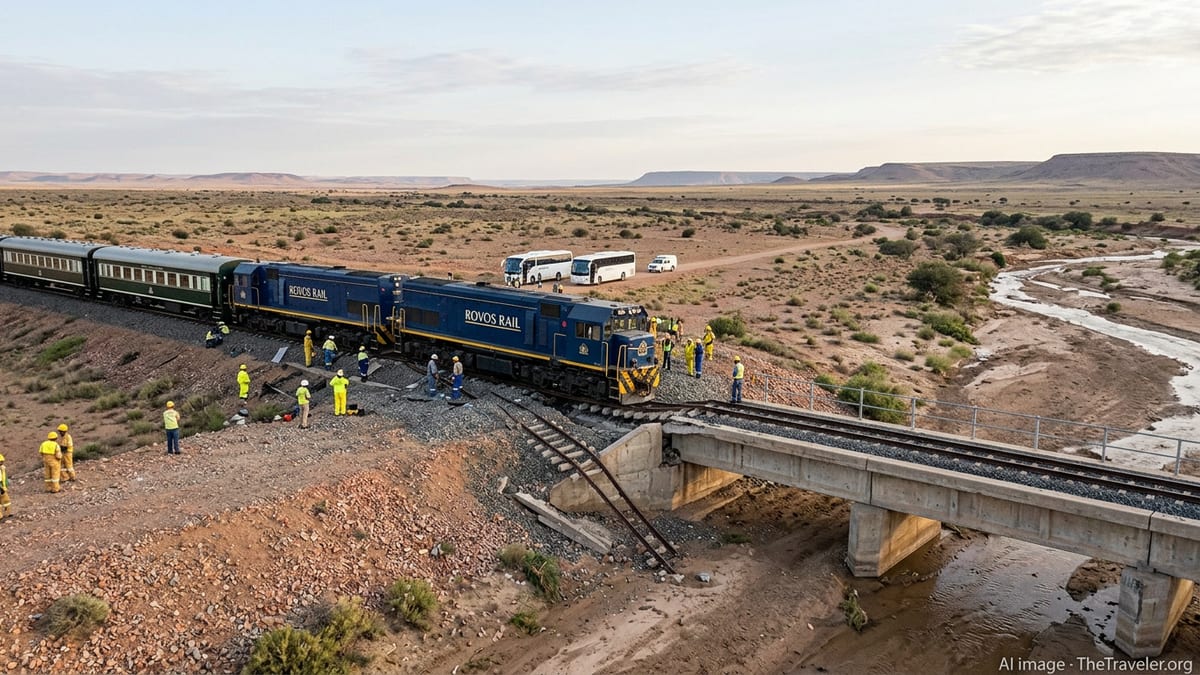
Bridge Collapse Blamed for Fatal Early-Morning Derailment
The accident occurred in the early hours of Sunday, 1 March 2026, near Naute in southern Namibia as the southbound Rovos Rail service was travelling from Windhoek towards the South African border. According to statements from Rovos Rail and TransNamib, the national rail operator, the train struck a section of bridge where the final span had been washed away following recent heavy rains in the area.
The impact sent two locomotives and two utility coaches off the tracks, killing the Rovos Rail driver and a TransNamib pilot who was on board as navigator. The remainder of the train, including passenger coaches, stayed upright after the automatic braking system activated, preventing a broader catastrophe.
Officials said no passengers or other staff members were injured, despite the dramatic nature of the derailment and the remote, arid setting of the crash site, roughly 285 kilometres short of the border town of Ariamsvlei.
Emergency Response and Passenger Evacuation Efforts
Rovos Rail and TransNamib reported that emergency plans were triggered immediately after the derailment was confirmed. Operations and engineering teams were dispatched to the scene to secure the site, support first responders and begin an initial technical assessment of the damaged bridge and rolling stock.
Given the isolation of the crash location, logistics quickly became a priority. Buses were arranged to transport shaken but unharmed passengers from Naute to the Northern Cape town of Upington in South Africa. From there, they were scheduled to board charter flights to Cape Town to complete their journey.
Medical and psychological support staff were mobilised to assist guests and crew, while liaison officers worked to keep families informed. Company representatives stressed that, although the incident was contained to the front of the train, the loss of life and the trauma experienced by those on board demanded sustained follow-up support.
Officials Demand Answers on Rail Maintenance and Climate Risks
The derailment has intensified scrutiny of Namibia’s rail infrastructure, particularly in the south of the country where extended dry spells can be followed by intense rainfall that undermines ageing bridges and embankments. Early indications point to a washaway of the bridge’s final span, raising questions about how quickly lines were inspected and certified safe after recent storms.
Political figures and transport analysts in Windhoek have called for an independent, transparent inquiry into the condition of the route used by Rovos Rail, as well as wider maintenance and inspection regimes across the network. Opposition representatives have argued that the crash underscores long-standing concerns about underinvestment in critical transport infrastructure that carries both freight and high-end tourism traffic.
Experts note that climate volatility is compounding the challenge, with flash flooding and soil erosion placing new stress on bridges and culverts originally designed for more predictable weather patterns. They say rigorous post-flood inspections, real-time monitoring of vulnerable structures and conservative operational decisions are essential to prevent similar washaways.
Investigations Under Way as Authorities Probe Infrastructure Collapse
TransNamib confirmed that a formal investigation has been launched into the bridge failure and the sequence of events leading up to the derailment. Engineers and accident specialists are examining the remains of the collapsed span, the state of the track and ballast, and any prior inspection records related to the Naute crossing.
Investigators are also expected to review rainfall data, drainage design and maintenance logs to determine whether the washaway could have been anticipated or mitigated. Key questions include how quickly the line was inspected after heavy rains, whether any structural weaknesses had previously been identified, and what real-time information was available to operations staff on the morning of the crash.
Rail safety observers say the findings will have implications beyond a single bridge, potentially prompting updated engineering standards, revised inspection intervals in flood-prone sections and clearer responsibilities between TransNamib, private operators and government agencies overseeing infrastructure resilience.
Tourism Shock as Luxury Rail Brand Confronts Tragedy
The accident has sent shockwaves through southern Africa’s high-end rail tourism sector. Rovos Rail, which markets itself as offering vintage-style luxury journeys across the region, has built a reputation on meticulous service and safety, attracting international travellers seeking multi-day rail experiences through Namibia’s deserts and South Africa’s interior.
Industry insiders say the derailment is a stark reminder that even premium operators remain dependent on public rail infrastructure that can be vulnerable to extreme weather and deferred maintenance. They note that a serious incident on a flagship route can affect international perceptions of safety, at least in the short term, for Namibia and its neighbours.
Tourism authorities in both Namibia and South Africa are expected to watch the investigation closely, aware that confidence in long-distance rail journeys is critical to broader destination marketing. For now, officials and operators are focused on supporting the families of the two men who died, assisting passengers and staff, and addressing mounting public concern over how a single collapsed span could lead to such a devastating loss of life.