

More news on this day
Royal Air Maroc has suspended all flights between Casablanca and Doha until at least March 15, 2026, as the expanding war between the United States, Israel and Iran continues to choke off airspace and disrupt travel across the Middle East.
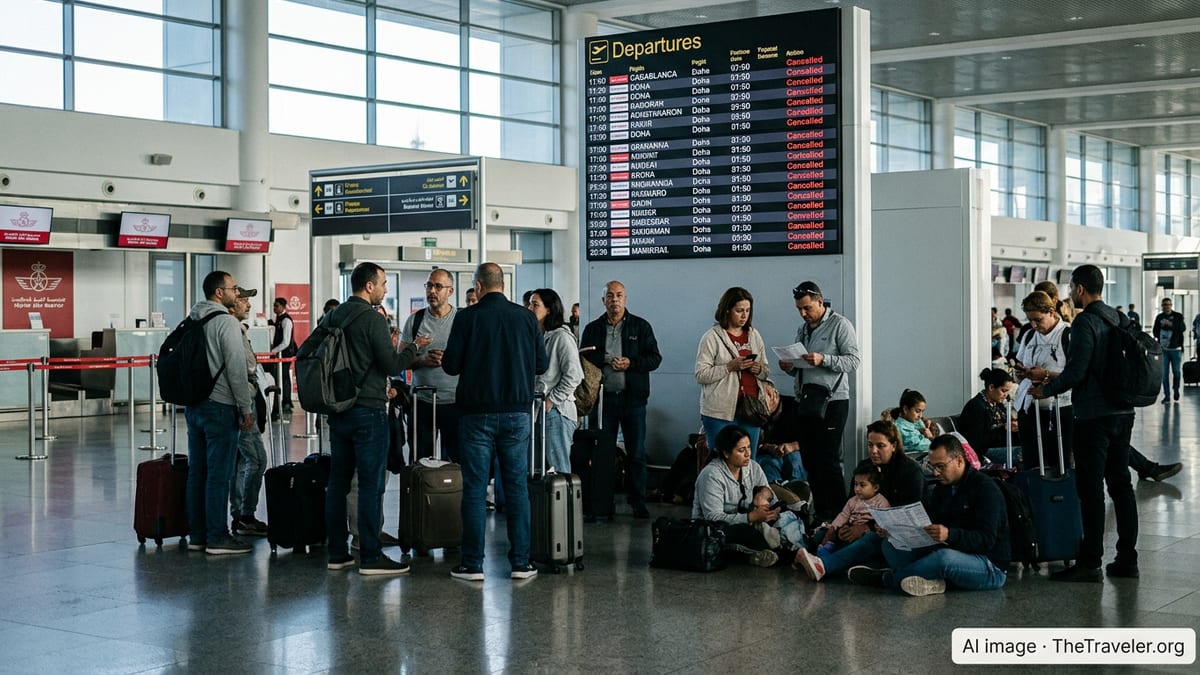
Royal Air Maroc Extends Doha Suspension Amid Regional Airspace Closures
Morocco’s flag carrier confirmed this week that all Royal Air Maroc services to and from Doha are cancelled through March 15, citing escalating security risks and widespread airspace restrictions across the Gulf. The decision affects the airline’s regular Casablanca–Doha link, an important connection for passengers heading onward to Asia and the Pacific via Qatar.
The airline’s announcement follows days of rolling disruptions after coordinated U.S. and Israeli strikes on Iran on February 28 triggered retaliatory missile and drone attacks and prompted several Gulf states to either shut or sharply restrict their airspace. Aviation trackers show little to no civilian traffic over Qatar and neighboring countries during peak periods, forcing airlines to ground flights or take long detours around the conflict zone.
Royal Air Maroc has also cancelled selected flights to Dubai and mounted at least one special evacuation operation from the United Arab Emirates, underlining how quickly routine commercial schedules have given way to ad hoc repatriation missions. Airline officials say they are reviewing the situation day by day but will not resume normal services until regional authorities lift airspace constraints and security advisers deem the corridors safe.
The suspension of the Doha route comes as airlines worldwide tally more than 15,000 cancellations linked to the Iran war in less than a week, with key hubs in Doha, Dubai and Abu Dhabi heavily affected. For Moroccan travelers and others who rely on Royal Air Maroc’s Gulf connections, that translates into missed trips, scrapped holidays and complex, often expensive rerouting through Europe or Africa.
What the Suspension Means for Booked Passengers
For travelers holding Royal Air Maroc tickets to or from Doha through at least March 15, the most immediate impact is that their original flight will not operate. The airline is offering rebooking options and, in many cases, the choice of travel vouchers or refunds, but these are being processed in waves as the situation evolves.
Passengers are being urged not to go to the airport in Casablanca, Doha or Dubai unless they have received a specific rebooking confirmation from the airline. With schedules changing hour by hour, turning up at the terminal without a reissued ticket risks long waits with little chance of boarding a same day alternative.
Travelers whose journeys were due to connect in Doha for onward long haul sectors face the most disruption. In many cases, itineraries built around Royal Air Maroc’s codeshares or separate tickets onto Gulf and Asian carriers have collapsed as partners suspend flights or avoid the affected airspace. Some passengers are being rerouted via European hubs such as Paris, Madrid or Lisbon, while others are being advised to accept full refunds and make fresh bookings once routes stabilize.
Those who booked through travel agents or online travel agencies should contact their intermediary first, as agency systems can often process changes more quickly than overwhelmed airline call centers. Direct Royal Air Maroc customers are being directed to manage their bookings through the carrier’s digital channels where possible, using email or app notifications to track updates.
Safety, Security and Government Travel Advice
The widespread cancellations are rooted in safety and security concerns, not just commercial calculations. Missile and drone strikes, shifting no fly zones and the risk of miscalculation in crowded skies have all led national aviation authorities and airline safety departments to take a conservative approach to routing decisions.
The United States and several European governments have now formally urged their citizens to leave parts of the Middle East while commercial options still exist, underscoring the seriousness of the situation. Advisories highlight the potential for further sudden airspace closures, disruptions to airports serving as evacuation hubs and fast changing security assessments that airlines must incorporate into their operations plans.
For Royal Air Maroc, suspending Doha flights removes exposure to Qatar’s heavily constrained airspace and the traffic flows in and out of Hamad International Airport, which has been at the center of the current disruption. By limiting operations into the Gulf, the airline reduces the risk of last minute diversions and keeps aircraft and crews positioned in Casablanca, where they can be deployed on alternative routes or special missions.
Travelers should also be aware that flight paths avoiding the Gulf and neighboring countries can add several hours to long haul journeys, increasing fuel burn and potentially leading to further indirect disruptions. Even if a flight is technically operating, it may be significantly delayed, re timed or rerouted at short notice as airlines navigate the patchwork of restrictions.
How Affected Travelers Can Respond Right Now
Passengers whose flights to or from Doha are cancelled should first verify the status of their booking using Royal Air Maroc’s official digital channels, then decide whether they wish to postpone their trip, reroute via a different region or seek a refund. Given the exceptional circumstances, airlines across the industry are generally waiving change fees for itineraries touching the Middle East within the coming days, although any fare differences for new routes may still apply.
Flexibility will be crucial. With seats scarce on popular alternative corridors through Europe, North Africa and South Asia, travelers may need to consider multi stop journeys, overnight layovers or departures from different cities. In some cases, reaching a major European or African hub by train or car to catch a long haul flight may be more realistic than waiting for a direct Middle East connection to resume.
Travel insurance policies that include disruption or security related coverage may help offset additional costs such as hotel stays, replacement tickets or non refundable ground arrangements. Policyholders should keep detailed records of cancellation notices, receipts and communications with airlines or agents, as claims teams are likely to face a surge in requests in the coming weeks.
For those who do not need to travel immediately, travel experts recommend deferring non essential trips that rely on transiting the Gulf until there is greater clarity on airspace openings and airline schedules. Royal Air Maroc’s decision to set a clear date of March 15 for the Doha suspension, while subject to change, at least gives passengers a time horizon for reviewing plans and making fresh arrangements if the conflict drags on.
Broader Impact on Middle East and Global Aviation
Royal Air Maroc’s Doha suspension is one element of a much wider aviation shock reverberating far beyond the Middle East. With key hubs in Qatar and the United Arab Emirates operating at reduced capacity and several countries closing their skies, carriers from Asia, Europe, Africa and the Americas are redrawing route maps that had long relied on Gulf stopovers.
Major Gulf carriers have cut or limited flights, international airlines have suspended services to multiple Middle Eastern cities, and flight paths have shifted north and south as operators skirt closed or high risk airspace. The result is longer journeys, higher costs and a strain on already tight global capacity at the tail end of the peak winter travel season.
For Morocco, the disruption threatens to dent a growing role as a bridge between Africa, Europe and the Middle East. Royal Air Maroc’s Gulf links feed traffic into its Casablanca hub, supporting tourism, business travel and diaspora connections. Prolonged closures or reduced frequencies on these routes could weigh on inbound tourism and complicate travel for Moroccans working in the Gulf states.
Aviation analysts note that airlines have become more adept at managing conflict related disruptions after previous crises, but they warn that the current Iran war touches a uniquely dense web of air corridors and hub airports. Until the conflict eases and regulators loosen restrictions, further schedule changes are likely, and travelers across multiple continents should expect the Middle East to remain an unstable transit point.