

More news on this day
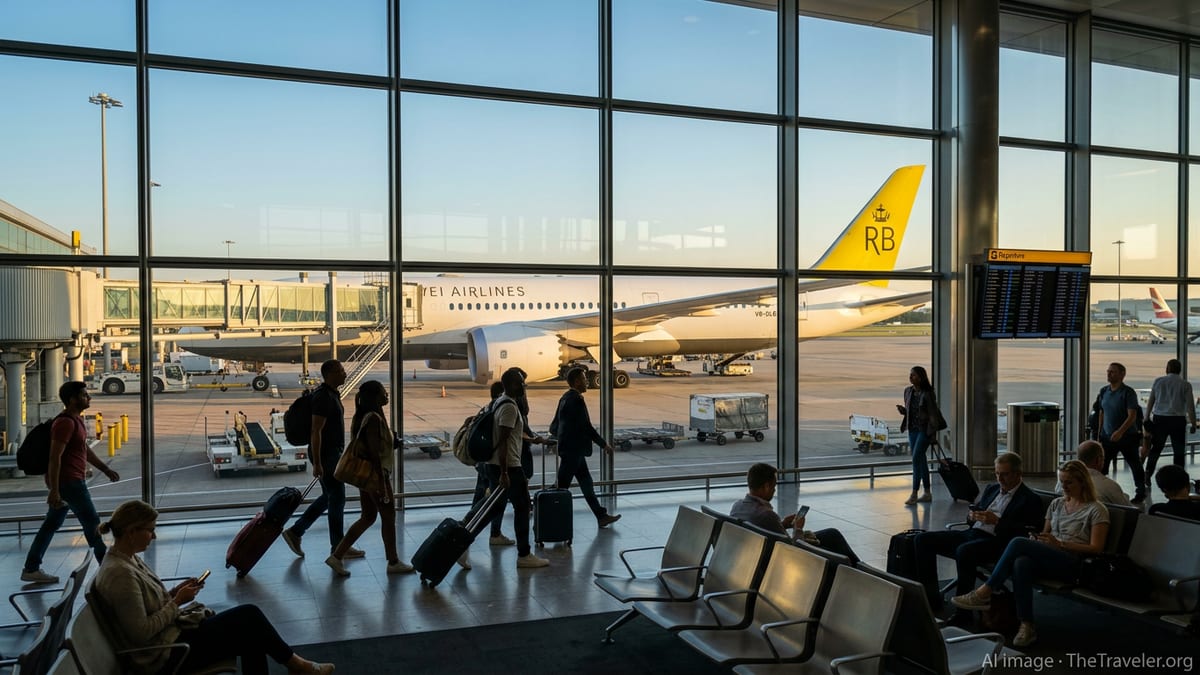
Royal Brunei Airlines has moved swiftly to shield passengers from the escalating Middle East airspace crisis, launching temporary nonstop flights between Brunei and London that bypass traditional Gulf hubs and restore a faster, more predictable route between Southeast Asia and the UK.
Nonstop London–Brunei Link Introduced as Dubai Stop Is Suspended
Royal Brunei Airlines announced that from 10 March to 27 March 2026 it will operate three weekly nonstop services between Bandar Seri Begawan and London Heathrow, temporarily replacing its usual one-stop routing via Dubai. The move follows the suspension of the Dubai sector as airspace closures and operational restrictions ripple across the region, disrupting established corridors between Europe and Asia.
The airline confirmed that the direct flights are being introduced specifically to “maintain passenger connectivity” while conditions in the Middle East remain unstable. The schedule offers evening departures from Heathrow and corresponding services from Brunei, allowing travellers to restore long-haul travel plans that had been thrown into doubt by sudden cancellations and reroutes.
Ordinarily, Royal Brunei’s flagship Europe service relies on Dubai as a technical and commercial stop, placing the carrier squarely within the broader Gulf hub-and-spoke ecosystem. With key airspace segments now restricted or closed, the airline’s decision to temporarily bypass Dubai puts it among a small but growing group of carriers opting to leapfrog the Middle East entirely to keep east–west routes open.
Bypassing Volatile Airspace to Keep Journeys Shorter
The new nonstop route allows Royal Brunei to avoid the patchwork of closures and no-fly zones currently affecting large swathes of Middle Eastern airspace, including skies over Iran, Iraq, Israel and parts of Jordan and the Gulf. Many airlines that traditionally rely on Gulf or Levant hubs have been forced either to cancel flights outright or add hours to their schedules by diverting far to the north or south.
By routing directly between Southeast Asia and the UK, Royal Brunei can operate outside the most affected corridors, limiting extra flying time and fuel burn compared with heavily detoured itineraries. While the airline has not disclosed exact block times, aviation analysts note that skipping a congested, compromised hub can translate into a significantly shorter overall journey versus multi-stop alternatives that zigzag around closed airspace.
For travellers, the benefits are immediate: a single long-haul sector with a predictable schedule, fewer missed connections and less exposure to last-minute operational changes. At a time when many Europe–Asia itineraries are seeing two to four additional hours in the air, Royal Brunei’s direct link offers one of the leaner options available between the UK and northern Borneo, and an attractive alternative gateway for passengers bound for nearby markets in Malaysia, Indonesia and the wider region.
Relief Valve for Stranded Europe–Asia Travellers
The Middle East crisis has triggered one of the most severe disruptions to global aviation since the early stages of the pandemic, with thousands of flights cancelled or delayed and fares on key Europe–Asia routes surging as capacity tightens. Major Gulf hubs such as Dubai, Doha and Abu Dhabi, usually among the world’s busiest transit points, have seen reduced operations as airlines scale back or reroute services to avoid restricted skies.
Against that backdrop, Royal Brunei’s nonstop London operation is emerging as a modest but meaningful relief valve. The three weekly services add limited but high-value capacity that is insulated from the most volatile segments of the network, offering an additional way out for passengers who might otherwise rely on congested reroutes through South Asia or northern Europe.
Travel agents report brisk interest from travellers looking for any available seats that keep journeys as simple as possible. With some flag carriers adding fuel surcharges and sharply higher last-minute fares, Royal Brunei’s move may also help temper price spikes on certain dates by providing a niche but competitive option in the broader Europe–Southeast Asia market.
Industry observers say the airline is also capitalising on its reputation for service quality, after repeatedly earning international awards for its cabin crew and onboard experience. In a period when many passengers are focused primarily on simply reaching their destination, the promise of a relatively calm, one-stop-free journey holds added appeal.
Operational Flexibility and Short-Term Strategy
Royal Brunei has framed the direct London flights as a time-limited measure, aligned with the current scheduling season and subject to further adjustment if conditions evolve. The carrier’s published operating plans still envisage a return to the traditional Brunei–Dubai–London pattern from late March, but executives have left open the possibility of revisiting that timeline should regional airspace restrictions persist.
Aviation analysts underline that switching an established route from one-stop to nonstop service on short notice is a complex undertaking. It demands careful recalculation of payload limits, fuel planning and crew scheduling, particularly on a long sector that pushes the range capabilities of the airline’s widebody fleet. Nevertheless, Royal Brunei’s swift execution underscores the flexibility that smaller, nimble carriers can bring to crisis management.
By rapidly redesigning its London operation, the airline is not only safeguarding its own revenue base but also reinforcing Brunei’s position on the global air map at a moment when many secondary gateways are losing connectivity. For a nation that relies on aviation links for tourism, business travel and outbound education, keeping a direct line to one of the world’s most important aviation markets carries strategic weight.
Whether the nonstop link extends beyond its initial March window will depend on both geopolitical developments and commercial performance. If the service proves popular and operationally sustainable, it could inform Royal Brunei’s longer-term thinking about how best to balance hub dependence with more direct, point-to-point flying.
What Passengers Need to Know Before Booking
Travellers considering Royal Brunei’s new London flights are being urged to pay close attention to travel dates, as the nonstop services are currently confined to a narrow window between 10 and 27 March. Outside that period, schedules may revert to the airline’s previous pattern or be reshaped again in response to ongoing events in the Middle East.
Passengers whose original itineraries routed via Dubai are being contacted with options that can include rebooking on the direct service, switching to alternative dates or obtaining refunds, depending on fare conditions. With aviation authorities and airlines issuing frequent updates, industry experts advise checking flight status repeatedly in the days and even hours before departure.
For those able to secure seats, the direct route offers a comparatively low-stress experience in an otherwise turbulent travel landscape: a single long-haul flight, reduced exposure to airspace-related disruption and an arrival at Heathrow with onward connections into the broader European network. For Bruneian travellers and visitors to the Sultanate alike, the new link is a reminder that, even in a period of heightened geopolitical risk, airlines can still innovate to keep people moving efficiently around the world.