

More news on this day
Royal Caribbean is stepping into the front lines of Mexico’s sargassum battle, backing a new public–private plan in Quintana Roo that aims to shield key Caribbean beaches and fragile coastal ecosystems from record seaweed arrivals while preserving one of the country’s most valuable tourism corridors.
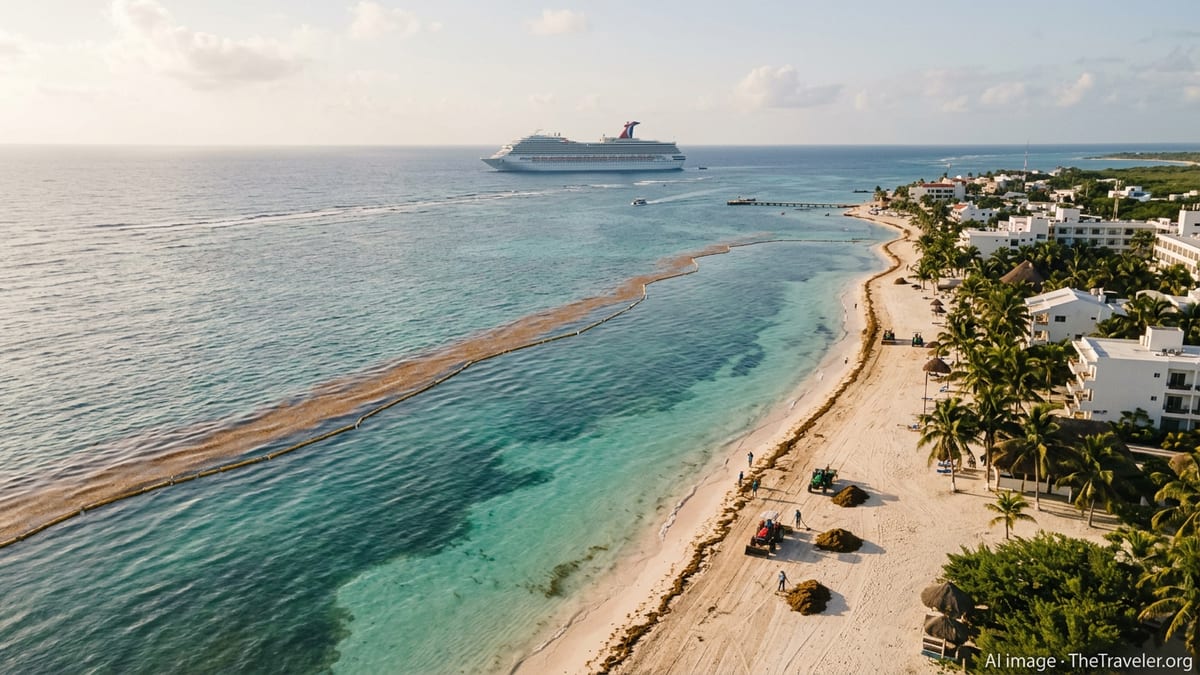
A Cruise Giant Tied to a Coast Under Pressure
The announcement comes as Quintana Roo braces for another intense sargassum season, with the Mexican Navy warning of potentially record accumulations along the state’s Caribbean shoreline in 2026. Authorities and tourism operators fear that heavy landings on beaches from Cancún to Mahahual could again disrupt visitor numbers and strain local clean-up budgets.
Royal Caribbean has deepened its footprint in the region through plans for major cruise infrastructure, including Perfect Day Mexico, a large-scale destination planned for Mahahual, and a new terminal project in Cozumel scheduled to open in 2026. Company executives have acknowledged that the long-term success of these developments depends on healthier coastal ecosystems and cleaner beaches.
In a recent statement, the cruise line framed its new environmental commitments in Quintana Roo as part of a broader strategy to limit its impact on sensitive coastal zones. The company has highlighted sargassum as both an ecological threat and a risk to local livelihoods, particularly in smaller communities that rely heavily on cruise calls and seaside tourism.
State officials, who have struggled with limited public funding to manage massive sargassum landfalls, say Royal Caribbean’s participation is intended to complement, not replace, government-led mitigation programs already under way across the Mexican Caribbean.
New Money and Technology for Year-Round Sargassum Response
Under the plan outlined by Quintana Roo authorities and Royal Caribbean, the company is channeling new funding to sargassum management and coastal protection projects, including year-round containment and collection efforts coordinated with the Mexican Navy and local municipalities. The initiative builds on the state’s decision to make its sea-to-shore sargassum strategy permanent after a record collection of more than 90,000 tons in 2025.
Royal Caribbean has earmarked dedicated resources for programs focused on protecting coastal ecosystems, including coral reefs, seagrass beds and sea turtle nesting sites that are vulnerable to prolonged sargassum accumulations. According to the company, these contributions are separate from its infrastructure investments and are meant to support local partners already engaged in beach cleaning, offshore barriers and habitat monitoring.
Officials in Quintana Roo say the cruise line’s participation will help strengthen early-warning systems and logistics. The state has developed a satellite-based Sargassum Monitoring Center and relies on specialized vessels and floating barriers to intercept algae before it reaches the shore. Additional private funding is expected to support expanded barrier lines, improved collection boats and more efficient transport of biomass to processing sites.
Tourism leaders note that the scale and timing of the effort are critical. Sargassum typically affects the Mexican Caribbean from spring through late autumn, overlapping with peak cruise and resort seasons. A more robust, year-round response backed by cruise industry funds is seen as essential to maintaining the region’s appeal for international travelers.
From Waste to Resource: Turning Sargassum into Energy and Materials
A central pillar of the new plan is the push to treat sargassum not only as marine debris but as a potential raw material. Quintana Roo has already begun working with international partners on pilot projects that convert collected seaweed into biogas, fertilizer and other products, reducing the volume that ends up in landfills or temporary dumpsites near sensitive wetlands.
Royal Caribbean’s involvement is expected to accelerate these circular-economy efforts by helping finance and stabilize supply to processing facilities envisioned along the coast. State officials have advanced proposals for integrated plants that combine wastewater treatment with sargassum biodigestion, providing renewable energy for nearby hotel zones while cutting emissions associated with conventional disposal.
Environmental specialists caution that large-scale reuse must be carefully managed to avoid new pollution risks, but they see promise in controlled, industrial facilities designed with strict environmental standards. By linking sargassum management to energy generation and agricultural inputs, authorities hope to create economic incentives that ensure consistent collection offshore and on beaches.
For Royal Caribbean, supporting these projects aligns with its own sustainability pledges, including emissions reductions and cleaner operations in key ports. The company has indicated that learnings from Quintana Roo could inform sargassum strategies at other destinations across the wider Caribbean where its ships regularly call.
Balancing Coastal Development With Ecosystem Protection
The cruise line’s expanding presence in southern Quintana Roo, particularly around Mahahual and the Costa Maya area, has prompted debate among residents and environmental groups who worry that large-scale private destinations could intensify pressure on mangroves, reefs and nearshore habitats. Critics argue that intensive tourism models risk undermining the very ecosystems the new sargassum initiative seeks to protect.
In response, Royal Caribbean and state authorities have stressed that the sargassum plan is tied to broader commitments on habitat conservation, water treatment and responsible construction. Project documents for Perfect Day Mexico reference advanced water treatment systems, coastal vegetation buffers and monitoring programs designed to track changes in marine health over time.
Local officials say that stricter environmental impact assessments and ongoing oversight will be necessary to ensure that new tourism infrastructure, including cruise ports and entertainment complexes, is compatible with the long-term resilience of coral reefs and seagrass meadows already stressed by warming seas and nutrient pollution. They view the sargassum partnership as one component of a wider shift toward more regulated, lower-impact coastal development.
Community leaders in Quintana Roo are calling for sustained transparency around how new environmental funds are spent and how benefits are shared among municipalities, not just in flagship cruise ports. Some have urged authorities to direct a portion of tourism-related fees and private contributions toward restoring eroded beaches, rehabilitating mangroves and supporting small-scale fishers affected by changing coastal conditions.
What the Plan Means for Travelers Heading to Quintana Roo
For travelers planning cruises or resort stays along Mexico’s Caribbean coast, the emerging partnership offers cautious optimism that the worst visual and odor impacts of sargassum can be mitigated at key tourism hotspots, even in heavy seasons. Hoteliers and cruise operators say that better forecasting and more efficient offshore collection will allow them to respond more quickly to new landings.
Travel agents report that questions about sargassum have become routine for clients considering Cancún, the Riviera Maya, Cozumel or Costa Maya. Authorities believe that visible investments in clean-up crews, offshore barriers and restoration projects, combined with clearer public information about daily beach conditions, can help sustain visitor confidence during the April to November seaweed period.
Royal Caribbean has indicated that it will highlight Quintana Roo’s conservation efforts in its own communications, positioning the state as a destination that is actively adapting to climate-driven challenges. The company also points to expanded support for local environmental groups and educational campaigns aimed at visitors and residents as part of its contribution.
While no strategy can fully eliminate sargassum from the shoreline, officials in Quintana Roo argue that closer coordination with major cruise operators marks an important step toward a more resilient coastal economy. The test in the coming seasons will be whether this new alignment of public and private interests can both protect sensitive ecosystems and keep one of the Caribbean’s busiest tourism corridors open for business.