

More news on this day
Royal Caribbean is ramping up its environmental footprint in Mahahual on Mexico’s Caribbean coast, backing a multi-year sargassum removal push that local officials say is becoming critical to keeping the fast-growing cruise hub clean, swimmable and economically viable.
New Funding Ties Cruise Growth to Cleaner Shores
Announced in Mahahual on March 3, 2026, Royal Caribbean’s latest commitment folds sargassum management directly into its broader expansion plans in Costa Maya, where the line has acquired the cruise port and more than 200 acres of surrounding coastline for its future Perfect Day Mexico destination. Local authorities say the company’s new pledge is designed to reinforce public efforts already battling record seaweed landings along the shore.
The initiative focuses on strengthening coastal defenses and accelerating collection of sargassum, the drifting brown macroalgae that periodically blankets beaches and nearshore waters, discoloring the sea and releasing strong odors as it decomposes. For Mahahual, a small fishing village turned cruise gateway, the seaweed surges have become a frontline issue for hoteliers, tour operators and residents whose livelihoods depend on postcard-ready beaches.
Royal Caribbean is positioning the program as a cornerstone of its SEA the Future sustainability vision and its Destination Net Zero strategy, which frame environmental safeguards as essential to the long-term success of its private-destination model. Company representatives in Mahahual have emphasized that sustaining cruise tourism now requires investing not only in attractions on land, but also in the resilience of the natural coastline that draws visitors in the first place.
State officials in Quintana Roo, who have welcomed the investment, describe the new private-sector backing as a practical response to a regional environmental challenge that has outgrown public budgets. They say tying cruise revenues to coastal protection is intended to create a virtuous circle in which rising passenger volumes directly support cleaner, more attractive beaches.
Heavy Machinery and Barriers Boost Sargassum Response
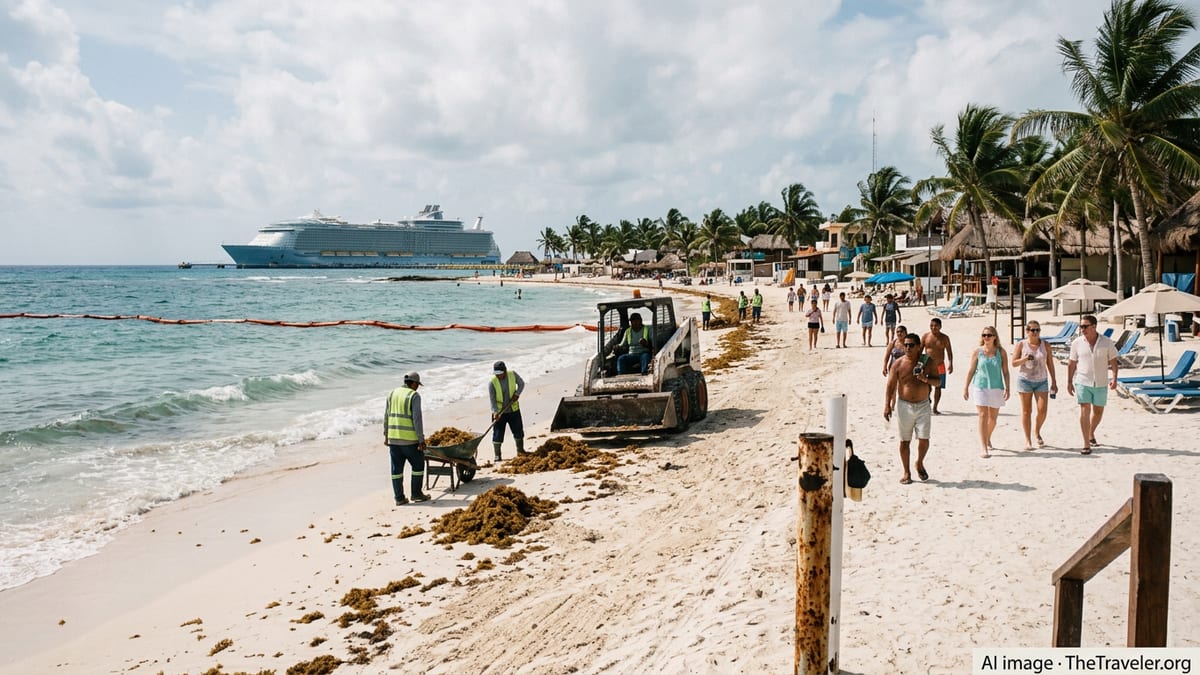
The expanded program builds on equipment already delivered to Mahahual in late 2025, when the state government deployed a 12-ton cargo truck and a backhoe dedicated to sargassum collection along the local shoreline. That purchase was financed through the Trust for the Well-being of Cruise Tourism, a fund that matches every dollar contributed by cruise companies with one dollar from the state, earmarking the joint resources specifically for destinations that receive cruise passengers.
Authorities report that nearly 90,000 tons of sargassum were removed across the state in the 2025 season, with Mahahual and the wider Costa Maya area among the hardest hit. Naval crews and civilian volunteers have also deployed floating containment barriers just offshore, intercepting seaweed before it accumulates in swimming zones. In a single late-summer week last year, more than 1,200 tons of sargassum were cleared from beaches around Mahahual and nearby Xcalak.
Royal Caribbean’s new commitment is expected to channel more consistent funding into these frontline measures, from barrier maintenance to beach cleaning teams and safer, faster removal of collected biomass. Local officials say the goal for the coming 2026 season is to cut the time beaches remain covered after heavy landings, allowing cleanup crews to restore access within hours rather than days in key stretches used by cruise visitors.
Operators in Mahahual note that effective response is not just about tourism imagery but also about public health and basic infrastructure. Large, decomposing mats of sargassum can damage nearshore ecosystems, overwhelm municipal waste systems and create unpleasant conditions for residents as well as visitors. Consistent, well-funded collection efforts, they argue, are now a baseline requirement for operating a major Caribbean cruise port.
Balancing Perfect Day Mexico With Local Expectations
The sargassum initiative comes as Royal Caribbean accelerates its investment in Mahahual, where it is developing Perfect Day Mexico, a large-scale private destination set to open later this decade. The project includes plans for water attractions, beach clubs and expanded visitor facilities, with projected daily capacities far exceeding those of the town’s current tourism infrastructure.
Company materials promoting the project highlight a set of environmental pillars that include habitat protection and restoration, reduced single-use plastics and advanced water treatment. Sargassum management is explicitly framed as part of that habitat pillar, with references to “sustainable solutions” for removing seaweed and coastal waste. The new cleanup funding in Mahahual is being presented as an early step toward delivering on those promises.
At the same time, community and environmental groups along Mexico’s Caribbean coast have voiced concern about the cumulative impact of mega-destinations on fragile ecosystems, including mangroves, dunes and the nearby Mesoamerican Reef. Some organizations have warned that any expanded tourism footprint, however green on paper, could increase pressure on local resources and wildlife if not tightly regulated and transparently monitored.
Regional officials insist that the latest sargassum efforts in Mahahual are being designed in coordination with federal and state environmental agencies. They argue that involving cruise companies more directly in managing the seaweed problem helps align private development interests with public conservation mandates, especially in a town where cruise arrivals are expected to keep climbing.
Economic Stakes High for Mahahual’s Cruise-Driven Economy
For Mahahual, the stakes are tangible. Local business groups estimate that even modest spikes in sargassum arrivals can trigger last-minute cancellations at beachfront hotels and shore excursions, particularly during the April to October season when seaweed landings typically peak. In 2025, some properties in the Costa Maya area reported measurable dips in occupancy tied to online images of brown-tinged water and seaweed-covered sand.
Cruise operators, who sell Mahahual and Costa Maya as gateways to clear Caribbean water, Mayan ruins and reef excursions, are acutely aware that repeat business depends on visitor perception. Travel advisors say lines that show a visible commitment to maintaining clean beaches are better positioned to reassure guests who now routinely ask about sargassum conditions when choosing itineraries.
Royal Caribbean’s expanded backing of cleanup work is therefore being interpreted by regional tourism officials as both a risk-management strategy and a competitive move. By helping to keep Mahahual’s coastline in better condition, the company stands to protect onshore spending by its passengers, from beach clubs and restaurants to local tour operators and artisans who rely heavily on cruise traffic.
Residents and small business owners, many of whom have shifted from fishing to tourism over the past two decades, say that any program that strengthens practical, on-the-ground cleanup capacity is welcome. The key question, they add, will be whether the new initiative translates into faster, more visible results on the sand as the next sargassum season approaches.
From Crisis Response to Long-Term Coastal Management
Experts across the Caribbean increasingly describe sargassum as a new normal rather than a temporary anomaly, pushing destinations like Mahahual to move beyond ad hoc cleanups toward integrated coastal management. Scientists point out that while individual landings vary from year to year, the broader belt of free-floating seaweed in the tropical Atlantic has expanded sharply over the past decade, influenced by climate patterns, ocean currents and nutrient inputs.
Royal Caribbean’s strengthened role in Mahahual coincides with wider efforts in the region to improve monitoring, forecasting and safe disposal of sargassum. Authorities in Quintana Roo have been testing different combinations of offshore barriers, mechanical collection and manual beach raking, while exploring options for reusing dried biomass in agriculture or construction materials where feasible.
Local leaders say that having a major cruise operator at the table, contributing funds and aligning its own destination planning with state strategies, could help Mahahual shift from reactive beach cleanups toward a more predictable, better-financed system. That includes investing in training for local crews, modernizing equipment and ensuring that disposal sites and transport routes are managed to avoid secondary impacts inland.
As Mahahual navigates the dual trajectory of rising cruise arrivals and recurring sargassum seasons, the town is emerging as a test case for how global tourism brands, small coastal communities and regional governments might share responsibility for maintaining the very beaches that underpin their shared prosperity.