

More news on this day
Royal Caribbean has announced a multi-year sargassum protection and management program for Mexico’s Quintana Roo coastline, centering on the cruise gateway of Mahahual just as authorities warn of a potentially record seaweed season in the Mexican Caribbean.
New Multi-Year Commitment on the Mahahual Front Line
The initiative, unveiled this week in coordination with Quintana Roo authorities, local leaders and the Mexican Navy, aims to strengthen shoreline protection and accelerate long-term solutions to the recurring influx of sargassum along the state’s southern coast. Mahahual, home to the Costa Maya cruise port and a string of small beach hotels, has been repeatedly hit by heavy seaweed landings that darken nearshore waters, generate odor and disrupt beach tourism.
Royal Caribbean has framed the program as a community-driven effort rather than a short-term, port-only fix. A dedicated working group has been set up with residents, small businesses, environmental specialists and municipal representatives to identify priority areas and guide investment. Company executives say the focus is on tools that can be scaled and maintained locally, not just during peak cruise periods but throughout the year.
The announcement comes as Quintana Roo’s government and federal agencies reiterate that private-sector participation is essential to keep pace with the growing volumes of seaweed washing ashore. Officials have welcomed the cruise line’s move as a signal that large tourism operators are prepared to share responsibility for maintaining beach quality and protecting sensitive coastal ecosystems.
While Royal Caribbean has not disclosed a precise dollar value for the initiative, local authorities describe it as a “long-term” commitment that will run over multiple seasons and complement public clean-up budgets, which already run into the hundreds of millions of pesos annually across the state.
How the Sargassum Protection Plan Will Work
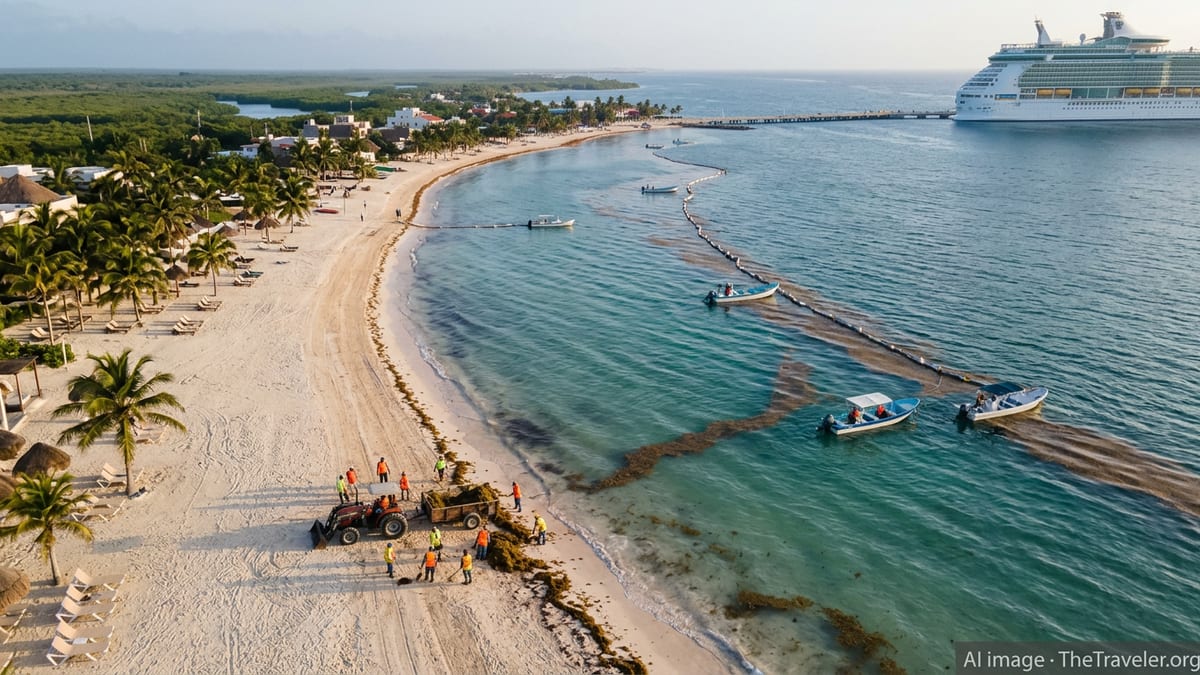
At the core of the program is a sea-to-shore strategy designed to intercept and remove sargassum before it decomposes on the sand. Royal Caribbean is supporting the deployment of seaweed skimming equipment to collect floating sargassum in nearshore waters off Mahahual, where currents frequently funnel large mats of the brown macroalgae toward the beach. The collected biomass is to be transferred to onshore reception points for controlled handling and eventual reuse or disposal.
The plan also reinforces the existing system of offshore barriers that the Mexican Navy and state authorities have been gradually installing along sections of the Quintana Roo coastline. These semi-permeable floating barriers are positioned parallel to the shore to slow and redirect incoming seaweed so that collection vessels and amphibious units can remove it more efficiently in open water.
On land, the program supports beach-cleaning brigades and mechanical removal where permitted, with an emphasis on minimizing the disturbance of sand dunes and turtle nesting areas. Officials in Mahahual say coordination between ship schedules and clean-up teams will be tightened so that crews can prioritize areas used by day visitors from docked cruise ships while still maintaining access for local residents and overnight tourists.
Beyond hardware and manpower, the working group plans to develop protocols for monitoring sargassum arrivals in real time, drawing on satellite imagery, oceanographic forecasts and community reporting. The goal is to anticipate heavy landings several days in advance, allowing port operators, hotels and tour providers to adjust operations and communicate transparently with visitors.
Why Sargassum Has Become a Critical Issue in Quintana Roo
Sargassum, a naturally occurring floating seaweed in the Atlantic, has surged in recent years, forming vast blooms that drift across the Caribbean and into the Gulf of Mexico. When large quantities reach shore, they can overwhelm local clean-up capacity, altering water color, smothering seagrass beds and coral, and affecting air quality as the seaweed decomposes in the sun.
For Quintana Roo, where tourism is a central pillar of the economy, the seasonal waves of sargassum have become a structural challenge. State officials estimate that tens of thousands of tons of seaweed have been collected annually along beaches from Cancún and Playa del Carmen down to Tulum, Cozumel, Mahahual and Xcalak. The cost of removal, transport and disposal is borne largely by municipal authorities and hotel operators, who also face reputational risks when beaches turn brown at the height of the vacation season.
This year, the Mexican Navy and scientific monitoring programs have warned that the volume of sargassum drifting toward the region could exceed historical averages by a significant margin during March and April. In anticipation, authorities have expanded the network of collection vessels and barriers and shifted sargassum management from a seasonal response to a year-round strategy.
Environmental groups stress that the phenomenon is linked to broader ocean changes, including warming waters and nutrient flows, and that no single resort, hotel or cruise line can solve the issue independently. Against that backdrop, Royal Caribbean’s program is being viewed in Quintana Roo as one piece of a larger, evolving mosaic of public and private responses.
From Nuisance to Resource: What Happens to the Collected Seaweed
A growing part of the conversation along the Mexican Caribbean coast is how to transform sargassum from a costly waste stream into a useful resource. The state government has been encouraging companies to explore circular-economy models that turn the biomass into products such as soil conditioners, building materials, biogas or industrial inputs, under new frameworks that offer incentives for sustainable processing.
Within the Mahahual initiative, Royal Caribbean and local partners are working to align with these efforts by channeling collected sargassum to authorized treatment or valorization sites instead of open-air dumps that can leach contaminants. Officials say the aim is to ensure traceability from the moment the seaweed is lifted from the water to its final use, in order to meet environmental standards and reassure communities that the problem is not simply being shifted out of sight.
Experts warn that processing sargassum at scale presents technical and economic hurdles, including fluctuating supply, high moisture content and the need to control heavy metals or other impurities. Pilot projects elsewhere in Quintana Roo will help determine which uses are viable in the long term, and Mahahual is expected to feed into that learning process by providing a steadier flow of collected material as offshore interception improves.
For now, authorities emphasize that the priority remains rapid removal from the nearshore zone so that beaches, seagrass beds and reefs are less exposed to dense accumulations. Any value-added use of the biomass is seen as a bonus that could eventually offset part of the cost of collection.
What Cruise Passengers and Beach Travelers Should Know
For travelers planning cruises and beach holidays in Quintana Roo, the new sargassum protection plan signals intensified efforts to keep key stretches of shoreline swimmable and visually appealing, particularly around Mahahual’s cruise pier and adjacent beaches. However, officials and tourism operators alike caution that no strategy can guarantee sargassum-free conditions, especially during peak arrival months when winds and currents can change rapidly.
Cruise passengers calling at Costa Maya can expect to see more visible offshore infrastructure, such as barriers and collection boats, and more early-morning clean-up activity on the sand. Local guides may adjust shore excursions on short notice if certain beaches experience heavier landings than forecast, steering visitors toward less-affected areas or to inland attractions.
Beach travelers are being encouraged to check recent photos and local reports rather than relying solely on historical experience, since sargassum patterns can vary significantly from year to year and even week to week. Tourism officials stress that many experiences in Quintana Roo, from cenotes and lagoons to archaeological sites and jungle tours, remain unaffected by seaweed conditions and can be good alternatives on days when the shoreline is under strain.
Royal Caribbean and local authorities say the success of the new program will be measured not only by cleaner beaches during cruise calls, but also by how well it supports the broader Mahahual community and coastal ecosystems over time. With sargassum now a recurrent feature of the Caribbean seascape, the initiative is being watched closely as a test case for how major cruise lines can participate in destination-wide resilience efforts.