

More news on this day
Travelers passing through Amman’s Queen Alia International Airport on April 5 faced a fresh wave of disruption as Royal Jordanian Airlines recorded three flight cancellations and a cluster of delays on some of its busiest regional and long haul routes.
Get the latest news straight to your inbox!
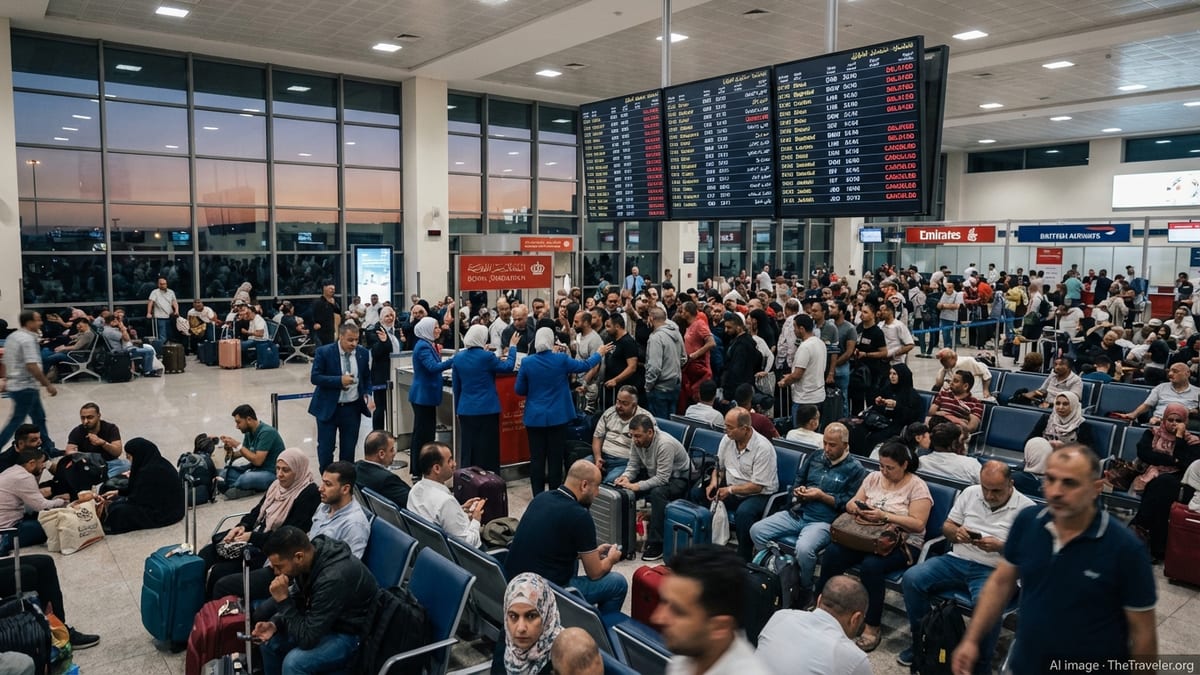
Operational Strain at Queen Alia International Airport
Publicly available flight-tracking boards and aviation data for April 5 indicate that Royal Jordanian’s schedule at Queen Alia International Airport came under visible strain, with three flights cancelled and more than a dozen departures or arrivals operating behind schedule. While the overall percentage of affected services remains relatively small compared with the airline’s full daily operation, the impact on passengers was significant because the disruptions struck several of the carrier’s core regional and European routes.
The affected services include links between Amman and key cities such as Beirut, Frankfurt, Amsterdam and Addis Ababa, where delays of varying length rippled through connecting banks. For many travelers using Amman as a transfer hub between Europe, the Levant and East Africa, late arrivals translated into missed onward flights and unplanned extended time in transit areas or nearby hotels.
Regional aviation observers note that Queen Alia International Airport continues to handle a busy flow of traffic despite wider Middle East uncertainties, and most airlines serving the Jordanian capital have been operating relatively close to schedule. Against that backdrop, the latest batch of Royal Jordanian disruptions stands out, not as a full operational breakdown, but as a reminder of how quickly pressure on a single hub can cascade across a much wider network.
Travel industry commentary points out that even a handful of cancellations can create a knock-on effect for crews, aircraft rotations and baggage transfers for the rest of the day. As a result, some Royal Jordanian passengers whose own flights were technically running on time still reported longer queues at check in and service desks as staff worked through earlier issues.
Key Routes Hit: Beirut, Frankfurt, Amsterdam and Addis Ababa
Data from airline schedules and same day airport information show that among the routes most visibly affected were services linking Amman with Beirut, Frankfurt, Amsterdam and Addis Ababa, all of them important components of Royal Jordanian’s network. Beirut is a high frequency short haul market that feeds connections to Europe and the Gulf, so disruptions there often have an outsized effect on itineraries involving tight connections.
On the European side, Frankfurt and Amsterdam are among the principal gateways for passengers traveling between Jordan and the wider continent, including those connecting onward on partner or interline carriers. Delays on these sectors can mean missed evening departures to North America or other European cities, adding rebooking complexity for travelers who expected smooth same day transfers.
Addis Ababa, meanwhile, represents a strategic bridge between Amman and East Africa. Disruptions on this route can affect both point to point passengers and those traveling between Europe and African destinations using Amman as a change point. Reports from aviation tracking platforms suggest that at least one of the day’s three cancellations involved a flight on a regional or medium haul route, further reducing flexibility for passengers seeking same day alternatives.
Although complete details of each affected flight’s cause are not publicly itemized, the concentration of issues on such high value routes means the disruption resonates beyond Jordan’s borders. Travel agents monitoring the situation noted that limited spare capacity to and from Amman on other carriers in early April leaves fewer straightforward rerouting options when Royal Jordanian flights are pulled from the schedule or operate late.
Regional Turbulence and an Already Fragile Middle East Network
The turbulence at Queen Alia International Airport arrives in a broader Middle East context where schedules remain fragile. Recent compilations of regional flight performance show hundreds of delays and dozens of cancellations across carriers in Turkey, the United Arab Emirates, Egypt, Kuwait and beyond, as airlines navigate airspace restrictions, security advisories and shifting demand patterns.
Industry summaries published over the past week describe how some European and Gulf airlines have dramatically scaled back or temporarily suspended flights on certain Middle Eastern routes, including services touching Amman and Beirut. These moves have increased reliance on carriers still operating full networks, positioning Royal Jordanian as a crucial connector at precisely the moment when its own operations are under pressure.
Jordan-focused travel advisories and tour operator updates released in late March emphasized that the country’s airspace remains open and that Queen Alia International Airport continues to receive regular commercial traffic. However, they also cautioned that flight plans can change at short notice as airlines adjust routings and schedules around neighboring airspace constraints, particularly on corridors linking Europe with the Gulf and East Africa.
Against this regional backdrop, Royal Jordanian’s April 5 cancellations and delays appear less as an isolated incident and more as part of a complex operating environment that has left many Middle East carriers with little spare resilience. When weather, technical checks, crew availability or airspace reroutes converge on a single day, the result for passengers can be a sudden and confusing wave of disruption such as the one visible at Queen Alia.
Passenger Experience: Missed Connections and Long Queues
Accounts shared through social platforms and traveler forums on April 5 paint a picture of crowded help desks and longer than expected queues at transfer counters in Amman, as Royal Jordanian customers sought rerouting or overnight accommodation after missed connections. Some passengers reported seeing their flights listed differently across channels, with a service appearing cancelled in a booking portal while still showing as scheduled on airport screens, adding to the confusion.
For travelers heading toward Europe from the Gulf and South Asia via Amman, missed onward flights to Frankfurt or Amsterdam created particular complications. With other major airlines having cut capacity on some Middle East routes, alternative same day options were sometimes limited or involved lengthy detours through third country hubs. This left some passengers choosing between extended layovers, complex rebookings, or pushing back their trips entirely.
Royal Jordanian’s contractual conditions of carriage, available publicly, state that in the event of cancellations or substantial delays, passengers are typically entitled to options such as rebooking on the next available flight, a refund, or in some circumstances travel on another carrier. In practice, the speed and ease with which travelers can secure these remedies often depends on how quickly they reach an agent, which helps explain the heavy footfall at airport counters during disruption events.
Travel advisers routinely recommend that passengers monitor their flight status through airline apps or official channels on the day of travel, and that those with tight connections build in extra buffer time when flying through hubs in regions experiencing heightened operational volatility. The April 5 situation at Queen Alia will likely reinforce that message for many regular travelers on Royal Jordanian’s network.
What Travelers Should Watch in the Coming Days
For now, there is no wide public indication that Royal Jordanian plans systematic schedule cuts at Queen Alia International Airport beyond the April 5 disruptions, and broader reporting on Jordan’s aviation sector continues to describe operations as broadly stable. Nonetheless, the combination of regional airspace complexity and a constrained pool of alternative carriers on some routes means travelers booked over the next several days may face further timetable adjustments.
Passengers with imminent departures involving Amman, particularly those traveling to or from Beirut, Frankfurt, Amsterdam or Addis Ababa, are being urged in public advisories and travel commentary to keep a close eye on departure boards and any notifications from their airline or online travel agency. Early awareness of a delay or cancellation increases the chances of securing seats on limited replacement services before they fill.
Analysts following Middle East aviation trends suggest that sporadic waves of disruption are likely to continue as airlines refine routings and attempt to rebuild reliability into their networks. For Royal Jordanian, maintaining its role as a stable connector between Europe, the Levant and East Africa will depend on how effectively it can manage days like April 5, when multiple pressures align.
For travelers, the latest disruption at Queen Alia International Airport serves as a practical reminder to incorporate flexibility into itineraries, consider travel insurance that covers schedule changes, and remain prepared for unexpected overnight stays or reroutings when crossing a region where aviation remains under unusual strain.