

More news on this day
Royal Jordanian and Gulf Air have canceled key flights linking Baghdad with Amman and Bahrain amid heightened regional security risks, triggering fresh disruption for travelers who rely on these routes to connect across the Middle East and beyond.
Get the latest news straight to your inbox!
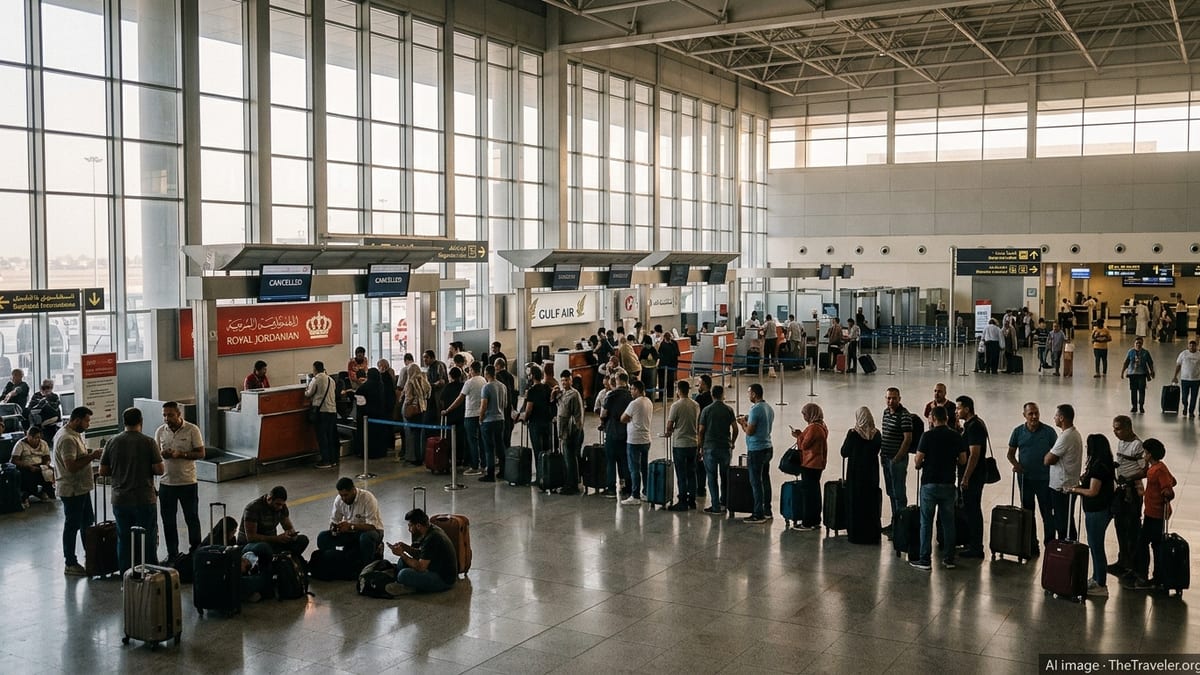
Targeted Cancellations on Baghdad–Amman and Baghdad–Bahrain Routes
Recent schedule updates and advisory documents indicate that both Royal Jordanian and Gulf Air have suspended selected services from Baghdad International Airport to their home hubs in Amman and Bahrain. These routes are normally among the busiest corridors for passengers traveling between Iraq, the Levant, and the Gulf, and they serve as vital transit links to Europe, North America, and Asia.
For Royal Jordanian, the Baghdad to Amman connection is a cornerstone of its Iraq network, feeding long haul departures from Queen Alia International Airport. Publicly available information now shows that flights touching Iraqi destinations, including Baghdad, have been removed or temporarily halted in the carrier’s timetables during the current security escalation. Gulf Air has taken similar steps, with multiple reports describing the suspension of Baghdad to Bahrain operations, in line with broader disruption to services through Bahrain International Airport following regional strikes and airspace restrictions.
These selective cancellations form part of a wider wave of schedule changes by Middle Eastern airlines as they adapt their operations to evolving security assessments, shifting airspace availability, and the need to keep crew and passengers away from perceived high risk corridors.
Regional Security Escalation Behind Network Changes
The Baghdad route suspensions are closely tied to a broader deterioration in regional security conditions that began in late February 2026. Public reporting on Iranian missile and drone strikes across several Arab countries, including Jordan and Bahrain, has highlighted growing risks to aviation infrastructure and airspace stability across parts of the Middle East.
In Iraq, security alerts around Baghdad, including incidents near Baghdad International Airport and the city’s diplomatic zone, have contributed to heightened caution by carriers. At the same time, Bahrain and neighboring Gulf states have faced repeated disruptions linked to air defense activity and temporary airspace restrictions, forcing airlines such as Gulf Air to repeatedly adjust or suspend flights, especially those that rely on contentious flight paths.
Industry and security advisories emphasize that these measures are precautionary. They are designed to limit overflight exposure to potential missile or drone trajectories and to reduce congestion in airspace that may be subject to military operations or jamming. As a result, routes which pass close to recent strike locations or key military installations are among the first to see cancellations, even if airport terminals themselves remain physically undamaged.
Knock-On Effects for Passengers and Transit Hubs
The loss of direct Baghdad services to Amman and Bahrain has immediate consequences for travelers who use these cities as transit hubs. Passengers bound for Europe or North America via Royal Jordanian now face the prospect of rebooking through alternative gateways such as Istanbul, Doha, or Dubai, where capacity is already under pressure from rerouted traffic. Those relying on Gulf Air for connections via Bahrain to South and Southeast Asia confront similar challenges, often involving longer flight times and additional stops.
Travelers have reported extended layovers, last minute itinerary changes, and difficulties finding seats on replacement flights as airlines across the region simultaneously trim high risk routes and consolidate remaining services. This has been particularly acute for business travelers, medical travelers, and members of the Iraqi diaspora, many of whom plan itineraries around the relatively short and frequent Baghdad links to Amman and Bahrain.
Airport operations in Amman remain largely normal according to recent port and aviation advisories, but carriers serving Jordan are contending with delays and limited slack in their schedules. The suspension of Iraqi sectors effectively reduces feeder traffic into Amman, while at the same time demand for outbound seats from safer hubs has increased. In Bahrain, the disruption to Gulf Air’s network has been more severe, as periodic airspace closures and flight suspensions have constrained the carrier’s ability to maintain stable banked connections through its hub.
Airline Waivers, Rerouting Options, and Passenger Rights
In response to the cancellations, Royal Jordanian has issued flexible policies for passengers booked on Iraq routes. Publicly available service notices describe options including free date changes, rerouting within the same IATA zone without fare differences in many cases, and vouchers for those who prefer to postpone travel altogether. Travelers with itineraries that included Baghdad sectors can also request to remove Iraqi legs from their tickets without additional fees, though unused sectors may not be compensated beyond standard fare rules.
Gulf Air has likewise broadened its disruption policies, with consumer reports indicating extended windows for free cancellation or rebooking on affected flights during March. Some travelers have been reprotected on alternative routings via partner airlines or neighboring hubs, while others have opted for full refunds where local regulations and fare conditions allow. The specific remedies available vary according to ticket type, point of sale, and applicable consumer protection laws in the country where the journey originated.
Travel experts recommend that passengers review the conditions of carriage on their tickets and monitor airline advisories closely, as policies are being updated frequently in line with new security assessments. In several cases, passengers transiting via Amman or Bahrain have been offered involuntary rerouting through other regional hubs, although availability can be limited during peak disruption periods.
What Travelers Should Watch in the Coming Weeks
With the security situation across parts of the Gulf and Levant still fluid, industry observers expect further short notice adjustments to airline schedules, particularly on routes that cross or approach contested airspace. The future of the Baghdad to Amman and Baghdad to Bahrain links will depend on how quickly risk assessments improve around Iraq’s capital and along key flight corridors connecting it to neighboring states.
Royal Jordanian has signaled, through general operational updates, that flights will continue to operate as normal where Jordanian airspace and overflight permissions are stable, and that only routes directly affected by regional closures are being suspended. Gulf Air’s ability to restore full service from Baghdad is likely to track any relaxation of airspace restrictions around Bahrain and adjacent Gulf territories.
For now, travelers planning to use Baghdad as an origin or transit point are being advised across multiple public channels to build flexibility into their itineraries, avoid tight connections, and consider alternative gateways where possible. The situation is evolving day by day, and the latest schedules published by airlines, airports, and global distribution systems remain the most reliable indicators of whether key Baghdad routes to Amman and Bahrain are operating or remain on hold.