

More news on this day
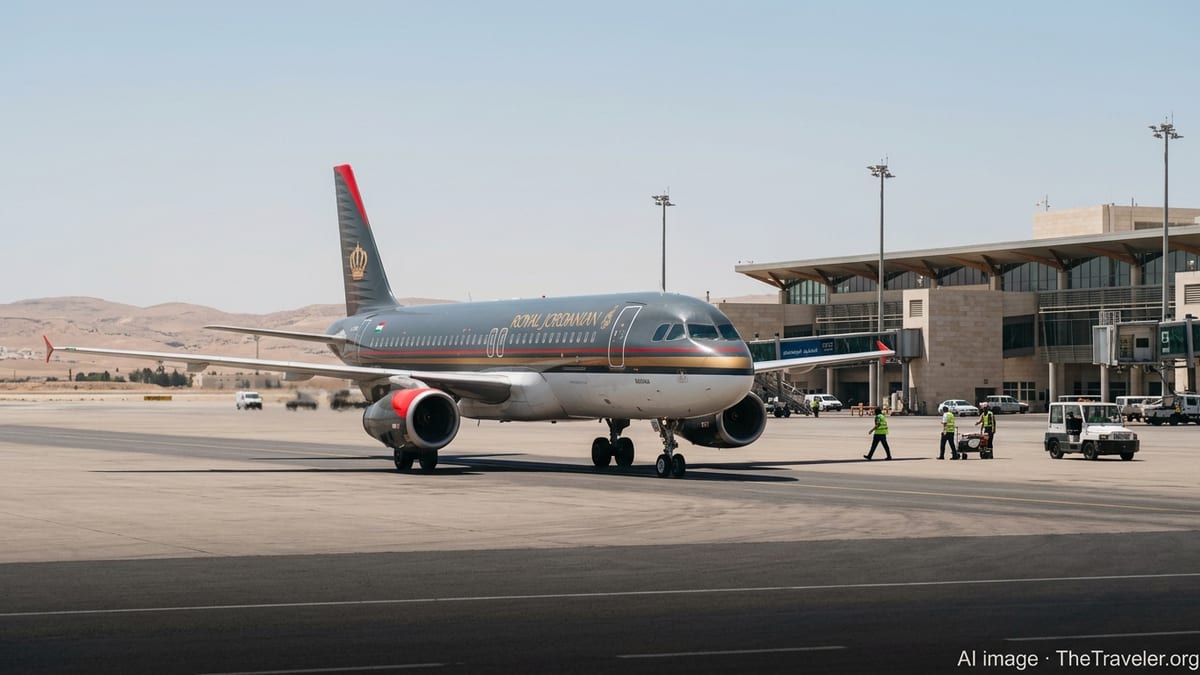
Royal Jordanian is doubling down on reliability and safety-focused operations, reinforcing its fleet, schedules and hub in Amman to keep passengers moving even as regional tensions and temporary airspace restrictions challenge travel across the Middle East.
Get the latest news straight to your inbox!
Operational Reliability Under Pressure
Recent months have underscored how exposed Middle East aviation is to geopolitical shocks, with airspace closures, missile interceptions and shifting security advisories reshaping flight paths across the region. Publicly available information shows that Jordan itself has faced intermittent disruptions linked to cross-border tensions and, more recently, to Iranian projectiles intercepted over the kingdom, prompting short-term restrictions in Jordanian skies. Against this backdrop, Royal Jordanian has emphasized schedule resilience and continuity of service as core priorities.
Reports from regional travel outlets and passenger accounts indicate that the Amman-based carrier has often been among the first to restore scheduled flying when airspace has reopened, leveraging its role as Jordan’s national airline and primary hub operator at Queen Alia International Airport. While some routes have required rerouting or retiming, the airline has signaled that maintaining connectivity for Jordan-based travelers and transit passengers remains central to its strategy.
Industry tracking data also point to meaningful improvements in day-to-day operational performance. Coverage of on-time statistics for late 2025 placed Royal Jordanian at or near the top of Middle East and African carriers, with an on-time arrival rate above 95 percent in October. That performance, coming after several years of post-pandemic recovery and staffing adjustments, illustrates how tighter scheduling discipline and a more modern fleet can translate into fewer cancellations and missed connections for travelers.
Financial disclosures filed in late 2025 acknowledge that regional instability has weighed on demand and yields, contributing to continued but narrowing losses. Yet the same filings outline a determined focus on restoring full pre-pandemic capacity, improving unit costs and using a leaner, more efficient fleet to support a reliable operation even when macro conditions are volatile.
Fleet Renewal to Enhance Safety and Resilience
Central to Royal Jordanian’s push for more resilient operations is a far-reaching fleet renewal program that replaces older aircraft with new-generation jets designed for fuel efficiency, extended range and improved reliability. Trade and aviation publications report that the airline has committed to expanding its Airbus A320neo-family fleet to a total of 12 aircraft, with additional deliveries scheduled through the mid-2020s. These aircraft offer lower fuel burn and reduced emissions, while newer avionics and systems support more predictable maintenance planning.
Alongside the narrowbody refresh, Royal Jordanian continues to rely on its Boeing 787 Dreamliner fleet for long-haul services to North America, Europe and Asia. Cabin refurbishment projects, highlighted in regional aerospace magazines, are focused not only on passenger comfort but also on standardizing interiors and equipment, which can simplify operations and maintenance. A more homogeneous long-haul fleet enables the airline to swap aircraft between routes when disruptions occur, helping keep services running when individual jets are temporarily unavailable.
The airline is also investing in dedicated cargo capacity, including the conversion of an A321 to a freighter configuration as part of a broader cargo development plan described in the company’s official publications. Additional cargo lift provides flexibility when passenger demand softens and supports critical supply chains during crises, which can make the overall operation more financially and operationally resilient.
These fleet moves support safety in several ways. Younger aircraft typically incorporate the latest safety enhancements, benefit from stronger manufacturer support and allow operators to retire older, less efficient models that may be more susceptible to technical delays. For travelers, this translates into more consistent hardware across the network, fewer last-minute aircraft changes and greater confidence that schedules will hold, even in challenging operating environments.
Expanding and Diversifying the Route Network
While some carriers have pulled back capacity in response to regional tensions, Royal Jordanian has taken a more selective approach, trimming or rerouting certain services while opening new long-haul and regional links that diversify its risk. Airport traffic data and local business media report that Amman’s Queen Alia International Airport handled record passenger volumes in the first half of 2025, supported in part by Royal Jordanian’s network expansion.
The airline has launched or announced new services to key markets including Washington, D.C. and Dallas–Fort Worth, adding to existing routes such as New York, Chicago and Detroit. Industry coverage notes that these routes are typically operated by Dreamliner aircraft and are timed to connect smoothly with regional flights to destinations across the Levant, Gulf and North Africa, offering travelers in North America additional one-stop options to secondary cities.
Within the region, Royal Jordanian has restored or added links to nearby markets such as Damascus and Aleppo as conditions have allowed, positioning Amman as a practical gateway for travelers navigating a fragmented regional airspace map. By spreading capacity across Europe, North America, the Middle East and parts of Asia and Africa, the airline reduces its dependence on any single corridor and can reallocate aircraft if specific routes are affected by security developments.
This diversified network also strengthens Royal Jordanian’s role within the oneworld alliance, giving partner airline customers more options for connecting through Amman. For passengers, broader alliance connectivity can provide alternative routings during disruption events, reinforcing the robustness of travel plans that include Royal Jordanian segments.
Digital Tools and Passenger Support
Operational resilience is not only about aircraft and airspace; it also hinges on how effectively passengers are informed and supported when plans change. Publicly available interviews with Royal Jordanian executives and coverage in travel trade media highlight a push toward enhanced digital tools, from upgraded mobile applications to streamlined rebooking interfaces, designed to give travelers clearer, more timely information.
Real-time flight status updates, proactive notifications about gate changes or delays, and the ability to adjust itineraries via app or website reduce pressure on airport counters during disruption events. For passengers facing tight connections in Amman, faster communication can mean the difference between a missed onward flight and a successful same-day reroute.
The airline has also placed renewed emphasis on customer care in irregular operations, including expanded call center capacity and closer coordination between airport teams and central control. While traveler reviews remain mixed, as is common across the industry, many recent accounts on public forums describe relatively swift rebooking efforts when flights have been rescheduled due to weather or security measures in surrounding airspace.
Frequent flyer program enhancements, including expanded mileage redemption opportunities on new long-haul routes, aim to keep loyal customers engaged even as the operating environment remains fluid. By integrating loyalty, digital self-service and ground support, Royal Jordanian is working to form a more coherent response framework that can cushion the impact of unforeseen events on passengers.
Positioning Amman as a Stable Regional Hub
Jordan’s broader economic and political positioning provides important context for Royal Jordanian’s operational strategy. International financial institutions and regional economic analyses emphasize that Jordan has managed to preserve relative macroeconomic stability despite reduced tourism flows and trade disruptions linked to conflicts in neighboring states. That stability underpins the country’s ambition to maintain Amman as a dependable gateway for business and leisure travel.
Queen Alia International Airport’s operators have highlighted the role of strategic airline partnerships and route development in sustaining passenger growth, even as some neighboring hubs have grappled with more severe volatility. Royal Jordanian’s growth plans, which envision a fleet of around 40 aircraft and a direct network spanning more than 50 destinations worldwide, are calibrated around using Amman as a resilient, mid-sized hub where connections remain manageable and security protocols are tightly coordinated.
For travelers weighing whether to transit the region, this positioning matters. Jordan’s authorities have frequently stressed their focus on airspace safety and coordination with international partners, and airline schedules show that Royal Jordanian continues to operate a full slate of departures and arrivals outside temporary, pre-announced restrictions. When airspace windows narrow, the carrier’s combination of flexible fleet resources, alliance partnerships and hub connectivity offers multiple options for rerouting.
As regional dynamics evolve through 2026, Royal Jordanian’s ability to sustain safe, reliable travel options will remain a bellwether for Jordan’s broader role as a bridge between East and West. For now, the airline’s investment in fleet renewal, network diversification and passenger support signals a clear intention: to keep Amman open for travelers seeking a stable path through an unsettled neighborhood.