

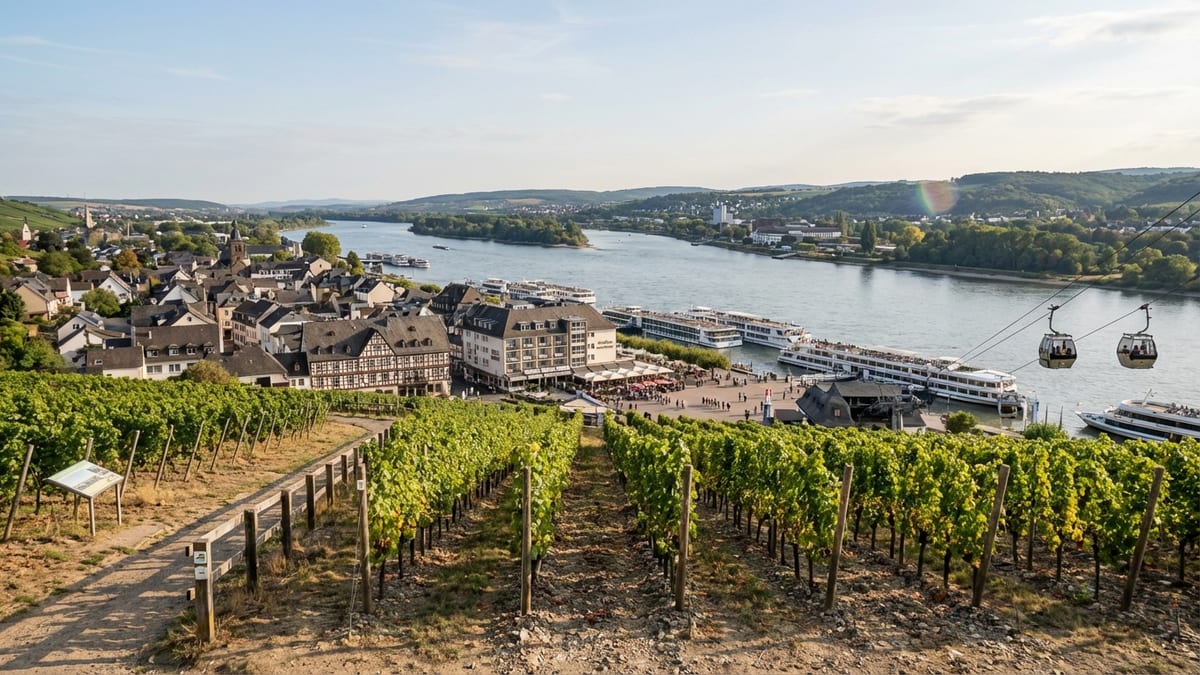
I went to Rüdesheim am Rhein with very mixed expectations. Friends had described it as a Rhine Valley classic, but also as a bit of a tourist circus. After spending time there in different seasons, taking the cable car up to the Niederwalddenkmal, riding the boats, walking the vineyards and getting stuck behind far too many tour groups in Drosselgasse, I came away with a nuanced view.
Rüdesheim is beautiful in a postcard sense and very convenient as a base, but it is also more commercial, more crowded and less “old world romantic” than the brochures suggest. Whether it is worth visiting really depends on what you are hoping to get out of your trip and how you plan it.
First Impressions: Cute, Crowded and Quite Commercial
My first glimpse of Rüdesheim from the river was almost exactly what I had imagined. Half-timbered houses rising above the Rhine, vineyards climbing steep slopes behind the town and church spires marking the skyline. Arriving by boat felt right, and it framed Rüdesheim as a classic Rhine stop, which in many ways it still is. Stepping off the boat, though, the romance quickly collided with reality: queues for ice cream, souvenir stands selling the same magnets and mugs I had seen all over Germany, and a noticeable number of tour groups following raised umbrellas down narrow streets.
The compact old town makes everything feel intense. Rüdesheim is not large, so the influx of day trippers from river cruises and coaches hits hard, especially between late morning and late afternoon in peak season. Walking toward the famous Drosselgasse, I could feel the character of the place shifting from lived-in town to theme-park corridor. It is picturesque, but it is also curated for visitors in a very obvious way. If you are looking for a quiet, “undiscovered” village, this is not it.
That said, once I adjusted my expectations, I began to appreciate what Rüdesheim does offer: it is straightforward, unapologetically visitor-oriented and extremely easy to navigate. Everything you have heard about is within a short walk: the cable car station, the river promenade, the wine taverns, and the boat piers. For a first-time Rhine traveler or someone who values convenience over authenticity at all costs, that can be a big plus.
Drosselgasse: Iconic Lane or Overhyped Bottleneck
Drosselgasse is probably the most heavily marketed lane in the Rhine Valley, and it was where my expectations and reality clashed the hardest. Photos show cobblestones and flowers, timbered facades, and musicians playing under wine tavern signs. All of that exists, but you share it with an enormous number of other people, many of them half-distracted by group guides or phones. At peak times it can be shoulder to shoulder, with the atmosphere more like a festival alley than a charming village lane.
The bars and restaurants along Drosselgasse are energetic but not subtle. Live music often leans toward generic party hits, and prices reflect the location’s fame rather than finesse. I found the wine acceptable but far from the best I had in the region, and the food solid but tailored to international tastes. I did not feel ripped off, exactly, but I also did not feel compelled to linger. For me, one pass through in the daytime and one short evening stop were enough.
I had a much better time in the side streets just off Drosselgasse. Move one or two blocks away and things calm down quickly. There are smaller wine taverns and restaurants that feel more local, where staff have the time to talk about the wines and you are not competing with a band. Prices were often slightly lower, and I found the overall experience more relaxed. My advice, based on my visit, is to treat Drosselgasse as a sight to see rather than a place to base your entire evening. Walk it, take the photos, then veer off and explore the back streets.
The Cable Car, Chairlift and Ringticket: Scenic, Seasonal and Slightly Rushed
The classic Rüdesheim experience is the so-called Ring tour: cable car up from Rüdesheim to the Niederwalddenkmal, walk through the forest and vineyards above the Rhine, descend by chairlift into Assmannshausen, then return by boat. On paper it is perfect. In practice it is still very good, but there are a few practical details that shaped my experience more than I expected.
The Rüdesheim cable car runs seasonally, typically from around late March to early November, with extended operation on some winter market days. It starts at roughly 9:30 in the morning, with hours stretching to around 19:00 in high summer and shorter hours in spring and autumn. This seasonal schedule matters. On my first trip in very early spring, the cable car was not yet operating, and a big part of what people associate with Rüdesheim simply was not available. I could still hike up or drive to the monument, but the “hover above the vines” moment was missing. If that experience is important to you, you really do need to check exact dates for your year and aim for late March through October.
When I came back in season, the cable car ride itself was delightful but brief. The views down over the Rhine, the tiled roofs of Rüdesheim and the ordered lines of vines are genuinely impressive. Each cabin is small, fitting up to two adults and two children, and you float silently above the vineyards for a few minutes that are over faster than you expect. There were queues at the valley station in late morning, but they moved reasonably quickly. I noticed that accessibility has improved, with lifts at the valley station and level access at the top, although some steps remain just to reach the forecourt, and electric wheelchairs cannot be transported.
The Assmannshausen chairlift is older, with more of a vintage feel. It typically runs from around late March to early November, roughly from 10:00 in the morning, with slightly longer hours on weekends in high season. I found it more relaxed than the Rüdesheim cable car, partly because it seemed to attract fewer big tour groups. The open chairs give even better panoramic views, but they may be uncomfortable in bad weather or for anyone uneasy with heights. I appreciated that the staff were patient and the loading and unloading felt calm rather than frantic.
The boat leg of the Ring tour connects Assmannshausen and Rüdesheim as part of the broader Rhine schedule. Large operators run daily services on the Rhine between roughly April and October, with multiple daily departures that stop in both Rüdesheim and Assmannshausen. On my visit, this part felt the most constrained, because I had to match my walk and chairlift ride to a fairly specific departure time. I ended up hurrying my vineyard walk more than I would have liked to avoid a long wait at the Assmannshausen pier. If I did it again, I would check the boat times first and work backward.
The Niederwalddenkmal and Vineyard Walks: Genuine Rhine Romance
If Rüdesheim risks feeling over-commercial in the town center, the area above the town is where it redeems itself. The Niederwalddenkmal, the enormous Germania monument above the Rhine, is undeniably grandiose. It is also genuinely moving to see up close. From the viewing terraces below the statue, the river bends in slow curves past Bingen, Rüdesheim and across to the hills of the opposite bank. On clear days, the light over the water and vineyards really does look like the Rhine landscape that inspired the 19th century romantics.
What surprised me most on my visit was how quickly the crowds thinned once I walked away from the main monument area. The forest and vineyard paths of the Niederwald are easy to follow and well signposted. Within a few minutes I was alone or passing just a handful of other walkers. There are several viewpoints along the ridge, small pavilions and a few ruins that break up the walk. I found it easy to tailor the loop to my energy level: a shorter direct walk to the Assmannshausen chairlift or a longer, meandering route.
Season makes a big difference here. In high summer, the sun on the slopes is strong and the paths can feel dusty. In spring and early autumn, I enjoyed it much more. The vines were green without the oppressive heat, and the forest sections offered shade. After rain, some sections can be muddy, though the gradients are mostly gentle. Good walking shoes make the experience more pleasant but are not strictly essential if you are comfortable on uneven paths.
For me, this upper section of Rüdesheim is where the town justifies its popularity. You can still feel the weight of tourism, but it is less in your face. If I had skipped the monument and the ridge walk, I would have been much more critical of Rüdesheim overall. As it was, my memory of standing above the Rhine with rows of vines below and boats gliding past anchored the trip in a very positive way.
Boats, Trains and Getting Around: Easy Access With Some Quirks
Rüdesheim is extremely easy to reach and navigate, which is one of its big advantages. Regular trains connect nearby larger towns and cities, and the station is a short walk from the river and the old town. I found the connections straightforward, though in peak season the regional trains can be crowded, especially on weekends when people use discount regional tickets to explore the Rhine Valley. If you are coming from Frankfurt or Mainz, you have frequent options and you do not need a car.
On the river, Rüdesheim is a key stop for scheduled boats between roughly April and October. Services link it to Bingen just across the water and to a chain of Rhine towns in both directions, including Bacharach, St. Goar and Koblenz. For me, this boat network was one of the main reasons to stay in Rüdesheim: I could leave my luggage in my accommodation and take relaxed day trips up and down the river without worrying about parking or timetables as much as if I had been based in a smaller place with fewer departures.
There are, however, a few quirks. Many boat services are heavily season-dependent. Outside the core season, schedules thin out or stop entirely. Even in season, some routes only run certain days of the week or a limited number of times per day. On my trip, I nearly missed a vessel because I assumed departures were hourly, when in fact there was a mid-day gap. It is essential to verify the current year’s timetable rather than relying on old blog posts or generic guidebook summaries.
Within the town itself, everything is walkable, but the cobbled streets can be tiring for those with mobility issues. The contrast between the upgraded, partially step-free cable car station and some of the older, less accessible streets is noticeable. If accessibility is a priority, it is worth choosing accommodation close to the river or cable car, both to avoid steep climbs and to reduce the need to navigate some of the more uneven alleys repeatedly.
Wine, Food and Prices: Decent but Not Always Memorable
Rüdesheim sells itself as a wine town, and there is no shortage of places to drink local Riesling or Spätburgunder. Tasting wine here is convenient. Glasses are poured in every tavern, and there are plenty of opportunities to sit under vines or in small courtyards. I enjoyed several evenings sampling dry Rieslings with a view of the river or nestled in a side alley. However, not all wine experiences in Rüdesheim are equal.
Along the most touristy strips, wine is often framed as a novelty rather than a craft. Menus lean on big, easy-drinking options that please crowds, and staff do not always have the time or training to talk about terroir or vineyards in detail. Prices reflect the high foot traffic, and while they are not outrageous, they are certainly higher than at many village wine taverns elsewhere in the Rheingau or Mosel. When I wanted a more serious tasting, I had to seek out specific producers or quieter bars away from Drosselgasse, where owners and staff were more engaged and the selection was more interesting.
Food was similar. Traditional dishes like schnitzel, sausages, flammkuchen and hearty regional mains are easy to find and generally satisfying. Portions are generous, which is nice after a day of walking. I did have some enjoyable meals, but very few that I would describe as destination-worthy. In the core tourist lanes, menus repeat the same dishes with minor variations, and it becomes harder to tell one restaurant from another. When I took the time to research and walk a little further out, I found more characterful spots and slightly better value.
Overall, I would not come to Rüdesheim as a primary food destination. Instead, I would treat wine and food as comfortable background elements to the scenery. If you are particularly serious about Riesling, you will likely want to use Rüdesheim as a jumping-off point to visit specific wineries in the wider Rheingau rather than relying solely on what you find within the tourist zone.
Crowds, Atmosphere and Seasonality: Choosing the Right Time
The biggest variable in whether I enjoyed Rüdesheim on any given day was the season and time of day. In high summer on a clear weekend, especially when multiple river cruise ships are in port, the town can feel overloaded. The narrow streets magnify the effect, and it becomes hard to find a quiet corner. I overheard more English and other languages than German at times, which is not necessarily a problem but underlined how geared the town is to tourism.
Early mornings and later evenings were much better. Before about 10:00, the old town is calm and almost sleepy. I liked walking along the river promenade at that hour, watching the day’s boats arrive and seeing locals going about their routines. Similarly, after dinner, once day trippers had left and river cruise passengers were mostly back on board, the streets relaxed. If you stay overnight rather than just coming for a few hours, you get these quieter windows that change the feel of the place entirely.
Seasonally, I found late spring and early autumn the sweet spots. The cable car and boats were running regular schedules, vineyards were green, and the weather was pleasant without intense heat. Crowds were still present but more manageable. In deep winter, outside of Christmas market days, Rüdesheim can feel sleepy and parts of the typical tourist infrastructure shut down or operate on very reduced hours. The upside is lower hotel prices and more space; the downside is that key experiences like the cable car might be closed.
If you are sensitive to crowds or allergic to overtly touristy environments, your enjoyment of Rüdesheim will hinge on careful timing. If you accept that you are stepping into a popular, sometimes crowded, staging point for Rhine tourism, then Rüdesheim does what it promises reasonably well.
Is Rüdesheim Worth It, and Who Is It Really For?
For me, Rüdesheim was worth visiting, but not in the way the marketing materials suggested. It did not feel like a timeless, untouched Rhine village, and it is not the place to go if you crave authenticity above all else. Instead, it is a polished entry point to the UNESCO-listed Middle Rhine, packaged for ease and efficiency. I would not choose to spend a full week only in Rüdesheim, but as a two or three night base to explore the region by boat and trail, it worked well enough.
I would especially recommend Rüdesheim to first-time visitors to the Rhine who want maximum scenery with minimal logistical hassle. Being able to step off a train or boat, drop bags close to the river, and have cable cars, boats and walking routes all within easy reach is genuinely valuable. If you are traveling with children or older relatives, the compact layout and clear tourist infrastructure reduce stress. The classic Ring tour offers a simple, scenic day with built-in variety that most people in a mixed group will enjoy.
I would be more cautious about recommending Rüdesheim to travelers who value quiet, less commercial destinations. If you are a serious wine enthusiast, you might find the tourist side of Rüdesheim a bit superficial unless you plan and target specific spots. If you are looking for a truly atmospheric old town where tourism feels more incidental than central, you may be happier basing yourself in a smaller Rhine village and visiting Rüdesheim only as a brief stop for the cable car and monument.
Personally, if I went back, I would structure my time differently. I would arrive in the late afternoon, enjoy the town in the quieter evening, devote one full day to the Ring tour with a focus on longer walks above the Rhine, and then move on to a smaller village for a more peaceful stay. With that kind of plan, Rüdesheim becomes a useful and enjoyable chapter in a larger Rhine itinerary rather than the main event.
The Takeaway
Rüdesheim is not perfect, and it does not pretend to be. It has embraced its role as a Rhine highlight for mass tourism, and the result is a town where charm and commercialism coexist in constant tension. On my visit, there were moments I really enjoyed: floating over the vines in the cable car, standing beneath the Germania statue while riverboats traced slow arcs below, sharing a glass of crisp Riesling in a quiet courtyard away from the main lanes. There were also moments of frustration: jostling through Drosselgasse, waiting in lines, and paying more than I felt the experience merited at some restaurants.
In the end, I think Rüdesheim is worth visiting if you walk in with clear expectations. Do not expect solitude or raw authenticity. Expect a well-oiled, highly accessible gateway to some of the best Rhine scenery, with simple ways to combine boats, cable cars and walks into easy day trips. Accept that you will be sharing it with many other visitors and that some parts will feel a bit like a theme park.
If you are planning a first trip to the Rhine, traveling with mixed abilities or ages, or you simply want a convenient base with lots of ready-made excursion options, Rüdesheim still makes sense. If you are a repeat visitor to Germany, focused on quieter wine villages or deeper cultural immersion, you may want to limit your time in Rüdesheim or use it mainly as a launchpad to explore further. For me, it ultimately delivered exactly what it is set up to provide: a structured, scenic, if sometimes crowded taste of Rhine romanticism, best enjoyed in moderation and with a realistic eye.
FAQ
Q1: How many days should I spend in Rüdesheim?
I found two nights ideal. That gives you one full day for the Ring tour with the cable car, vineyard walk, chairlift and boat, plus extra time to explore the town in quieter morning or evening hours.
Q2: When is the best time of year to visit Rüdesheim?
Late April to June and September to early October felt best to me. The cable car and boats run frequent schedules, the vineyards are green, and the town is lively without the most oppressive summer crowds.
Q3: Is Rüdesheim worth it in winter?
Outside the Christmas market period, winter can feel quiet and somewhat empty, and key experiences like the cable car may not operate. It can still work as a calm, cheaper base, but you lose much of what makes Rüdesheim distinctive.
Q4: Is the famous Drosselgasse really a must-see?
I think it is worth walking once to understand what it is, but I would not base my evening there. It is crowded and commercial. I enjoyed nearby side streets and smaller taverns much more.
Q5: Do I need to book the cable car or Ring tour in advance?
For regular days I did not need advance reservations for the cable car or chairlift, and tickets were easy to buy on the spot. In peak holiday periods it is still wise to check opening times in advance and allow for queues.
Q6: Is Rüdesheim a good base for exploring the Rhine by boat?
Yes, that is one of its strong points. Regular seasonal boats connect Rüdesheim to Bingen and other Rhine towns, so I could take scenic day trips without needing a car.
Q7: How crowded does Rüdesheim get?
On sunny weekends in high season, especially when cruise ships are in port, the old town can feel very crowded from late morning into the afternoon. Early mornings and evenings were much calmer in my experience.
Q8: Is Rüdesheim suitable for travelers with limited mobility?
Partially. The upgraded cable car station and riverside area are quite accessible, but some streets are steep and cobbled, and older buildings can have stairs. Choosing central accommodation helps reduce daily walking on uneven surfaces.
Q9: How does Rüdesheim compare to smaller Rhine towns like Bacharach or St. Goar?
Rüdesheim is busier and more overtly touristy, but it offers better transport connections and more accommodation choices. Smaller towns feel more tranquil and authentic but have fewer services and departures.
Q10: Would I return to Rüdesheim?
Yes, but not for a long stay. I would happily return for a night or two to do the Ring tour again, enjoy the views from the Niederwald and use the town as a launchpad for boat trips, then move on to a quieter village for the rest of my time on the Rhine.